Coding Tools
NVIDIA Warp and MjWarp guide for robotics simulation
Hugging Face Bloghigh confidence
Why it matters
- →MJWarp enables scaling physics simulations to thousands of parallel environments on NVIDIA GPUs.
- →CUDA graph capture significantly reduces kernel dispatch overhead for batched simulation steps.
- →The workflow is optimized for aggregate throughput in reinforcement learning rather than single-step latency.

NVIDIA has published a technical guide on using MuJoCo Warp (MJWarp) to accelerate robotics simulation workflows. The article details migrating standard MuJoCo models to NVIDIA Warp, enabling up to 2,048 parallel environments on CUDA GPUs. Key technical steps include configuring batched resources, capturing CUDA graphs to reduce dispatch overhead, and tuning constraint buffers for memory efficiency. This approach prioritizes aggregate throughput over single-environment latency, making it suitable for large-scale reinforcement learning training.
Read originalThe story around this
Earlier coverage that leads up to this article, and what followed. Lines connect each piece to the closest one after it, converging here.
How we got here
- 1NVIDIA Advances Robotics with Simulation-to-Real Transfer
NVIDIA Blog · May 28, 2026 · Same story
- 2Nvidia Unveils Blueprint for Advanced Humanoid Robots
WIRED AI · June 3, 2026 · Related
- 3llama.cpp b9827 release enhances CUDA performance
llama.cpp Releases · June 28, 2026 · Background
- 4NVIDIA's Nemotron Enhances AI with Open Synthetic Data
Hugging Face Blog · July 8, 2026 · Related
- 5Simulation Advances in Physical AI Development
Hugging Face Blog · July 21, 2026 · Same story
- 6NVIDIA Boosts Local AI with New Open Models
NVIDIA Blog · August 11, 2026 · Related
- 7Nvidia Highlights Importance of AI Harness Over Model
TechCrunch AI · August 21, 2026 · Background
- 8NVIDIA Jetson Orin Nano 2 targets edge AI for robots
AI News · August 26, 2026 · Background
What happened next
- 9Worldmodeldata brokers video game data for AI training
WIRED AI · September 28, 2026 · Background
- 10llama.cpp optimizes NVIDIA V100 inference performance
llama.cpp Releases · October 2, 2026 · Background
- 11Nvidia releases open Nemotron models for agents and PCs
TechCrunch AI · October 19, 2026 · Background
- 12NVIDIA Dory: 4B Looped Transformer
Sam Witteveen · November 2, 2026 · Background
- 13Nvidia and Unity back Emulate in $700m raise
Sifted · November 11, 2026 · Background
More from Hugging Face Blog
 © Hugging Face Blog
Coding Toolsagents
Microduck Sim2Real Obstacle Avoidance Tutorial
This tutorial bridges the gap between simulation and reality for quadruped navigation by decoupling balance from steering. By freezing a pre-trained walking policy in Isaac Lab and training a separate PPO controller on simulated Time-of-Flight sensor data, developers can achieve robust obstacle avoidance without retraining locomotion. The workflow leverages Newton’s raycasting for realistic depth sensing and supports deployment on real hardware with minimal code changes. It provides a practical blueprint for adding high-level navigation to existing low-level control policies.
Hugging Face Blog
 © Hugging Face Blog
Researchother
RoboTrack benchmark exposes real-world robot tracking gaps
Existing point trackers fail significantly on messy, real-world robotic manipulation compared to controlled lab benchmarks. Ai2’s new RoboTrack-Bench reveals that leading models like CoWTracker drop performance scores when facing cluttered scenes and occlusions common in physical tasks. To fix this, they released RoboTrack-15M, a synthetic dataset generated via MolmoSpaces simulation, which improves tracker robustness on real footage. This work underscores the critical gap between simulated training data and the chaotic reality of robot perception. The benchmark includes 307 human-annotated videos from sources like DROID and Ego-Exo4D. These results show that current state-of-the-art trackers perform significantly worse on real-world clutter than on established synthetic benchmarks. To address this, the team generated RoboTrack-15M using the MolmoSpaces simulation environment. They also released two new models, RoboTracker and RoboTracker-Warp, trained with this data to demonstrate improved accuracy.
Hugging Face Blog
 © Hugging Face Blog
Coding Toolscoding
Hugging Face guide to agentic evaluation
Agentic benchmarks are becoming the standard for measuring model utility, yet most scores remain opaque and unverifiable. Hugging Face addresses this by publishing a rigorous framework for open-source agentic evaluation, leveraging their hub's new Traces and Environments features to make agent actions auditable. The guide demonstrates how adapting existing tasks like Terminal-Bench allows builders to focus on domain expertise rather than infrastructure. This shift from static QA to dynamic environment verification is critical as enterprises demand trust in autonomous systems.
Hugging Face Blog
More in Coding Tools
 © GitHub Changelog
Coding Toolscoding
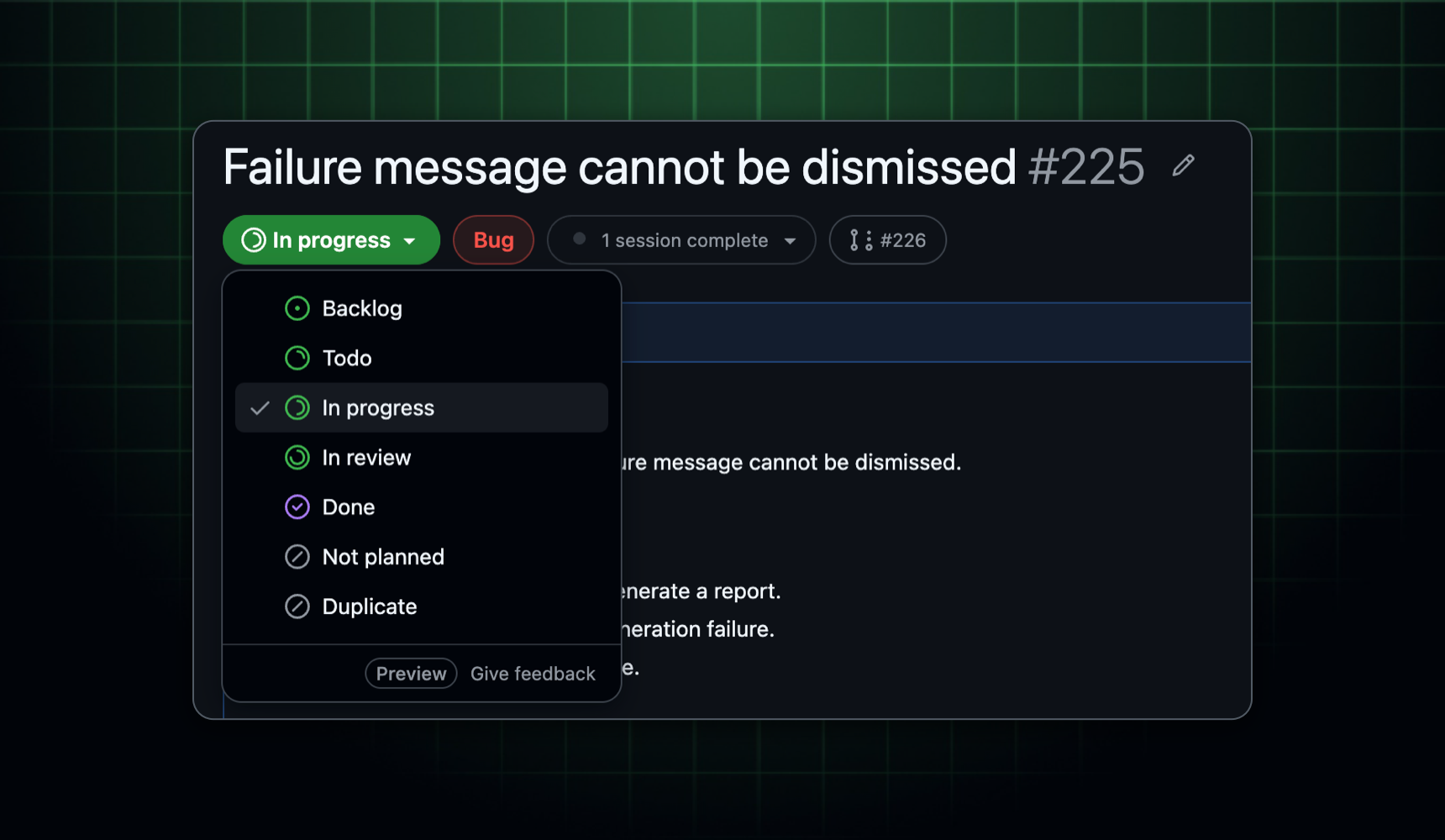
GitHub adds issue statuses and board views
GitHub is finally giving issues more granularity than just open or closed. The new public preview introduces specific statuses like In Review and Not Planned, which automatically update based on pull request states and agent assignments. This isn't just UI polish; it creates a structured data layer that agents and Copilot automations can now read and write to directly via API. Repository boards let teams visualize this workflow without leaving the issue tracker, bridging the gap between simple task lists and complex project management.
GitHub Changelog
 © GitHub Changelog
Coding Toolscoding
GitHub Code Quality now rejects invalid coverage reports
GitHub has tightened its code coverage pipeline by enforcing strict Cobertura XML validation. Previously, malformed reports silently failed to display data on pull requests, leaving developers in the dark about their test quality. Now, the upload step explicitly fails with a clear error message, forcing immediate correction rather than silent degradation. This shift from passive acceptance to active enforcement ensures that CI/CD pipelines reflect actual coverage metrics, reducing wasted debugging time on phantom data.
GitHub Changelog
Coding Toolscoding
llama.cpp b12642 fixes MoE weight copying bug
This release patches a critical correctness bug in multi-node Mixture-of-Experts inference where shared expert weights were copied partially, leading to stale data and incorrect outputs. The fix ensures all experts are properly replicated across nodes before graph execution, stabilizing large-scale distributed runs. While the binary lineup remains consistent with previous versions—supporting CUDA 13, ROCm 10.0, and various CPU/GPU backends—the underlying logic correction is vital for anyone running complex MoE models like Inkling2 on multi-node setups. It’s a quiet but necessary fix for reliability in advanced deployment scenarios.
llama.cpp Releases