Coding Tools
Hugging Face guide to agentic evaluation
Hugging Face Bloghigh confidence
Why it matters
- →Agentic evaluation is becoming the primary metric for model utility beyond simple QA.
- →Open-source frameworks like Hugging Face's Traces enable verifiable, auditable agent testing.
- →Reusing existing benchmarks reduces infrastructure overhead for builders focusing on domain expertise.

Hugging Face has published a comprehensive guide on building and maintaining agentic evaluations, highlighting the limitations of current opaque benchmarking practices. The article details how the platform supports open evaluation through new abstractions like Traces for reviewing agent work and Environments for RL setups. It outlines an eight-step process for creating verifiable benchmarks, using a physics lab task as a case study to show how open-source components can be reused. This initiative aims to increase transparency in agentic AI performance metrics.
Read originalThe story around this
Earlier coverage that leads up to this article, and what followed. Lines connect each piece to the closest one after it, converging here.
How we got here
- 1Hugging Face Introduces ALTK-Evolve for Efficient AI Agents
Hugging Face Blog · August 11, 2026 · Related
- 2MiniCPM5-2B targets sub-agent roles with high efficiency
Sam Witteveen · September 10, 2026 · Related
- 3Hugging Face Tackles AI Consistency with New Tool
Hugging Face Blog · September 15, 2026 · Related
- 4Jev: A Decision-Only AI Model for Agents
Cole Medin · September 21, 2026 · Related
- 5Jev as a Smart Router for Agent Harnesses
Sam Witteveen · September 29, 2026 · Related
- 6Hugging Face warns embedded AI evaluators lack standardization
TechCrunch AI · October 19, 2026 · Related
- 7AI agents lack real-time observability standards
MIT Technology Review AI · October 29, 2026 · Related
- 8Together AI measures agent developer experience
Together AI Blog · November 16, 2026 · Related
More from Hugging Face Blog
 © Hugging Face Blog
Coding Toolsagents
Microduck Sim2Real Obstacle Avoidance Tutorial
This tutorial bridges the gap between simulation and reality for quadruped navigation by decoupling balance from steering. By freezing a pre-trained walking policy in Isaac Lab and training a separate PPO controller on simulated Time-of-Flight sensor data, developers can achieve robust obstacle avoidance without retraining locomotion. The workflow leverages Newton’s raycasting for realistic depth sensing and supports deployment on real hardware with minimal code changes. It provides a practical blueprint for adding high-level navigation to existing low-level control policies.
Hugging Face Blog
 © Hugging Face Blog
Researchother
RoboTrack benchmark exposes real-world robot tracking gaps
Existing point trackers fail significantly on messy, real-world robotic manipulation compared to controlled lab benchmarks. Ai2’s new RoboTrack-Bench reveals that leading models like CoWTracker drop performance scores when facing cluttered scenes and occlusions common in physical tasks. To fix this, they released RoboTrack-15M, a synthetic dataset generated via MolmoSpaces simulation, which improves tracker robustness on real footage. This work underscores the critical gap between simulated training data and the chaotic reality of robot perception. The benchmark includes 307 human-annotated videos from sources like DROID and Ego-Exo4D. These results show that current state-of-the-art trackers perform significantly worse on real-world clutter than on established synthetic benchmarks. To address this, the team generated RoboTrack-15M using the MolmoSpaces simulation environment. They also released two new models, RoboTracker and RoboTracker-Warp, trained with this data to demonstrate improved accuracy.
Hugging Face Blog
 © Hugging Face Blog
Coding Toolsagents
Hugging Face harness adapters optimize agents via RL
Hugging Face proves that training a model inside its own execution environment yields significantly better results than generic fine-tuning. By using RL to train LoRA adapters for Qwen3.8-27B within specific agent harnesses like Pi and Hermes, they cut token usage by nearly half while boosting pass rates from 39% to 55%. This approach forces the model to reason more efficiently and call fewer tools, effectively squeezing out wasted compute. The release of a reusable recipe and merged super-adapters makes this specialized optimization accessible to anyone building agentic workflows.
Hugging Face Blog
More in Coding Tools
 © GitHub Changelog
Coding Toolscoding
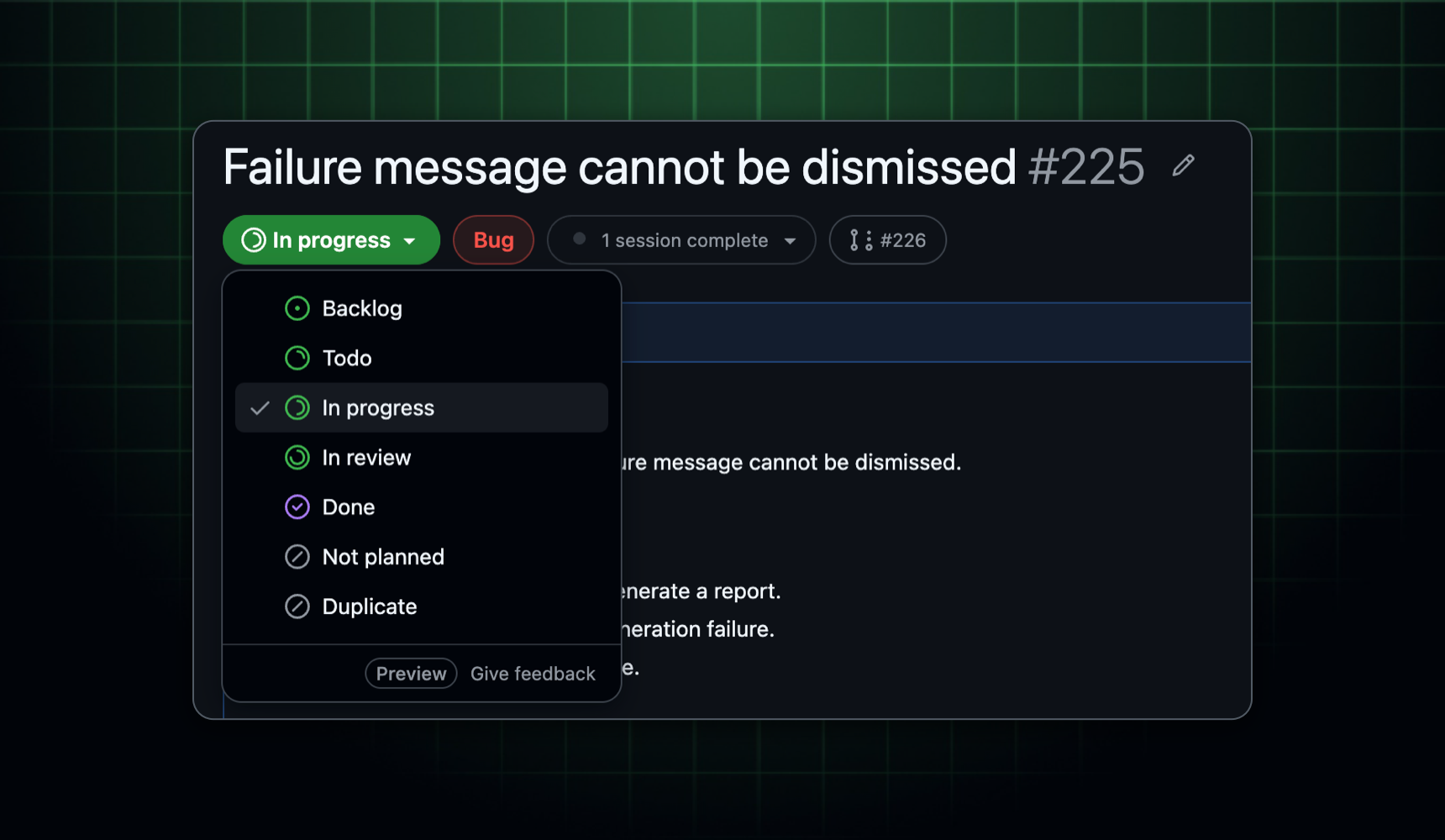
GitHub adds issue statuses and board views
GitHub is finally giving issues more granularity than just open or closed. The new public preview introduces specific statuses like In Review and Not Planned, which automatically update based on pull request states and agent assignments. This isn't just UI polish; it creates a structured data layer that agents and Copilot automations can now read and write to directly via API. Repository boards let teams visualize this workflow without leaving the issue tracker, bridging the gap between simple task lists and complex project management.
GitHub Changelog
 © GitHub Changelog
Coding Toolscoding
GitHub Code Quality now rejects invalid coverage reports
GitHub has tightened its code coverage pipeline by enforcing strict Cobertura XML validation. Previously, malformed reports silently failed to display data on pull requests, leaving developers in the dark about their test quality. Now, the upload step explicitly fails with a clear error message, forcing immediate correction rather than silent degradation. This shift from passive acceptance to active enforcement ensures that CI/CD pipelines reflect actual coverage metrics, reducing wasted debugging time on phantom data.
GitHub Changelog
Coding Toolscoding
llama.cpp b12642 fixes MoE weight copying bug
This release patches a critical correctness bug in multi-node Mixture-of-Experts inference where shared expert weights were copied partially, leading to stale data and incorrect outputs. The fix ensures all experts are properly replicated across nodes before graph execution, stabilizing large-scale distributed runs. While the binary lineup remains consistent with previous versions—supporting CUDA 13, ROCm 10.0, and various CPU/GPU backends—the underlying logic correction is vital for anyone running complex MoE models like Inkling2 on multi-node setups. It’s a quiet but necessary fix for reliability in advanced deployment scenarios.
llama.cpp Releases