Coding Tools
Microduck Sim2Real Obstacle Avoidance Tutorial
Hugging Face Bloghigh confidence
Why it matters
- →Decouples balance from navigation, simplifying training for complex quadruped tasks.
- →Demonstrates realistic sensor simulation using Newton's raycaster within Isaac Lab.
- →Provides a complete pipeline from parallel GPU training to real-robot deployment.

NVIDIA has published a technical tutorial demonstrating a Sim2Real workflow for the Microduck quadruped robot using Isaac Lab and Newton physics. The approach trains a separate obstacle avoidance controller that adjusts velocity commands based on simulated Time-of-Flight (ToF) sensor data, while keeping the underlying walking policy fixed. The guide details the setup of parallel simulation environments, reward shaping for safe navigation, and the export of policies to ONNX for real-world deployment. This resource offers a concrete example of how to layer high-level decision-making onto established locomotion models.
Read originalThe story around this
Earlier coverage that leads up to this article, and what followed. Lines connect each piece to the closest one after it, converging here.
How we got here
- 1Worldmodeldata brokers video game data for AI training
WIRED AI · September 28, 2026 · Background
- 2Physicl raises $10M for robot training simulations
TechCrunch AI · November 6, 2026 · Background
- 3ToyBlocks: Controlled simulation for robot learning research
Hugging Face Blog · November 6, 2026 · Related
- 4SimReady Central standardizes robot assets for Isaac Sim
Hugging Face Blog · November 13, 2026 · Background
- 5MIT microrobot achieves onboard autonomy
MIT News AI · November 18, 2026 · Background
More from Hugging Face Blog
 © Hugging Face Blog
Researchother
RoboTrack benchmark exposes real-world robot tracking gaps
Existing point trackers fail significantly on messy, real-world robotic manipulation compared to controlled lab benchmarks. Ai2’s new RoboTrack-Bench reveals that leading models like CoWTracker drop performance scores when facing cluttered scenes and occlusions common in physical tasks. To fix this, they released RoboTrack-15M, a synthetic dataset generated via MolmoSpaces simulation, which improves tracker robustness on real footage. This work underscores the critical gap between simulated training data and the chaotic reality of robot perception. The benchmark includes 307 human-annotated videos from sources like DROID and Ego-Exo4D. These results show that current state-of-the-art trackers perform significantly worse on real-world clutter than on established synthetic benchmarks. To address this, the team generated RoboTrack-15M using the MolmoSpaces simulation environment. They also released two new models, RoboTracker and RoboTracker-Warp, trained with this data to demonstrate improved accuracy.
Hugging Face Blog
 © Hugging Face Blog
Coding Toolscoding
Hugging Face guide to agentic evaluation
Agentic benchmarks are becoming the standard for measuring model utility, yet most scores remain opaque and unverifiable. Hugging Face addresses this by publishing a rigorous framework for open-source agentic evaluation, leveraging their hub's new Traces and Environments features to make agent actions auditable. The guide demonstrates how adapting existing tasks like Terminal-Bench allows builders to focus on domain expertise rather than infrastructure. This shift from static QA to dynamic environment verification is critical as enterprises demand trust in autonomous systems.
Hugging Face Blog
 © Hugging Face Blog
Coding Toolsagents
Hugging Face harness adapters optimize agents via RL
Hugging Face proves that training a model inside its own execution environment yields significantly better results than generic fine-tuning. By using RL to train LoRA adapters for Qwen3.8-27B within specific agent harnesses like Pi and Hermes, they cut token usage by nearly half while boosting pass rates from 39% to 55%. This approach forces the model to reason more efficiently and call fewer tools, effectively squeezing out wasted compute. The release of a reusable recipe and merged super-adapters makes this specialized optimization accessible to anyone building agentic workflows.
Hugging Face Blog
More in Coding Tools
 © GitHub Changelog
Coding Toolscoding
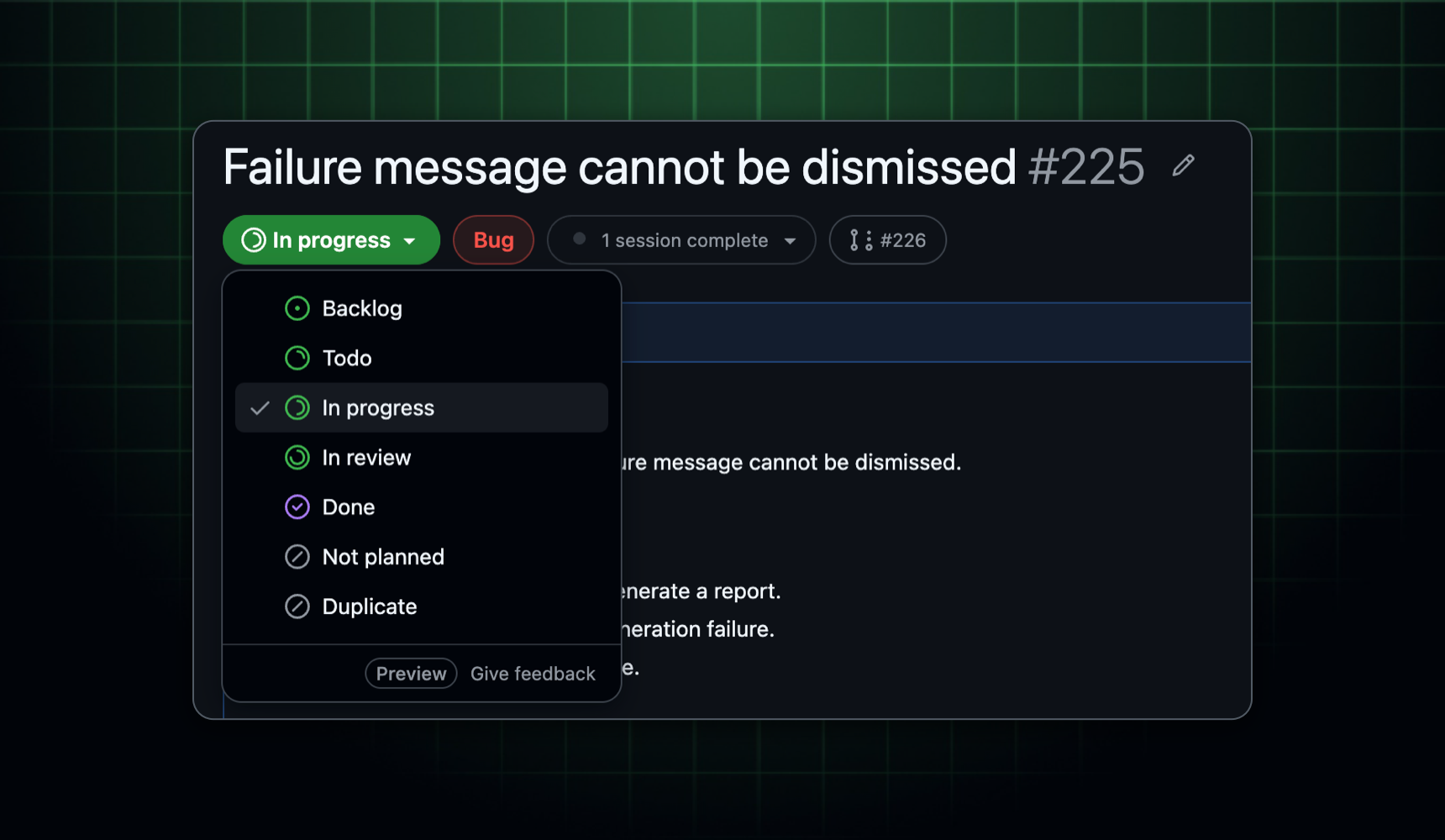
GitHub adds issue statuses and board views
GitHub is finally giving issues more granularity than just open or closed. The new public preview introduces specific statuses like In Review and Not Planned, which automatically update based on pull request states and agent assignments. This isn't just UI polish; it creates a structured data layer that agents and Copilot automations can now read and write to directly via API. Repository boards let teams visualize this workflow without leaving the issue tracker, bridging the gap between simple task lists and complex project management.
GitHub Changelog
 © GitHub Changelog
Coding Toolscoding
GitHub Code Quality now rejects invalid coverage reports
GitHub has tightened its code coverage pipeline by enforcing strict Cobertura XML validation. Previously, malformed reports silently failed to display data on pull requests, leaving developers in the dark about their test quality. Now, the upload step explicitly fails with a clear error message, forcing immediate correction rather than silent degradation. This shift from passive acceptance to active enforcement ensures that CI/CD pipelines reflect actual coverage metrics, reducing wasted debugging time on phantom data.
GitHub Changelog
Coding Toolscoding
llama.cpp b12642 fixes MoE weight copying bug
This release patches a critical correctness bug in multi-node Mixture-of-Experts inference where shared expert weights were copied partially, leading to stale data and incorrect outputs. The fix ensures all experts are properly replicated across nodes before graph execution, stabilizing large-scale distributed runs. While the binary lineup remains consistent with previous versions—supporting CUDA 13, ROCm 10.0, and various CPU/GPU backends—the underlying logic correction is vital for anyone running complex MoE models like Inkling2 on multi-node setups. It’s a quiet but necessary fix for reliability in advanced deployment scenarios.
llama.cpp Releases