Coding Tools
GitHub adds issue statuses and board views
GitHub Changeloghigh confidence
Why it matters
- →Agents can now read and write structured workflow states via MCP, enabling more precise automation.
- →Automatic status updates from PR links reduce manual administrative overhead for developers.
- →Repository boards provide immediate visual context without requiring external project management tools.
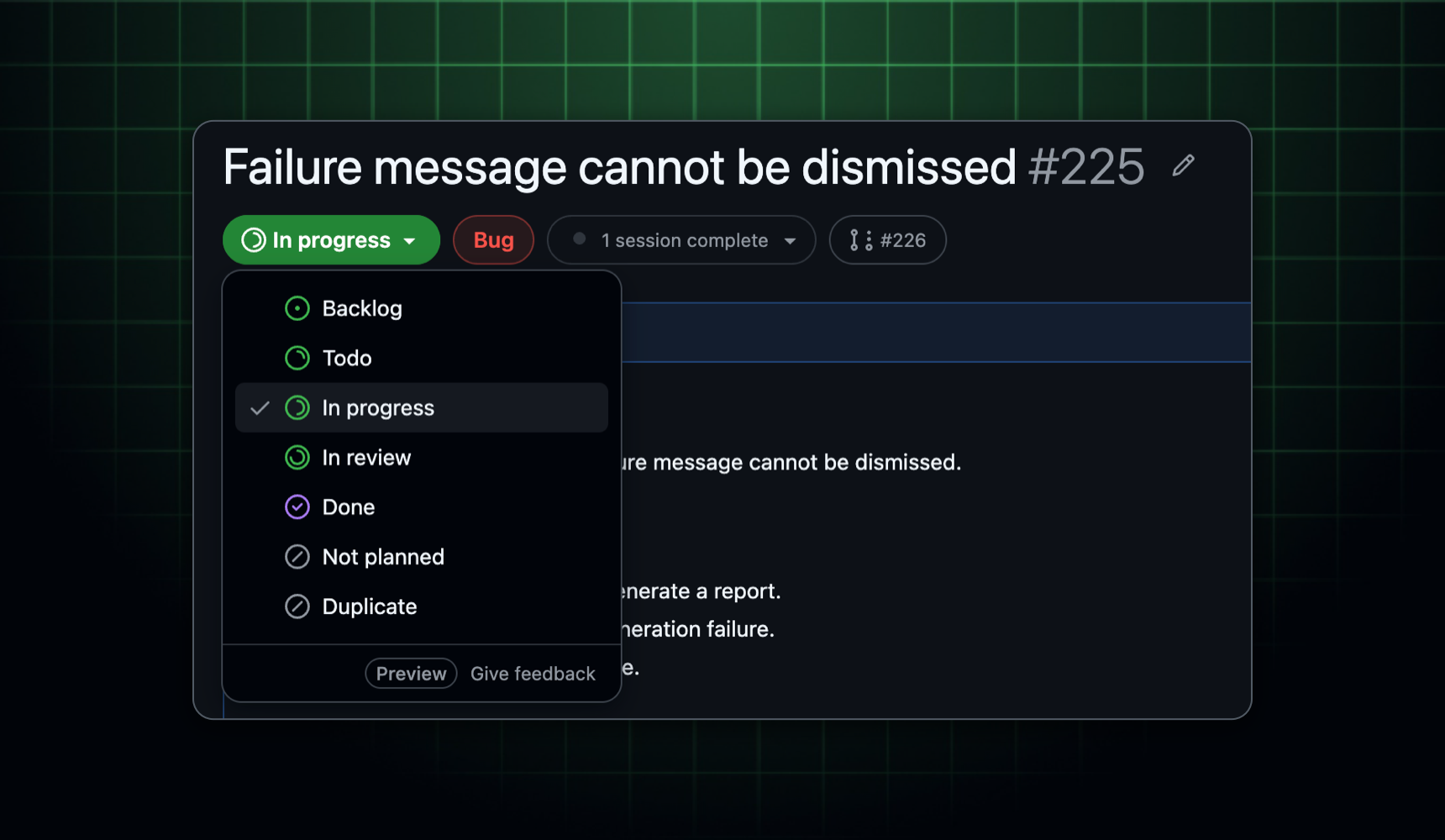
GitHub has launched public preview for issue statuses and repository boards, adding granular tracking beyond binary open/closed states. New statuses such as In Review and Not Planned are automatically updated by linked pull requests and agent assignments, with full support via GraphQL, REST API, and MCP server. Repository saved views now include a board layout for drag-and-drop status management, while issue fields can be added to any type without prior mapping. This update aims to streamline workflow visibility for both human teams and AI agents.
Read originalThe story around this
Earlier coverage that leads up to this article, and what followed. Lines connect each piece to the closest one after it, converging here.
How we got here
- 1GitHub Unveils Enhanced Pull Request Page Preview
GitHub Changelog · September 10, 2026 · Same story
- 2GitHub PR Overview Page Public Preview
GitHub Changelog · November 5, 2026 · Same story
More from GitHub Changelog
 © GitHub Changelog
Coding Toolscoding
GitHub Code Quality now rejects invalid coverage reports
GitHub has tightened its code coverage pipeline by enforcing strict Cobertura XML validation. Previously, malformed reports silently failed to display data on pull requests, leaving developers in the dark about their test quality. Now, the upload step explicitly fails with a clear error message, forcing immediate correction rather than silent degradation. This shift from passive acceptance to active enforcement ensures that CI/CD pipelines reflect actual coverage metrics, reducing wasted debugging time on phantom data.
GitHub Changelog
 © GitHub Changelog
Coding Toolscoding
GitHub expands security advisory permissions
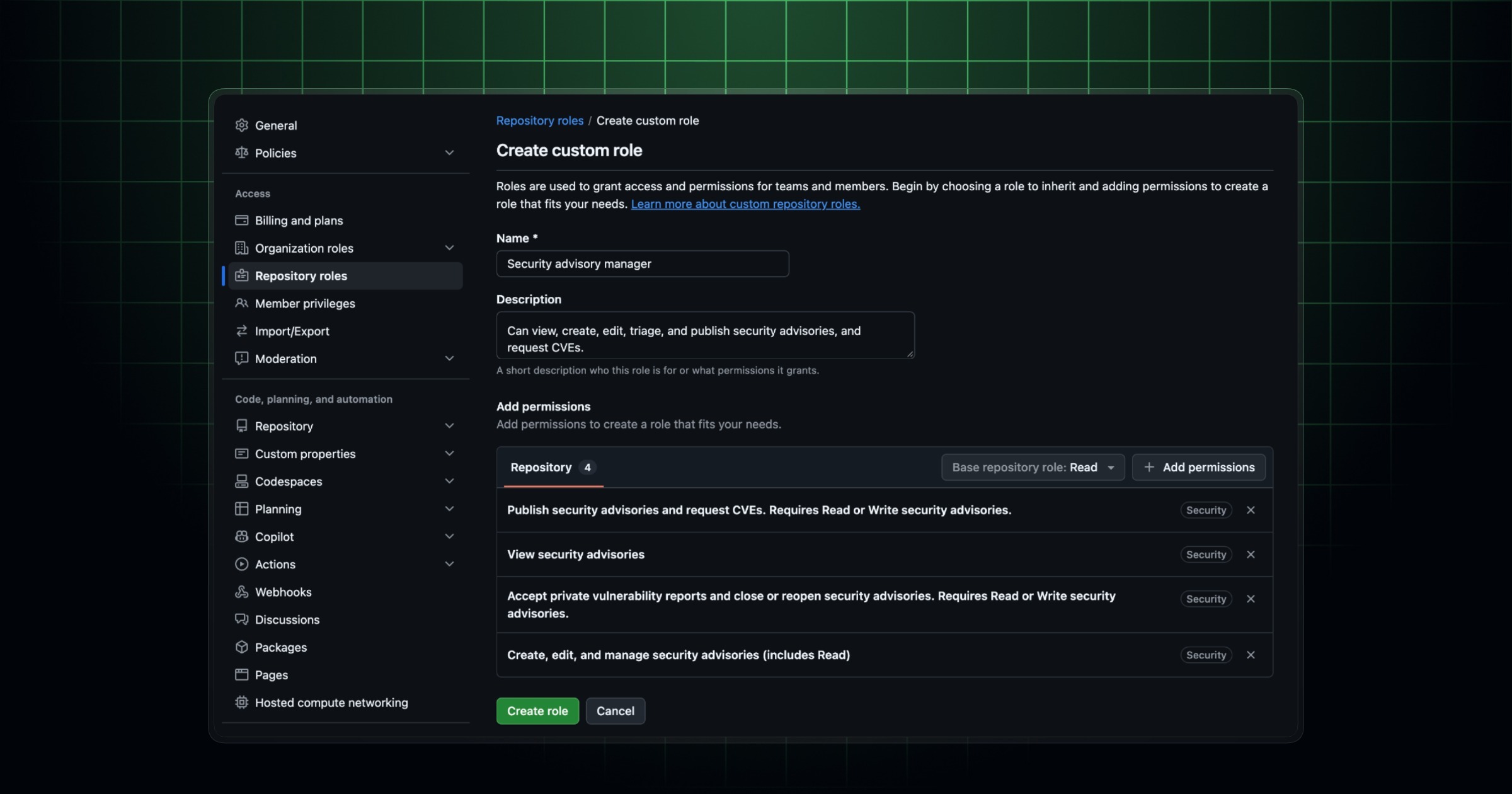
GitHub finally decouples security advisory management from full admin rights. By introducing granular custom repository roles, organizations can now grant specific teams access to private vulnerability reports without handing over the keys to the entire repo. This shift addresses a major friction point in secure software development, allowing for precise least-privilege access control. It moves GitHub closer to enterprise-grade security hygiene by separating code ownership from security oversight.
GitHub Changelog
 © GitHub Changelog
Coding Toolscoding
GHES 3.23 RC: On-device AI secret detection
GitHub Enterprise Server 3.23’s release candidate brings a critical security upgrade for air-gapped enterprises: on-device AI secret detection. Unlike cloud-based scanners, this self-contained model runs entirely on the appliance’s CPU, requiring no GPU or outbound connection to detect unstructured secrets. This capability effectively closes the gap between connected and isolated environments, allowing organizations with strict data sovereignty rules to maintain automated security hygiene. The update also expands Dependabot’s advisory coverage to six additional package ecosystems and introduces stricter OAuth token expiration defaults.
GitHub Changelog
More in Coding Tools
 © Hugging Face Blog
Coding Toolsagents
Microduck Sim2Real Obstacle Avoidance Tutorial
This tutorial bridges the gap between simulation and reality for quadruped navigation by decoupling balance from steering. By freezing a pre-trained walking policy in Isaac Lab and training a separate PPO controller on simulated Time-of-Flight sensor data, developers can achieve robust obstacle avoidance without retraining locomotion. The workflow leverages Newton’s raycasting for realistic depth sensing and supports deployment on real hardware with minimal code changes. It provides a practical blueprint for adding high-level navigation to existing low-level control policies.
Hugging Face Blog
Coding Toolscoding
llama.cpp b12642 fixes MoE weight copying bug
This release patches a critical correctness bug in multi-node Mixture-of-Experts inference where shared expert weights were copied partially, leading to stale data and incorrect outputs. The fix ensures all experts are properly replicated across nodes before graph execution, stabilizing large-scale distributed runs. While the binary lineup remains consistent with previous versions—supporting CUDA 13, ROCm 10.0, and various CPU/GPU backends—the underlying logic correction is vital for anyone running complex MoE models like Inkling2 on multi-node setups. It’s a quiet but necessary fix for reliability in advanced deployment scenarios.
llama.cpp Releases
Coding Toolscoding
llama.cpp b12643 fixes Qwen3 audio tail
This release quietly patches a critical inference bug in llama.cpp’s multimodal handling of Qwen3-Omni and Qwen3-ASR models. Previously, zero-padding artifacts introduced extra tokens that corrupted audio output, a subtle but fatal flaw for speech recognition tasks. The fix replaces magic numbers with explicit token mapping logic, ensuring the model processes only valid audio frames. While not a new feature, it stabilizes one of the most popular open-source multimodal pipelines for developers relying on Qwen’s audio capabilities.
llama.cpp Releases