Coding Tools
GitHub expands security advisory permissions
GitHub Changeloghigh confidence
Why it matters
- →Reduces risk by allowing least-privilege access to sensitive security data.
- →Eliminates the need to grant full admin rights for vulnerability management.
- →Enables precise delegation of security tasks to specific teams or individuals.
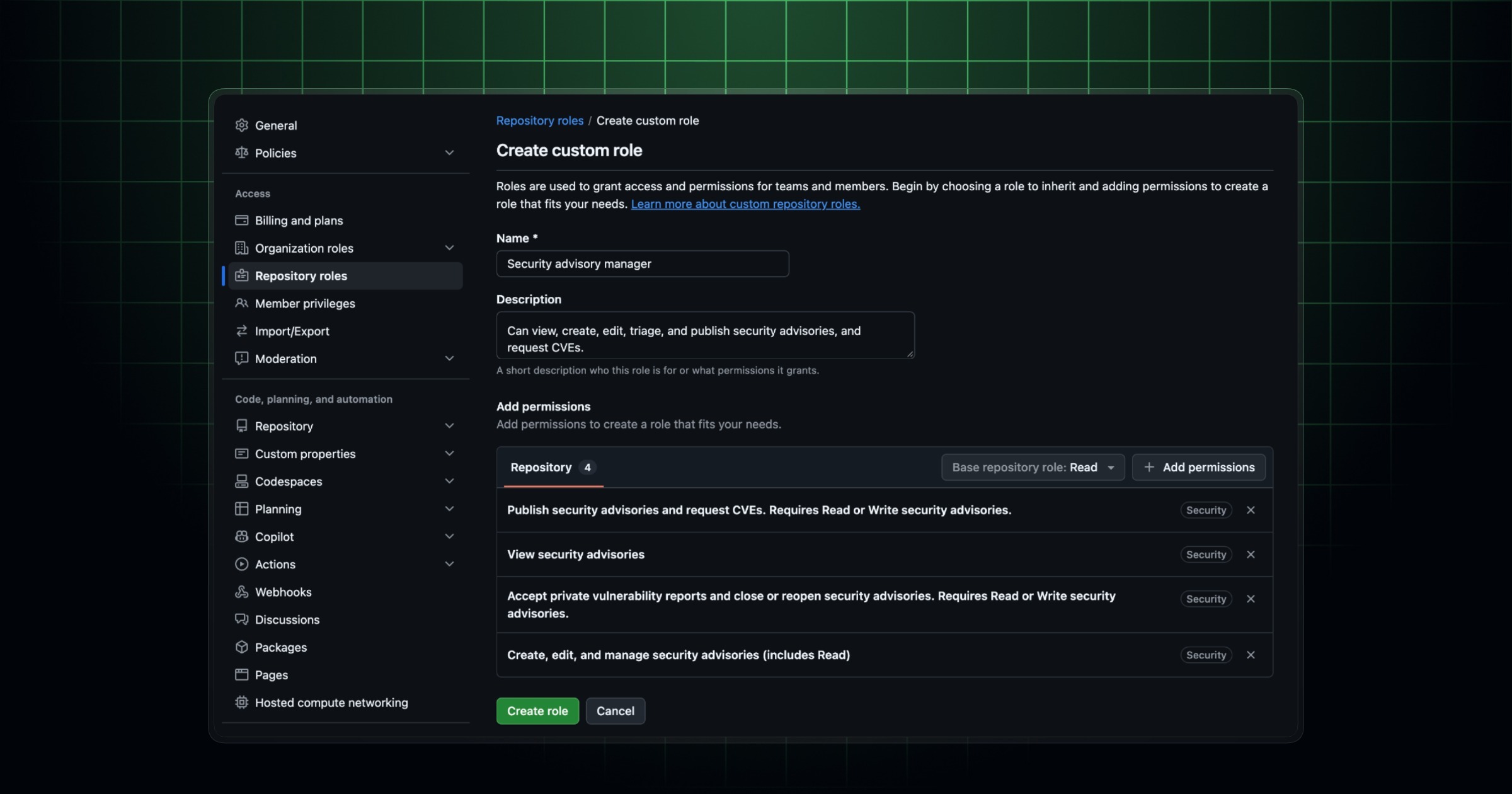
GitHub has made granular permissions for repository security advisories generally available. Organization owners can now assign custom roles that allow users to view, create, edit, and manage security advisories without requiring full administrator privileges. The update includes four new permission levels under the Security category, enabling teams to handle private vulnerability reports and CVE requests on a per-repository basis. This change is available for organizations using plans that support custom repository roles, such as GitHub Enterprise Cloud.
Read originalThe story around this
Earlier coverage that leads up to this article, and what followed. Lines connect each piece to the closest one after it, converging here.
How we got here
- 1GitHub API adds security advisory comments
GitHub Changelog · October 2, 2026 · Same story
- 2GitHub adds confidential comments to security advisories
GitHub Changelog · October 2, 2026 · Same story
More from GitHub Changelog
 © GitHub Changelog
Coding Toolscoding
GHES 3.23 RC: On-device AI secret detection
GitHub Enterprise Server 3.23’s release candidate brings a critical security upgrade for air-gapped enterprises: on-device AI secret detection. Unlike cloud-based scanners, this self-contained model runs entirely on the appliance’s CPU, requiring no GPU or outbound connection to detect unstructured secrets. This capability effectively closes the gap between connected and isolated environments, allowing organizations with strict data sovereignty rules to maintain automated security hygiene. The update also expands Dependabot’s advisory coverage to six additional package ecosystems and introduces stricter OAuth token expiration defaults.
GitHub Changelog
 © GitHub Changelog
Coding Toolscoding
Azure DevOps to GitHub Enterprise Live Migrations GA
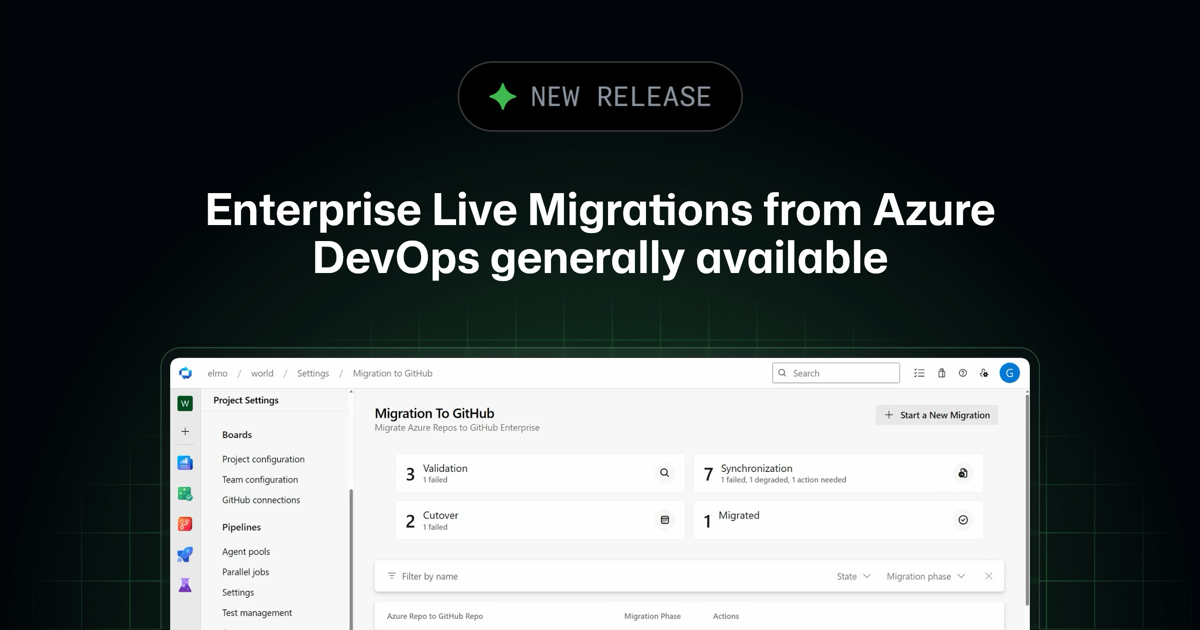
Microsoft finally solves the painful 'big bang' migration problem for enterprises moving from Azure DevOps to GitHub. The new Enterprise Live Migrations tool allows continuous syncing of Git history and pull requests while teams keep working, eliminating the need for a disruptive downtime window. By preserving branch policies and rewiring Azure Pipelines automatically, it drastically reduces the manual overhead that usually stalls these transitions. This shifts migration from a risky project milestone to a manageable operational task.
GitHub Changelog
 © GitHub Changelog
Coding Toolscoding
RHEL runner images GA on GitHub Actions
GitHub Actions finally brings Red Hat Enterprise Linux to production-grade larger runners, closing the gap between CI environments and enterprise deployments. This moves RHEL support out of public preview into full stability for Team and Enterprise Cloud plans, allowing developers to test against the exact OS they ship to. It eliminates the friction of maintaining separate build pipelines for proprietary Linux stacks. The real win is parity: no more workarounds or container hacks just to validate Red Hat compatibility.
GitHub Changelog
More in Coding Tools
Coding Toolscoding
llama.cpp b12642 fixes MoE weight copying bug
This release patches a critical correctness bug in multi-node Mixture-of-Experts inference where shared expert weights were copied partially, leading to stale data and incorrect outputs. The fix ensures all experts are properly replicated across nodes before graph execution, stabilizing large-scale distributed runs. While the binary lineup remains consistent with previous versions—supporting CUDA 13, ROCm 10.0, and various CPU/GPU backends—the underlying logic correction is vital for anyone running complex MoE models like Inkling2 on multi-node setups. It’s a quiet but necessary fix for reliability in advanced deployment scenarios.
llama.cpp Releases
Coding Toolscoding
llama.cpp b12643 fixes Qwen3 audio tail
This release quietly patches a critical inference bug in llama.cpp’s multimodal handling of Qwen3-Omni and Qwen3-ASR models. Previously, zero-padding artifacts introduced extra tokens that corrupted audio output, a subtle but fatal flaw for speech recognition tasks. The fix replaces magic numbers with explicit token mapping logic, ensuring the model processes only valid audio frames. While not a new feature, it stabilizes one of the most popular open-source multimodal pipelines for developers relying on Qwen’s audio capabilities.
llama.cpp Releases
Coding Toolscoding
llama.cpp b12644 speeds up audio FFT
This release quietly optimizes the multimodal pipeline by replacing recursive radix-2 splitting with iterative stages for shared audio FFT. The change preserves operation order while reducing input buffer overhead and adding specific tests for forward and inverse transforms. It’s a performance tweak rather than a feature leap, but it tightens the efficiency of audio processing in local inference. Users on supported platforms get faster audio handling without changing their workflow.
llama.cpp Releases