Coding Tools
GitHub adds confidential comments to security advisories
GitHub Changeloghigh confidence
Why it matters
- →Reduces friction in security triage by keeping sensitive discussions within the advisory context.
- →Prevents accidental exposure of investigation details to external reporters or collaborators.
- →Improves auditability of internal security coordination through view logging.
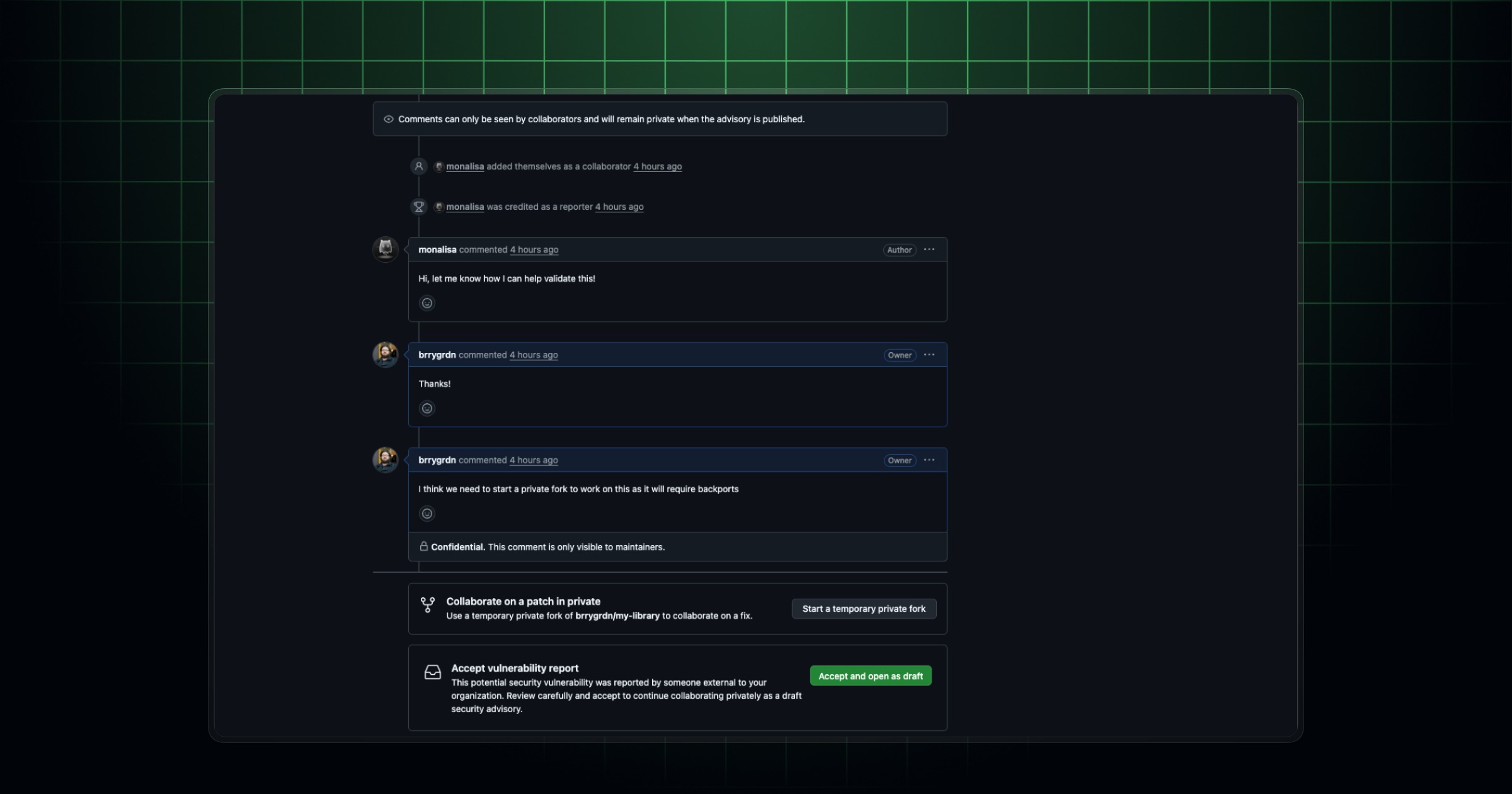
GitHub has enabled confidential comments for repository security advisories across all plans, including GitHub Free. This feature restricts comment visibility to users with write access, preventing reporters and external collaborators from seeing sensitive investigation notes or abuse reports. Confidential comments are clearly marked in the timeline, respect current repository permissions, and log views in the audit trail. The functionality is accessible via the GraphQL API but not the REST API.
Read originalThe story around this
Earlier coverage that leads up to this article, and what followed. Lines connect each piece to the closest one after it, converging here.
How we got here
- 1GitHub rate limits private vulnerability reports
GitHub Changelog · October 1, 2026 · Related
- 2GitHub API adds security advisory comments
GitHub Changelog · October 2, 2026 · Same story
More from GitHub Changelog
 © GitHub Changelog
Coding Toolscoding
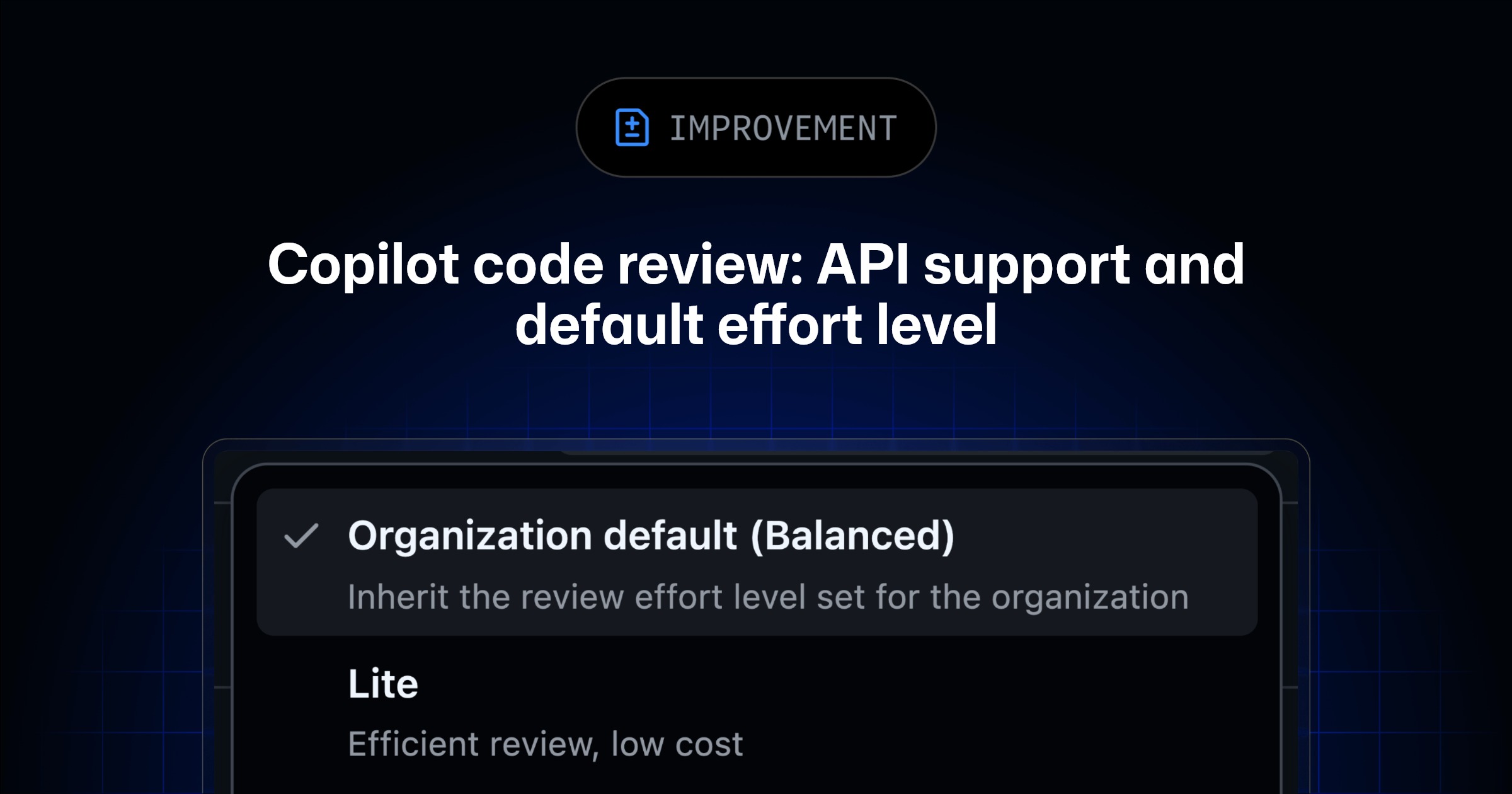
GitHub Copilot Code Review API and Default Effort Change
GitHub finally exposes Copilot code review to external automation via REST and GraphQL APIs, moving it from a manual UI action to an integrable pipeline step. This allows developers to trigger reviews directly from scripts or internal tools rather than relying on the web interface. Simultaneously, the default effort level shifts to Balanced, striking a middle ground between speed and depth for most repositories. While Lite remains available for those prioritizing raw throughput, the API access is the real win here, enabling true CI/CD integration for automated code quality checks.
GitHub Changelog
 © GitHub Changelog
Coding Toolscoding
GitHub Copilot deprecates specific models
GitHub quietly retired several underlying models for Copilot Chat and code completions, forcing a shift in the default inference stack. Enterprise admins must now manually enable alternative models via policy settings to maintain access, turning what was once automatic into an administrative task. This signals that GitHub is actively pruning its model portfolio rather than just adding new ones, likely to consolidate costs or improve quality control. Developers relying on specific legacy behaviors may find their workflows broken until policies are updated.
GitHub Changelog
 © GitHub Changelog
Coding Toolscoding
GitHub GraphQL API expands SecurityAdvisory fields
GitHub’s GraphQL API now exposes critical vulnerability metadata directly, eliminating the need to fall back to REST for basic advisory data. Five new fields like cveId and nvdPublishedAt allow developers to pull CVE identifiers and NVD publication times in a single query. The addition of severities and isWithdrawn filters enables server-side narrowing, which significantly reduces client-side processing and rate limit consumption. This consolidation streamlines security integrations by unifying authentication paths and simplifying the construction of triage feeds.
GitHub Changelog
More in Coding Tools
Coding Toolscoding
Claude Code v2.1.288 fixes resume and MCP bugs
This release stabilizes the core session management of Claude Code, specifically targeting the fragile state of resumed conversations where context or thinking traces were previously lost. It also patches critical reliability issues in the Model Context Protocol (MCP) integration, ensuring tool calls don't duplicate or hang indefinitely when remote servers misbehave. The addition of $.ui.selection() for mods and better GitHub CLI handling in cloud sessions shows a focus on developer workflow friction rather than new capabilities. These are necessary maintenance updates that make the tool more robust for heavy daily use.
Claude Code Releases
Coding Toolscoding
Claude Code v2.1.289 patches sandbox and plugin stability
This release is a classic maintenance patch for Claude Code, focusing on stabilizing the terminal interface and tightening security rules. It fixes critical bugs where deny/ask rules were bypassed in nested shell commands or via symlinks, ensuring sandbox policies actually hold. The update also resolves numerous UI freezes caused by malformed HTML tags and plugin rendering errors, making the agent feel less brittle during complex coding sessions.
Claude Code Releases
Coding Toolscoding
llama.cpp b11372 optimizes Qwen4-Exp memory and GPU support
This release tackles the notorious memory hunger of long-context inference for Qwen4-exp models by halving indexer score memory. The optimization works by computing head scores in place rather than materializing separate tensors, a change that significantly reduces VRAM pressure during heavy workloads. Beyond memory efficiency, b11372 expands hardware coverage with CUDA 13 support and Vulkan tiling for the lightning indexer. It also adds ROCm 10.0 binaries, keeping AMD users in step with NVIDIA's latest driver ecosystem. The result is a leaner runtime that handles extended contexts without hitting out-of-memory errors as quickly.
llama.cpp Releases