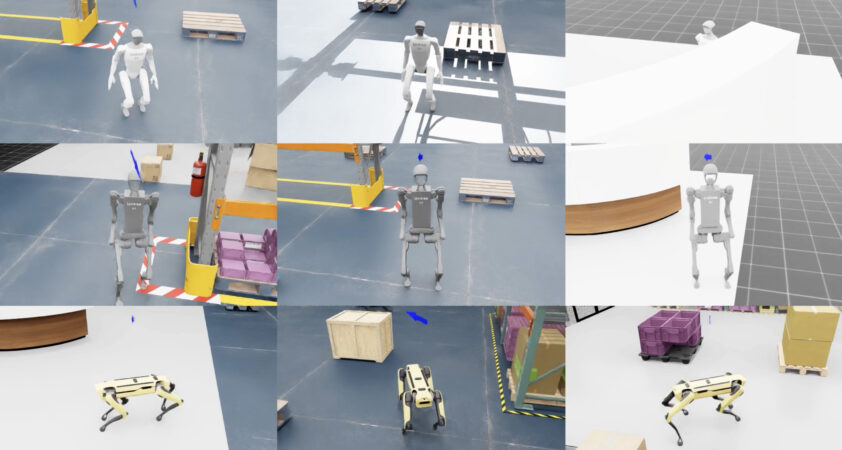
NVIDIA Research is making strides in robotics by focusing on simulation-to-real transfer, as presented in eight papers at the ICRA conference. These papers cover a range of challenges, from coordinating multiple robotic arms to adaptive grasping and navigation across different robot bodies. The research emphasizes training in simulation environments, which allows for significant improvements in real-world applications without the need for real-world data. This advancement is crucial for developing robots that can operate reliably in dynamic and unpredictable environments.
Read original
© NVIDIA BlogNVIDIA is redefining AI infrastructure with its concept of 'AI factories,' which are designed to produce intelligence continuously and efficiently. These factories convert energy into tokens, the fundamental units for reasoning models and intelligent systems, optimizing performance per watt to maximize output. By integrating advanced hardware like the NVIDIA Blackwell Ultra GPU and the Vera Rubin platform, these AI factories promise significant improvements in throughput and cost efficiency. This marks a shift from traditional data centers to a new era where AI is an essential, always-on infrastructure, transforming how enterprises operate and scale AI capabilities.
© NVIDIA BlogNVIDIA's new Vera CPU is making waves with its impressive performance in AI-centric workloads, challenging the dominance of Intel and AMD. Featuring 88 custom Olympus cores and a remarkable 1.2TB/s memory bandwidth, Vera is designed to handle the demanding tasks of modern AI factories efficiently. Initial benchmarks by Phoronix highlight its superior memory performance and power efficiency, particularly in comparison to traditional x86 CPUs. This positions Vera as a formidable competitor in the CPU market, offering a significant generational leap over NVIDIA's previous Grace CPU. As Vera becomes available through partners, it promises to redefine performance standards in AI infrastructure.
© MIT News AIMIT is set to establish the Quantum Systems Laboratory (QSL) with support from the Commonwealth of Massachusetts, aiming to position the region as a leader in quantum innovation. The facility will provide state-of-the-art resources for quantum computing and research, integrating quantum sensors and peripherals. This initiative is expected to drive significant advancements in fields like life sciences and defense, while also creating job opportunities and fostering startup growth. By enhancing Massachusetts' quantum capabilities, the QSL aims to secure the state's role in the next era of technological breakthroughs.
© TechCrunch AIRecursive self-improvement (RSI) is emerging as a buzzword in AI, akin to the earlier hype around AGI. The concept involves AI systems that can autonomously upgrade themselves, potentially leading to rapid advancements limited only by available compute power. Notable figures like Richard Socher and Andrej Karpathy are actively pursuing RSI, with projects like Auto-Research and AutoScientist aiming to automate AI research processes. While the industry is not yet close to achieving full RSI, the pursuit is driving significant interest and investment, hinting at a future where AI could independently push its own boundaries.
© The Rundown AIBiohub, backed by Mark Zuckerberg and Priscilla Chan, has unveiled a groundbreaking open-source model for protein biology. This 'world model' aims to accelerate drug discovery by predicting and designing proteins, potentially reducing the time from years to months. The model, ESMFold2, claims state-of-the-art performance in protein structure prediction, surpassing even AlphaFold. It has already shown promising results in designing binders for cancer and immune disease targets. This release could democratize access to advanced molecular tools, empowering researchers worldwide to tackle diseases more effectively.