Open Source
NVIDIA Boosts Local AI with New Open Models
NVIDIA Bloghigh confidence
Why it matters
- →NVIDIA's new models enable complex AI tasks to be run locally, reducing cloud dependency.
- →The open-source nature of these tools fosters innovation and customization among developers.
- →Local AI processing can lead to faster, more secure, and cost-effective AI solutions.
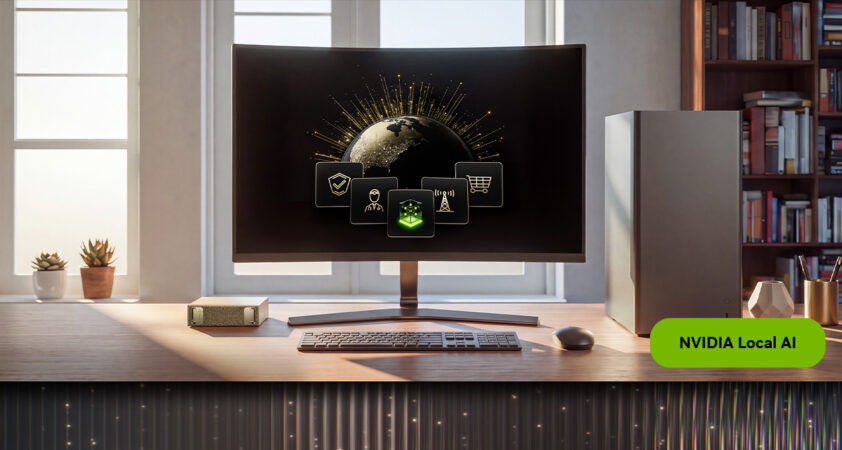
NVIDIA has announced a series of new open-source models and tools aimed at enhancing local AI capabilities. Key releases include the Cosmos 3 Edge model for robotics and the MiniMax-H3 model for video and audio generation, both optimized for NVIDIA GPUs. Additionally, the launch of Unsloth Desktop offers a fully open-source solution for AI model training and inference on personal devices. These advancements highlight NVIDIA's commitment to empowering developers with the tools needed to run sophisticated AI tasks locally, minimizing the need for cloud-based resources.
Read originalThe story around this
TopicNvidia Product And Business UpdatesCooling
Earlier coverage that leads up to this article, and what followed. Lines connect each piece to the closest one after it, converging here.
How we got here
- 1Together AI Launches NVIDIA Nemotron 3 Nano Omni
Together AI Blog · April 28, 2026 · Related
- 2NVIDIA Launches Cosmos 3 for Physical AI
Hugging Face Blog · June 1, 2026 · Same story
- 3NVIDIA Unveils Cosmos 3 for Physical AI Development
NVIDIA Blog · June 1, 2026 · Same story
- 4NVIDIA Unveils Cosmos 3 World Foundation Model
Sam Witteveen · June 1, 2026 · Same story
- 5Nvidia Unveils AI Agent-Centric Tech at COMPUTEX
The Rundown AI · June 2, 2026 · Related
- 6NVIDIA Launches Nemotron 3 Ultra Model
Ollama Blog · June 4, 2026 · Related
- 7NVIDIA Releases Cosmos 3 Edge for Robotics
Hugging Face Blog · July 20, 2026 · Same story
- 8NVIDIA Nemotron 3.5 Lightning Launches for Local AI Agents
Ollama Blog · August 11, 2026 · Related
What happened next
- 9Nvidia Highlights Importance of AI Harness Over Model
TechCrunch AI · August 21, 2026 · Related
- 10Nvidia Unveils PAIR for Home AI Computing
The Verge AI · September 3, 2026 · Related
- 11NVIDIA Boosts Local AI with New Tools at IFA 2026
NVIDIA Blog · September 3, 2026 · Same story
- 12NVIDIA Launches PAIR Local AI Router
Sam Witteveen · September 6, 2026 · Same story
- 13Nvidia Launches Open-Source AI Agent Security Platform
WIRED AI · September 28, 2026 · Related
Follow this story
Open the full story →NVIDIA Cosmos 3 Advances Open World Models for Physical AI
2 developments
- Aug 6 · NVIDIA Blog
NVIDIA Cosmos 3 Advances Open World Models for Physical AI - Aug 11 · NVIDIA Blog
NVIDIA Boosts Local AI with New Open Models (This article)↳ NVIDIA releases Cosmos 3 Edge for robotics, MiniMax-H3 for media, and Unsloth Desktop to boost local AI capabilities.
More in Open Source
 © The Verge AI
Open Sourceagents
Meta open sources Muse AI agent SDK for custom hardware
Meta is handing the keys to its Muse AI agent by open-sourcing the software needed to run it on custom hardware. Developers can now hook Muse into ESP32 boards or Raspberry Pi setups, effectively turning workbench scraps into personalized AI terminals. This moves Muse beyond a cloud-only interface into tangible, local devices like E Ink displays or HDMI sticks. It signals a shift toward decentralized, user-owned AI interactions rather than relying solely on proprietary apps.
The Verge AI
 © Hugging Face Blog
Open Sourcewriting
Ai2 open-sources AstaBrief 8B for scientific reports
Allen Institute for AI has released AstaBrief 8B, an open-weight model designed specifically for generating cited scientific literature reviews. Built on Qwen3-8B and trained with supervised fine-tuning and direct preference optimization, it prioritizes speed and grounding over complex multi-step reasoning. The model generates full reports in a single pass, cutting generation time to roughly 51 seconds compared to the 178 seconds required by proprietary alternatives like Claude. This release offers researchers a faster, locally deployable option for synthesizing evidence without relying on external APIs.
Hugging Face Blog
Open Sourceother
llama.cpp adds IBM ZDNN backend support
IBM is finally getting first-class CI support in llama.cpp with the addition of the ZDNN backend for s390x architecture. This isn't just a minor tweak; it enables efficient inference on mainframe hardware, bridging a gap for enterprise environments that rely on IBM Z systems. While currently limited to build pipelines without automated testing, this signals a serious commitment to supporting non-x86/ARM infrastructure in the local LLM ecosystem. It’s a quiet but necessary expansion for anyone running models on legacy or specialized enterprise silicon.
llama.cpp Releases