Research
MIT's CheMeleon predicts molecule behavior from scant data
MIT News AIhigh confidence
Why it matters
- →CheMeleon solves the 'small data' problem in drug discovery by leveraging pre-training on general molecular structures.
- →It has already demonstrated superior performance in competitive benchmarks and real-world pharmaceutical workflows.
- →The open-source nature allows any researcher to fine-tune the model for specific chemical properties without starting from scratch.
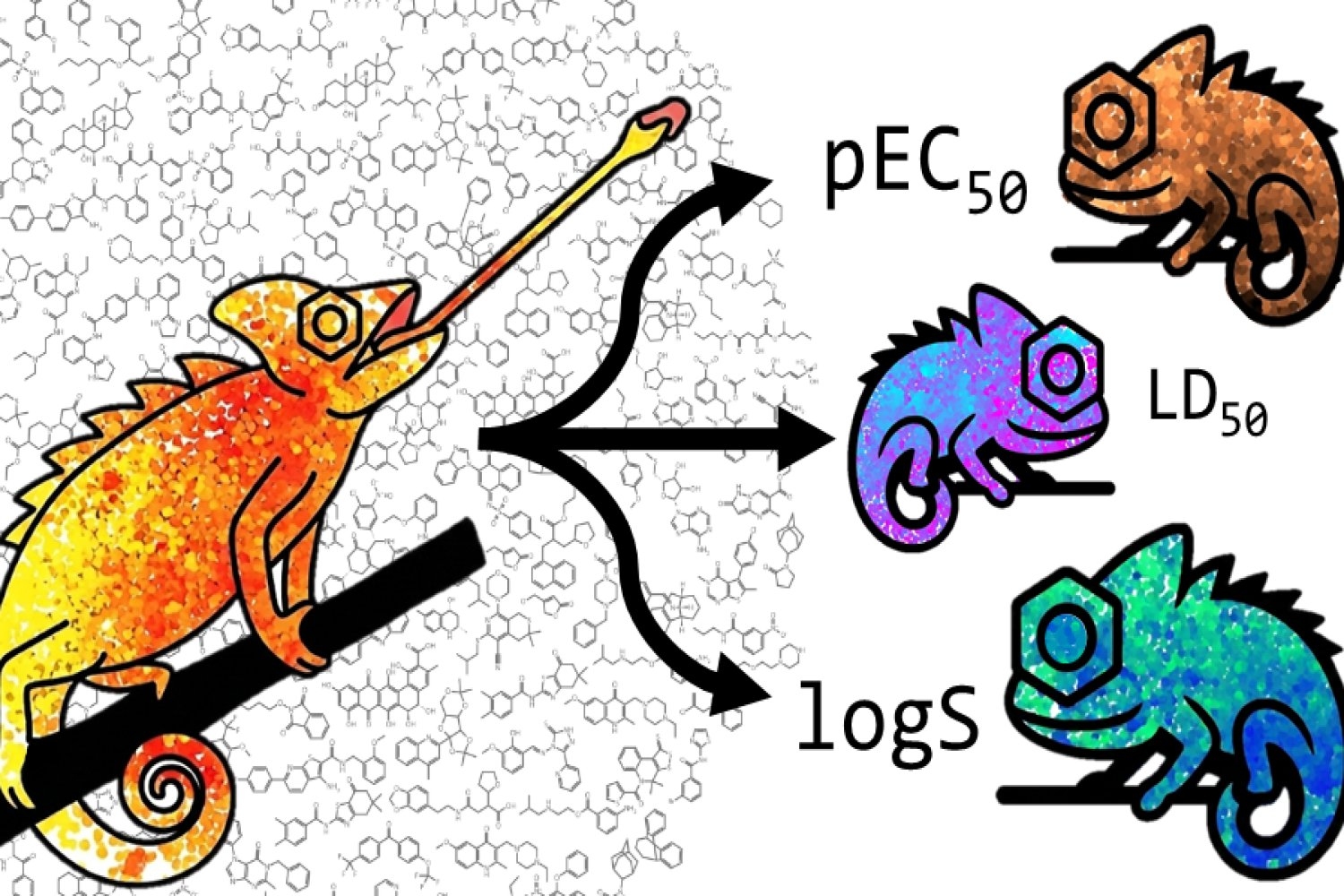
MIT researchers have released CheMeleon, an open-source foundation model for predicting molecular properties with limited data. Built on the ChemProp architecture and pre-trained on one million molecules from PubChem, the model learns general chemical correlations rather than specific task labels. In a recent OpenADMET contest, nine of the top twenty entries utilized CheMeleon, and it has reportedly been adopted as a standard tool by at least one major pharmaceutical company. The model outperformed classical expert-driven methods across 58 test cases, offering a faster, cheaper alternative to traditional trial-and-error screening.
Read originalThe story around this
TopicNeural Network Interpretability
Earlier coverage that leads up to this article, and what followed. Lines connect each piece to the closest one after it, converging here.
How we got here
- 1Quantum Computing Boosts AI in Drug Discovery
WIRED AI · July 12, 2026 · Background
- 2AI's Role in Transforming Drug Discovery
MIT Technology Review AI · July 27, 2026 · Background
- 3AI Agents Could Transform Scientific Research
MIT Technology Review AI · August 10, 2026 · Background
- 4MIT Develops PottsMPNN for Protein Design
MIT News AI · August 27, 2026 · Background
- 5Anthropic's Claude discovers novel enzyme system
The Verge AI · September 23, 2026 · Background
- 6Claude discovers novel enzyme system in DNA
Wes Roth · September 24, 2026 · Background
- 7ML-Intern: Autonomous AI Agent for Model Training
Hugging Face Blog · October 8, 2026 · Background
- 8MIT's IRIS model decodes cell signaling fingerprints
MIT News AI · October 15, 2026 · Related
More from MIT News AI

More in Research
 © The AI Daily Brief
Researchresearch
AI-Led Research Acceleration Reported by Meter
Meter reports that research driven by artificial intelligence is accelerating, highlighting a trend in scientific and technical discovery.
The AI Daily Brief
 © WIRED AI
Researchother
Open Chinese AI Models Match Frontier Labs in Hacking
The long-held assumption that closed frontier models hold a definitive edge in cyber capabilities has collapsed. Vals research shows DeepSeek matching OpenAI’s Daybreak on complex network attacks, completing 73% of tasks versus 81%. This parity arrives just months after Anthropic predicted such a shift, rendering gated access strategies largely moot for slowing capability proliferation. The cost disparity is stark: $2 to $3 for open models versus up to $46 for proprietary APIs, creating a powerful economic incentive for widespread adoption by both defenders and attackers. We are now in a landscape where advanced offensive AI is cheap, accessible, and effectively democratized.
WIRED AI
 © Hugging Face Blog
Researchagents
ToyBlocks: Controlled simulation for robot learning research
Hugging Face launched ToyBlocks, a controlled simulation framework designed to isolate and study the specific mechanics of robot learning. By focusing on a simple tabletop environment with blocks, it allows researchers to automatically generate massive datasets of tasks and demonstrations without manual teleoperation. This setup enables precise testing of how high-level reasoning models like Molmo 2 interact with low-level action controllers like ManiFlow. The real value lies in reproducibility; scientists can now systematically vary training data to understand exactly why a robot fails or succeeds, moving beyond the black-box nature of current robotics benchmarks.
Hugging Face Blog