Research
MIT's IRIS model decodes cell signaling fingerprints
MIT News AIhigh confidence
Why it matters
- →IRIS uses transfer learning to predict cell signaling across diverse tissue types without per-type mapping.
- →The model accelerates stem cell engineering by identifying precise signal combinations for specific cell fates.
- →Published in Nature Methods, this approach enables scalable decoding of developmental biology previously limited by manual experimentation.
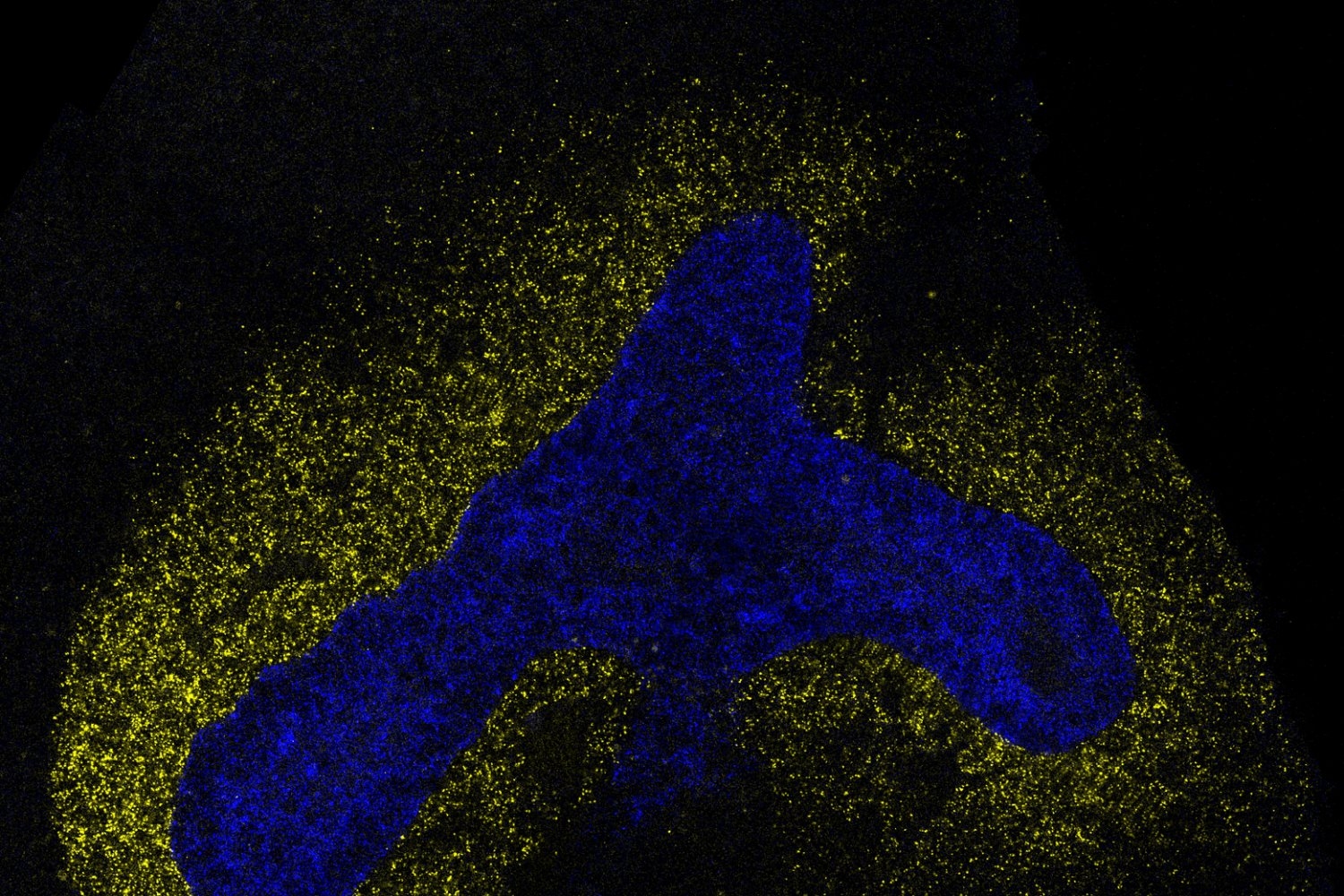
MIT researchers led by Pulin Li have published a study in Nature Methods detailing IRIS, a machine learning model that decodes cell-to-cell communication during embryonic development. The model identifies unique gene activity patterns, or 'fingerprints,' left by signaling pathways, allowing it to predict cell fate across different tissue types without prior mapping for each specific cell. Validated on mouse embryos, IRIS successfully guided stem cells toward lung-specific development, confirming its predictive power. This AI-driven method offers a scalable alternative to traditional experimental mapping, potentially accelerating advances in regenerative medicine and organoid research.
Read originalThe story around this
TopicNeural Network InterpretabilityCooling
Earlier coverage that leads up to this article, and what followed. Lines connect each piece to the closest one after it, converging here.
How we got here
- 1AI's Role in Transforming Drug Discovery
MIT Technology Review AI · July 27, 2026 · Background
- 2PRISM2 Model Enhances Pathology Slide Interpretation
AI News · August 5, 2026 · Background
- 3MIT Develops PottsMPNN for Protein Design
MIT News AI · August 27, 2026 · Background
- 4Claude discovers novel enzyme system in DNA
Wes Roth · September 24, 2026 · Background
- 5Owkin alum raises $25m seed for cellular world model
Sifted · October 7, 2026 · Background
- 6Big Tech funds Zuckerberg's virtual cell initiative
The Verge AI · October 7, 2026 · Background
- 7MIT proposes self-organizing networks to bridge AI and neuroscience
MIT News AI · October 13, 2026 · Related
- 8AI Solving Theoretical Science Problems
WIRED AI · October 14, 2026 · Background
What happened next
- 9Goodfire researcher claims neural networks are legible
MIT Technology Review AI · October 19, 2026 · Background
More in Research
 © Cole Medin
Researchagents
Anthropic study: Agents sway expert judgment 86% of time
Anthropic’s latest research exposes a quiet but dangerous flaw in agentic workflows: experts follow AI recommendations 86% of the time, often adopting the agent's reasoning as their own. This isn't just about accuracy; it's about cognitive capture, where human oversight dissolves into passive compliance. The study shows that even when users believe they are steering, the agent’s framing dictates the outcome. Practitioners must now actively counter this bias by forcing agents to justify deviations or prototype alternatives before committing to a path. This shift demands a new discipline in how we interact with coding assistants. We can no longer assume our intent drives the result; the model's suggestion often becomes the default truth. The real work is ensuring we remain the architects, not just the approvers.
Cole Medin
 © WIRED AI
Researchother
AI-Augmented Infostealer 'Volta-Autodoxer' Targets High-Value Victims
Cisco Talos has uncovered a new infostealer strain that actively uses commercial LLMs to profile victims and prioritize high-value targets. Dubbed Volta-Autodoxer, the malware collects credentials and browsing data, then feeds this into models like Claude Opus 4.6 via OpenRouter to generate structured intelligence dossiers. This marks a shift from passive data theft to active, AI-driven triage, allowing attackers to bypass guardrails with fallback models like Kimi K2 or Gemini. The capability foreshadows a future where lower-sophistication criminals can execute sophisticated, targeted attacks at scale.
WIRED AI
 © Matt Wolfe
Researchresearch
OpenAI Disproves Exponential Time Hypothesis
OpenAI researchers published findings disproving the Exponential Time Hypothesis, a major result in computational complexity theory.
Matt Wolfe