Models & Labs
Gemini 4 Hydrogen arrives in GitHub Copilot
GitHub Changeloghigh confidence
Why it matters
- →Gemini 4 Hydrogen enables agentic coding workflows within GitHub Copilot.
- →Improved instruction following over Gemini 3.8 Flash enhances multistep task performance.
- →Gradual rollout allows administrators to manage access through existing policy settings.
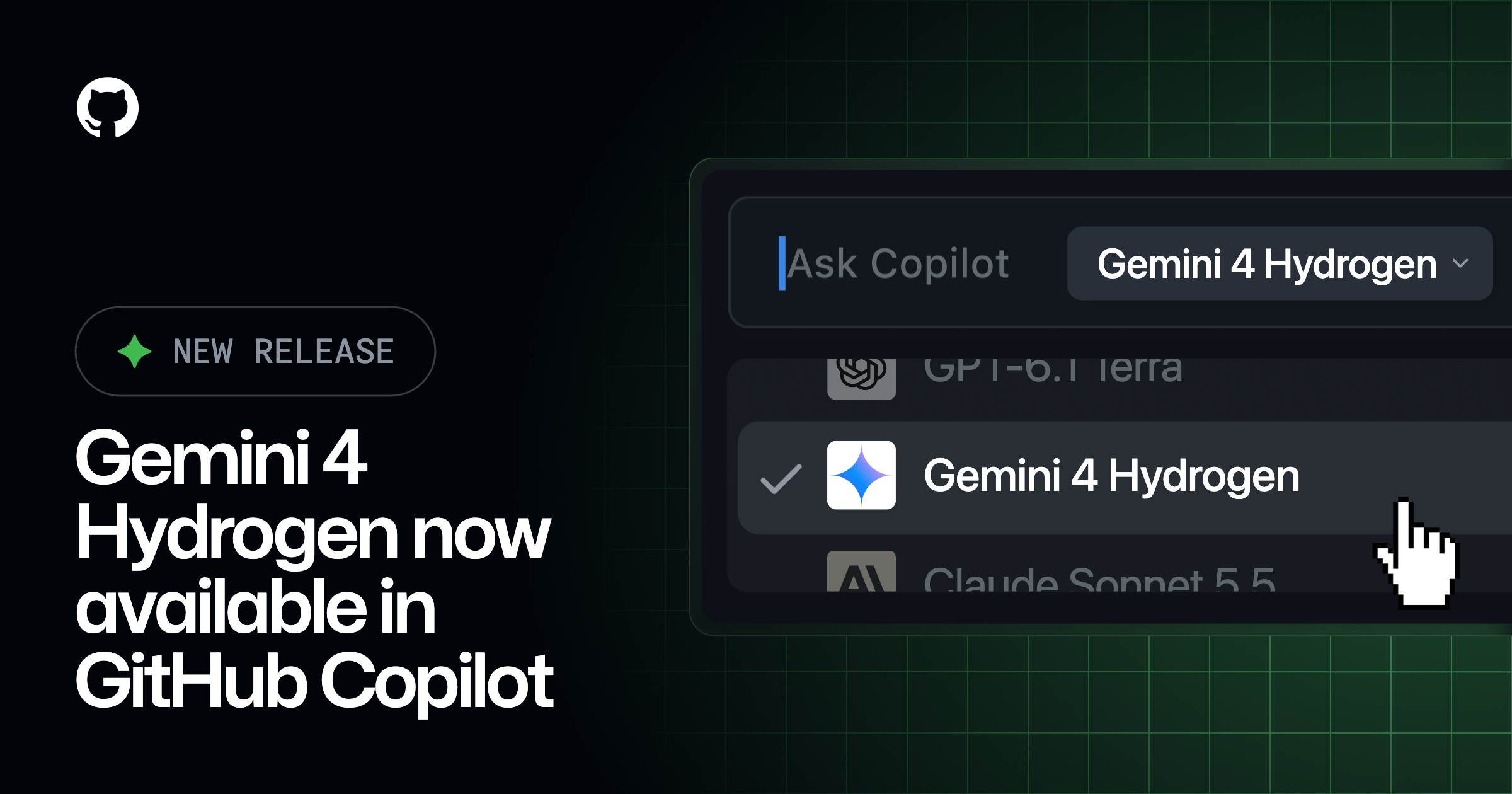
GitHub has made Google's Gemini 4 Hydrogen model generally available within its Copilot ecosystem. Designed for agentic coding tasks, the model promises better instruction following compared to its predecessor, Gemini 3.8 Flash. It is accessible to Pro, Business, and Enterprise users across major IDEs like VS Code and JetBrains, with a gradual rollout schedule. Administrators retain control over model access via policy settings.
Read originalThe story around this
Earlier coverage that leads up to this article, and what followed. Lines connect each piece to the closest one after it, converging here.
How we got here
- 1Google's Gemini 3.5 Pro Model Still Missing
The Rundown AI · July 22, 2026 · Related
- 2Gemini 3.7 Flash Now in GitHub Copilot
GitHub Changelog · August 13, 2026 · Same story
- 3Google Launches Gemini 3.8 Flash Model
The Verge AI · September 2, 2026 · Related
- 4Google Releases Gemini 3.8 Flash Model
Matthew Berman · September 3, 2026 · Related
- 5Gemini 3.8 Flash now in GitHub Copilot
GitHub Changelog · September 3, 2026 · Same story
More from GitHub Changelog
 © GitHub Changelog
Coding Toolscoding
GitHub Copilot Deprecates Claude Haiku 4.5 in Dec 2026
GitHub is quietly removing Claude Haiku 4.5 from its entire Copilot ecosystem by December 2026, a move that forces enterprise and business users to migrate away from Anthropic’s fastest model. While individual annual subscribers retain access, the deprecation signals a strategic shift in GitHub’s default model stack, likely prioritizing higher-margin or more integrated options like GPT-4o or newer Claude variants. This isn't just a sunset notice; it's a mandate for workflow updates, requiring administrators to actively manage model policies rather than relying on passive defaults. The move highlights the fragility of relying on third-party models within closed IDE ecosystems, where access can be revoked unilaterally. Developers must now audit their settings to ensure compliance with new default stacks. This transition marks a clear boundary between individual flexibility and enterprise control in AI tooling.
GitHub Changelog
 © GitHub Changelog
Coding Toolscoding
GitHub Copilot app supports Enterprise Server
The GitHub Copilot desktop app finally reaches parity with the web interface for enterprise users. Version 1.2.0 makes GitHub Enterprise Server support generally available, allowing developers to connect their GHES accounts directly within the IDE-like environment. This closes a significant gap for organizations that cannot or will not use GitHub.com, enabling remote repository and pull request workflows without leaving the app. While cloud sessions remain unavailable for these instances, local inference on enterprise code is now fully integrated.
GitHub Changelog
 © GitHub Changelog
Coding Toolscoding
GitHub AI Scan API now manages repository-level settings
GitHub finally gives developers programmatic control over AI-powered code scanning at the repository level. By adding a repository_scan property to existing endpoints, organizations can now automate enablement or disablement via scripts and infrastructure as code rather than clicking through the UI one by one. This closes a critical gap for security teams managing large fleets, allowing them to enforce consistent policies across public and private repos without manual overhead. It turns AI scanning from a manual toggle into an automated governance lever.
GitHub Changelog
More in Models & Labs
Models & Labsother
llamafile b12401 adds s390x and ROCm 10 support
This release quietly expands llamafile's reach into enterprise mainframes with Q0 quant support for IBM's s390x architecture. It also updates CUDA builds to version 13.5 and introduces ROCm 10.0, keeping the runtime competitive against NVIDIA's latest drivers. Apple Silicon KleidiAI is disabled in this build, shifting focus toward broader hardware compatibility rather than optimized ARM performance. The inclusion of Snapdragon NPU support on Linux further broadens the edge computing footprint. This is infrastructure maintenance that ensures llamafile remains a viable option for diverse, non-standard hardware environments.
llama.cpp Releases
Models & Labsmodels
llama.cpp adds Inkling 2 text and vision support
Inkling 2 is a new MoE architecture from Meta, and this release brings it to the local inference runtime. The update handles both text generation and multimodal image understanding via mtmd, including complex quantization schemes like NVFP4 and MXFP8 for the sparse experts. This means developers can now run this specific model locally without relying on cloud APIs or heavier enterprise frameworks. It’s a critical step for anyone wanting to experiment with Meta’s latest open-weight models on consumer hardware.
llama.cpp Releases
 © TechCrunch AI
Models & Labsproductivity
ElevenLabs launches ElevenAI for teams
ElevenLabs is moving beyond voice synthesis into the crowded meeting intelligence space with ElevenAI. The app merges transcription, dictation across 90+ languages, and agent-driven follow-ups like drafting emails directly from conversation context. This positions their $22B valuation engine as a central knowledge hub for enterprises, aiming to replace standalone notetakers. It’s a strategic play to lock teams into their ecosystem using the recently launched v3 Scribe models.
TechCrunch AI