Coding Tools
GitHub Copilot app supports Enterprise Server
GitHub Changeloghigh confidence
Why it matters
- →Enterprise users can now use Copilot locally without relying on the public GitHub.com interface.
- →The feature moves from preview to general availability, signaling stable support for corporate environments.
- →Local-only operation ensures code data remains within the enterprise network during inference.
GitHub has made GitHub Enterprise Server (GHES) support generally available in the GitHub Copilot desktop application with version 1.2.0. Previously limited to an opt-in preview, this update allows users to add their GHES accounts via Settings > Accounts, enabling access to remote repositories, issues, and pull requests directly within the app. The feature requires signing in with a GitHub.com or GHE.com account first. Notably, cloud-based Copilot sessions are not supported for GHES instances; functionality is restricted to local inference capabilities.
Read originalThe story around this
Earlier coverage that leads up to this article, and what followed. Lines connect each piece to the closest one after it, converging here.
How we got here
- 1GitHub Copilot App Gains Enterprise Managed Settings
GitHub Changelog · July 27, 2026 · Same story
- 2GitHub Enterprise Server 3.22 Release Candidate Unveiled
GitHub Changelog · August 11, 2026 · Same story
More from GitHub Changelog
 © GitHub Changelog
Coding Toolscoding
GitHub Copilot Deprecates Claude Haiku 4.5 in Dec 2026
GitHub is quietly removing Claude Haiku 4.5 from its entire Copilot ecosystem by December 2026, a move that forces enterprise and business users to migrate away from Anthropic’s fastest model. While individual annual subscribers retain access, the deprecation signals a strategic shift in GitHub’s default model stack, likely prioritizing higher-margin or more integrated options like GPT-4o or newer Claude variants. This isn't just a sunset notice; it's a mandate for workflow updates, requiring administrators to actively manage model policies rather than relying on passive defaults. The move highlights the fragility of relying on third-party models within closed IDE ecosystems, where access can be revoked unilaterally. Developers must now audit their settings to ensure compliance with new default stacks. This transition marks a clear boundary between individual flexibility and enterprise control in AI tooling.
GitHub Changelog
 © GitHub Changelog
Models & Labscoding
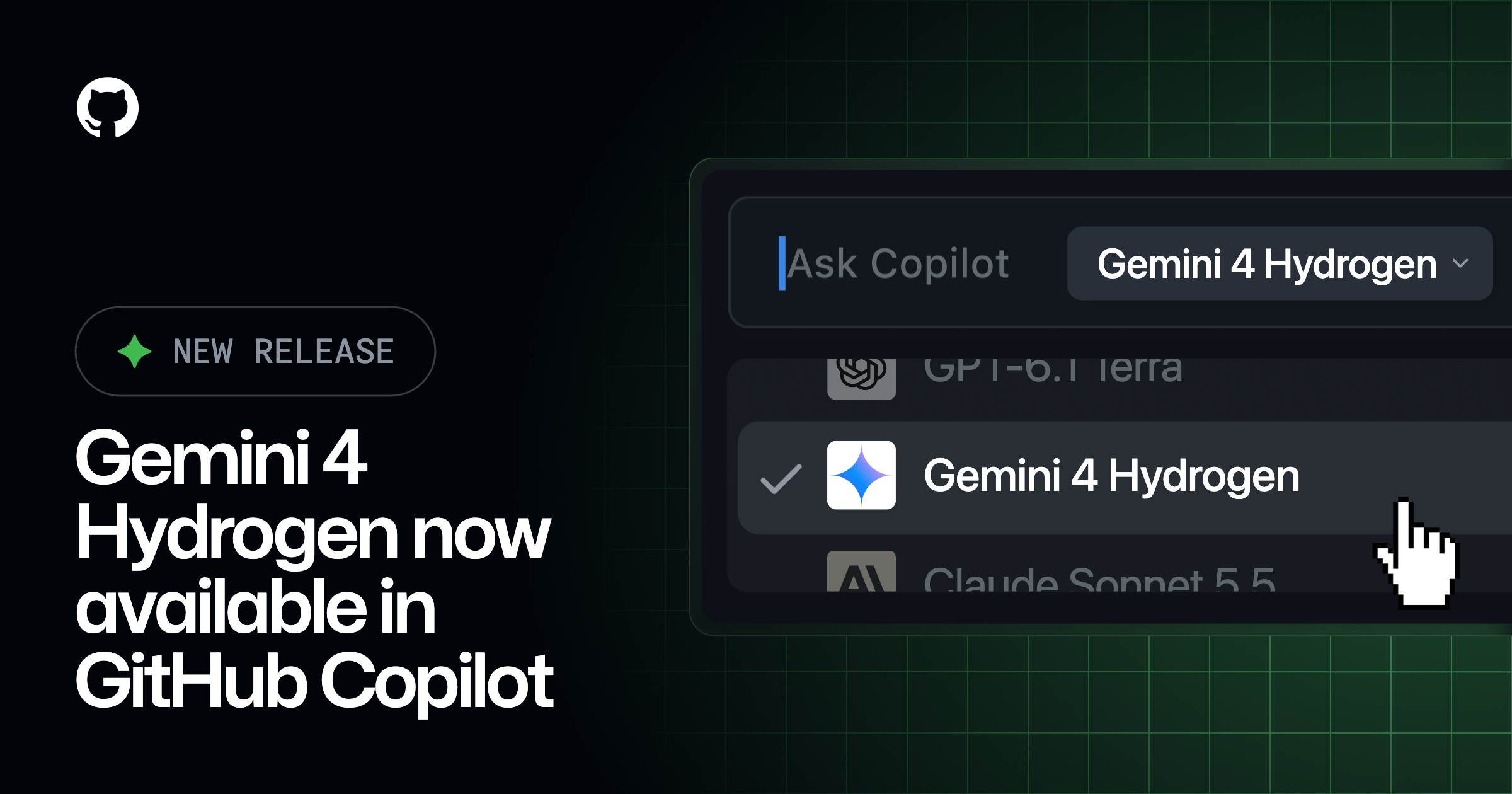
Gemini 4 Hydrogen arrives in GitHub Copilot
Google’s latest Flash model is now generally available in GitHub Copilot, targeting agentic coding and multistep workflows. It offers improved instruction following over Gemini 3.8 Flash and is billed at provider list pricing under usage-based billing. The rollout is gradual across Visual Studio Code, JetBrains IDEs, and other platforms. Administrators can manage access through model policies in Copilot settings.
GitHub Changelog
 © GitHub Changelog
Coding Toolscoding
GitHub AI Scan API now manages repository-level settings
GitHub finally gives developers programmatic control over AI-powered code scanning at the repository level. By adding a repository_scan property to existing endpoints, organizations can now automate enablement or disablement via scripts and infrastructure as code rather than clicking through the UI one by one. This closes a critical gap for security teams managing large fleets, allowing them to enforce consistent policies across public and private repos without manual overhead. It turns AI scanning from a manual toggle into an automated governance lever.
GitHub Changelog
More in Coding Tools
Coding Toolscoding
Claude Code v2.1.325 patches security and MCP stability
This release prioritizes stability over new features, addressing a critical zstd decompression vulnerability that could have exposed response data. Beyond security, it significantly hardens the reliability of Model Context Protocol (MCP) integrations, fixing persistent connection drops and authentication loops that plagued background tasks. The update also resolves context compaction failures on third-party gateways, ensuring sessions no longer crash when hitting token limits. For developers relying on Claude Code for complex workflows, this patch removes several friction points that previously interrupted automated coding sessions.
Claude Code Releases
Coding Toolscoding
llama.cpp b12398 optimizes Vulkan Flash Attention for AMD
This release targets the persistent performance gap on AMD hardware by optimizing Vulkan Flash Attention specifically for RDNA3 and RDNA4 architectures. The changes include reducing shared memory usage through buffer reuse and fixing critical stability issues like NVIDIA hangs and sparse FA underflow bugs. While there are no new model architectures, these low-level shader optimizations directly translate to faster inference speeds for local users on modern AMD GPUs. It is a quiet but necessary engineering update that tightens the ecosystem for non-NVIDIA accelerators.
llama.cpp Releases
Coding Toolscoding
llama.cpp b12399 adds ROCm 10 and CUDA 13 builds
This release quietly extends llama.cpp’s hardware support to the latest NVIDIA and AMD stacks. By shipping binaries for CUDA 13.5 and ROCm 10.0, it ensures users on cutting-edge GPUs don't have to compile from source to get performance gains. The Vulkan build also fixes header inclusion issues that previously broke compilation on some Linux distributions. It’s a maintenance update rather than a feature leap, but it keeps the local inference runtime compatible with the fastest consumer and datacenter hardware available today.
llama.cpp Releases