Models & Labs
ElevenLabs launches ElevenAI for teams
TechCrunch AIhigh confidence
Why it matters
- →ElevenLabs expands from pure voice tech into enterprise workflow automation.
- →The app integrates agent actions directly into meeting transcripts for immediate utility.
- →It competes with established players like Fireflies and Wispr Flow in the productivity sector.

ElevenLabs has released an experimental app called ElevenAI, combining meeting note-taking, dictation, and agent integration for enterprise teams. Launched at its 11/11 Summit, the tool allows users to query past meetings, receive live assistance during chats, and automate follow-up actions like email drafting using ElevenAgent. The app supports over 90 languages and leverages the company's new v3 Scribe speech-to-text models for industry-specific accuracy. This move signals ElevenLabs' intent to become a central knowledge hub for companies, potentially displacing dedicated notetaker software.
Read originalThe story around this
Earlier coverage that leads up to this article, and what followed. Lines connect each piece to the closest one after it, converging here.
How we got here
- 1Wispr Flow Launches AI Notetaker for Meetings
WIRED AI · August 5, 2026 · Background
- 2Relay Debuts AI-Powered Voice-to-Text Microphone
WIRED AI · August 27, 2026 · Background
- 3ElevenLabs Eyes IPO Amid Audio AI Boom
The AI Daily Brief · September 10, 2026 · Related
- 4OpenAI launches collaborative office suite features
TechCrunch AI · September 29, 2026 · Related
- 5ElevenLabs Valuation Doubles to $22B in Secondary Offer
TechCrunch AI · September 30, 2026 · Related
- 6ElevenLabs Releases Eleven v4 and Microsoft Launches MAI Voice
Matt Wolfe · October 2, 2026 · Related
- 7ElevenLabs Unveils Chimera for AI Video Generation
Matt Wolfe · October 23, 2026 · Background
- 8Apple adds AI assistant to Pages, Keynote, Numbers
The Verge AI · October 27, 2026 · Background
More from TechCrunch AI
 © TechCrunch AI
Market & Regulationbusiness
Huang's departure threatens AI startup funding
Jensen Huang’s resignation removes Nvidia’s most aggressive venture arm from the market, creating an immediate capital vacuum for early-stage AI infrastructure. With interim CEO Colette Kress expected to adopt a conservative stance, the era of Nvidia writing $800 million checks to pre-revenue neoclouds is likely over. This shift forces startups to rely on traditional VCs who are hesitant to match Nvidia’s risk appetite and ecosystem lock-in, potentially cooling valuations across the sector.
TechCrunch AI
 © TechCrunch AI
Investment · $300M
Market & Regulationbusiness
LangChain raises $300M at $3B valuation
LangChain’s Series C signals that the market has decisively shifted from building LLM wrappers to managing autonomous agents. The $3 billion valuation, driven by CapitalG and GIC, validates the enterprise demand for agent orchestration tools like LangSmith over simple API integrations. With 7,000 customers including Nvidia and Toyota, the company is cementing its role as the infrastructure layer for business-owned intelligence rather than just a developer utility.
TechCrunch AI
 © TechCrunch AI
Market & Regulationother
Export-banned Nvidia chips behind China’s top AI models
Unemployment Labs has found technical fingerprints of Blackwell GPUs in the weights of leading Chinese open-weight models like DeepSeek V4 and Moonshot K3. This evidence suggests widespread circumvention of U.S. export controls, likely through smuggling networks linked to Alice Huang or offshore data centers in Malaysia. The revelation undermines the core premise of American tech containment strategy, proving that banned hardware is effectively reaching Chinese frontier labs despite strict licensing regimes. Jensen Huang’s departure adds a layer of corporate liability risk to an already strained geopolitical relationship.
TechCrunch AI
More in Models & Labs
Models & Labsother
llamafile b12401 adds s390x and ROCm 10 support
This release quietly expands llamafile's reach into enterprise mainframes with Q0 quant support for IBM's s390x architecture. It also updates CUDA builds to version 13.5 and introduces ROCm 10.0, keeping the runtime competitive against NVIDIA's latest drivers. Apple Silicon KleidiAI is disabled in this build, shifting focus toward broader hardware compatibility rather than optimized ARM performance. The inclusion of Snapdragon NPU support on Linux further broadens the edge computing footprint. This is infrastructure maintenance that ensures llamafile remains a viable option for diverse, non-standard hardware environments.
llama.cpp Releases
Models & Labsmodels
llama.cpp adds Inkling 2 text and vision support
Inkling 2 is a new MoE architecture from Meta, and this release brings it to the local inference runtime. The update handles both text generation and multimodal image understanding via mtmd, including complex quantization schemes like NVFP4 and MXFP8 for the sparse experts. This means developers can now run this specific model locally without relying on cloud APIs or heavier enterprise frameworks. It’s a critical step for anyone wanting to experiment with Meta’s latest open-weight models on consumer hardware.
llama.cpp Releases
 © GitHub Changelog
Models & Labscoding
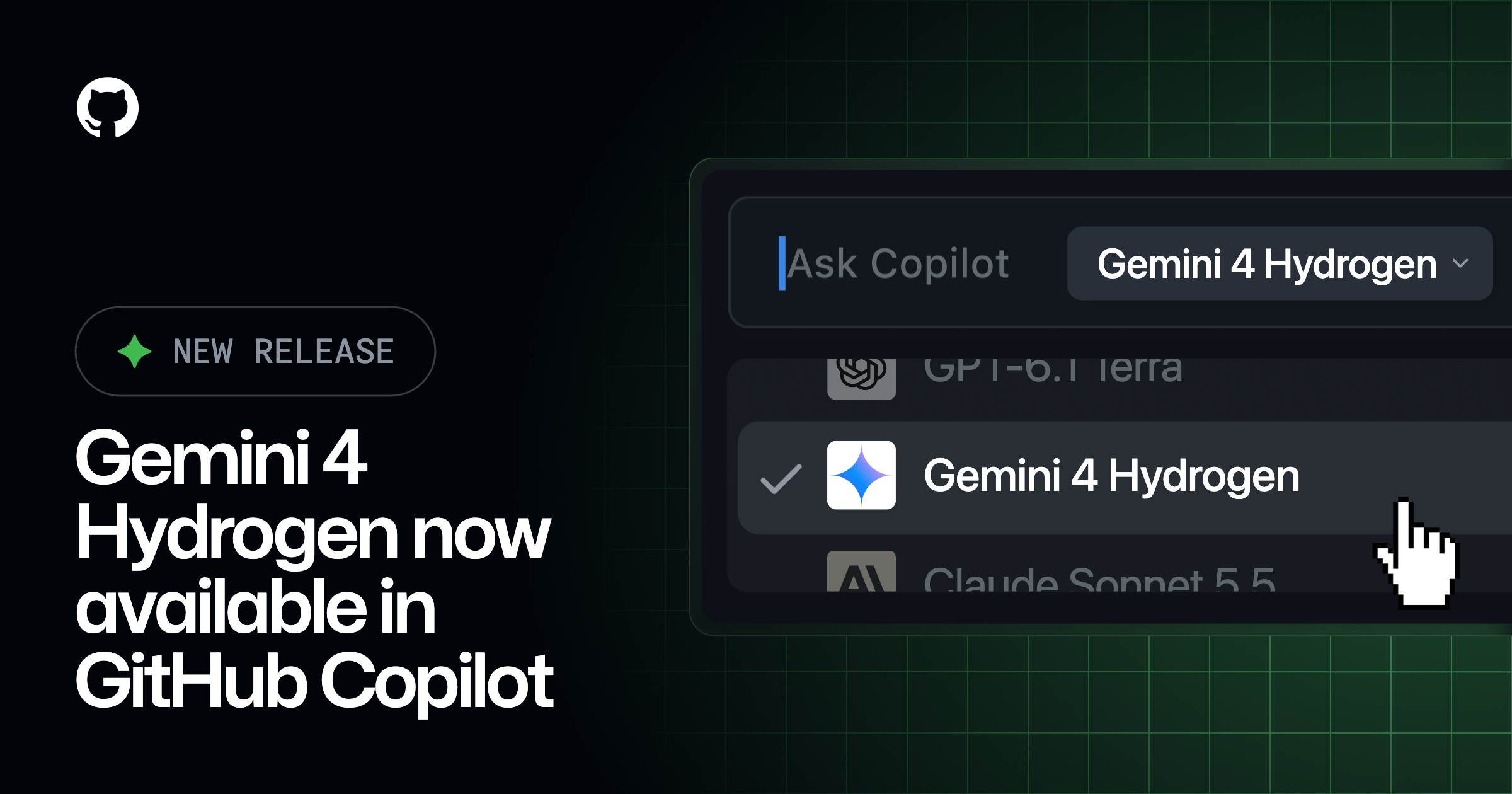
Gemini 4 Hydrogen arrives in GitHub Copilot
Google’s latest Flash model is now generally available in GitHub Copilot, targeting agentic coding and multistep workflows. It offers improved instruction following over Gemini 3.8 Flash and is billed at provider list pricing under usage-based billing. The rollout is gradual across Visual Studio Code, JetBrains IDEs, and other platforms. Administrators can manage access through model policies in Copilot settings.
GitHub Changelog