Models & Labs
Grok 4.5 Now Integrated with GitHub Copilot
GitHub Changeloghigh confidence
Why it matters
- →Grok 4.5 enhances GitHub Copilot's ability to handle complex coding tasks efficiently.
- →The model's large context window and multi-input support improve coding workflows.
- →Its integration signifies a step forward in AI-assisted coding tools.
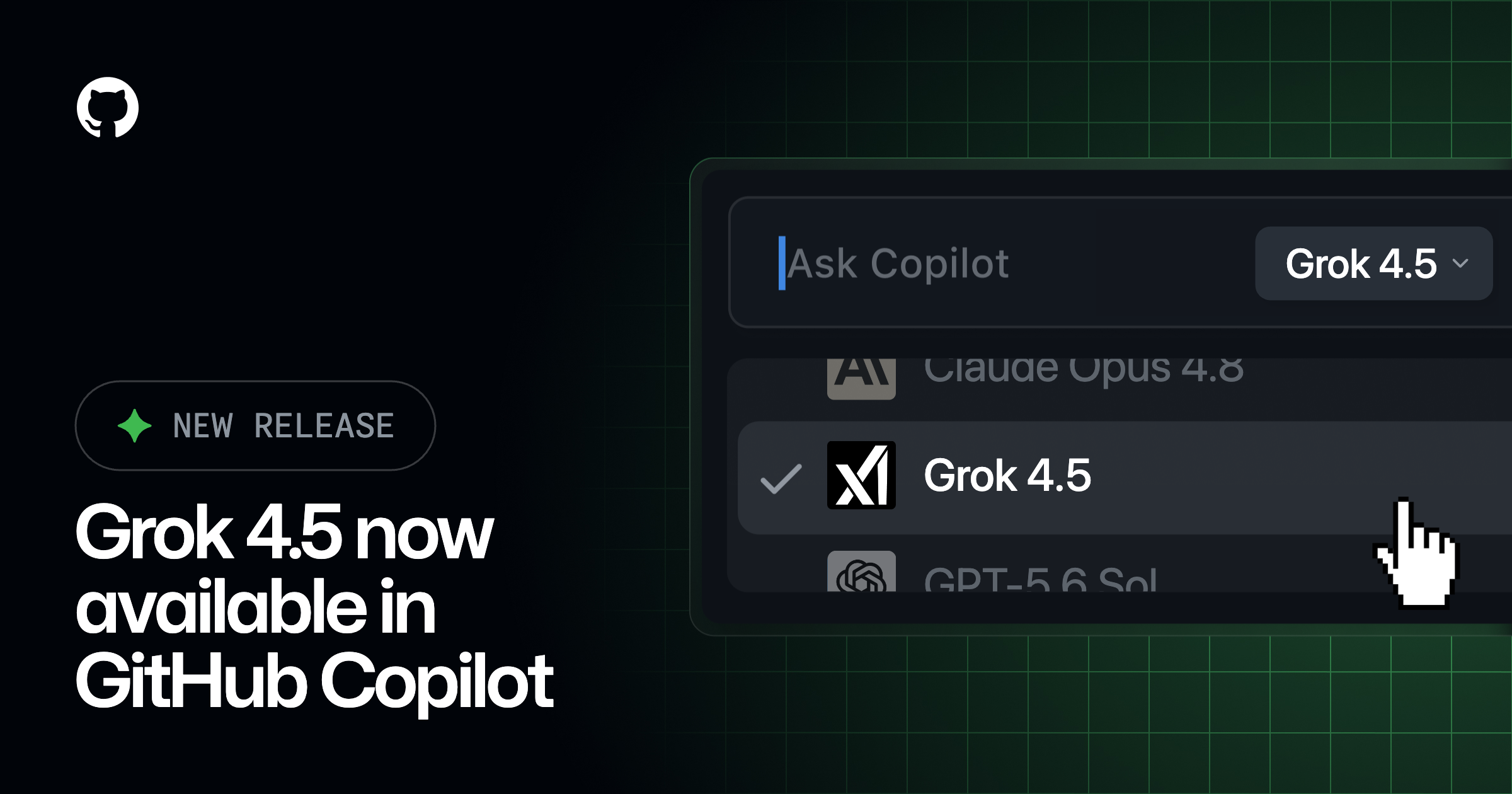
Grok 4.5, the latest reasoning model from xAI, is now available in GitHub Copilot. This model is designed to handle complex coding tasks with a context window of up to 500,000 tokens and supports both text and image inputs. It has shown strong performance in terminal-based coding tasks, particularly in Visual Studio Code and Copilot CLI. Grok 4.5 is available to various GitHub Copilot plans, including Pro and Enterprise, and requires administrators to enable it in settings. The rollout is gradual, so users should check back if they don't see it immediately.
Read originalThe story around this
Earlier coverage that leads up to this article, and what followed. Lines connect each piece to the closest one after it, converging here.
How we got here
- 1SpaceXAI and Cursor release Grok 4.5 model
The Rundown AI · July 9, 2026 · Related
- 2Grok 4.5 Model Released by x.ai
AI Explained · July 10, 2026 · Related
- 3Grok 4.5 and Cognition SWE 1.7 Focus on Coding Efficiency
The AI Daily Brief · July 10, 2026 · Related
What happened next
- 4Grok 4.6 Now Integrated with GitHub Copilot
GitHub Changelog · August 14, 2026 · Same story
- 5Grok 4.7 arrives in GitHub Copilot for agentic coding
GitHub Changelog · September 21, 2026 · Same story
More from GitHub Changelog
 © GitHub Changelog
Coding Toolscoding
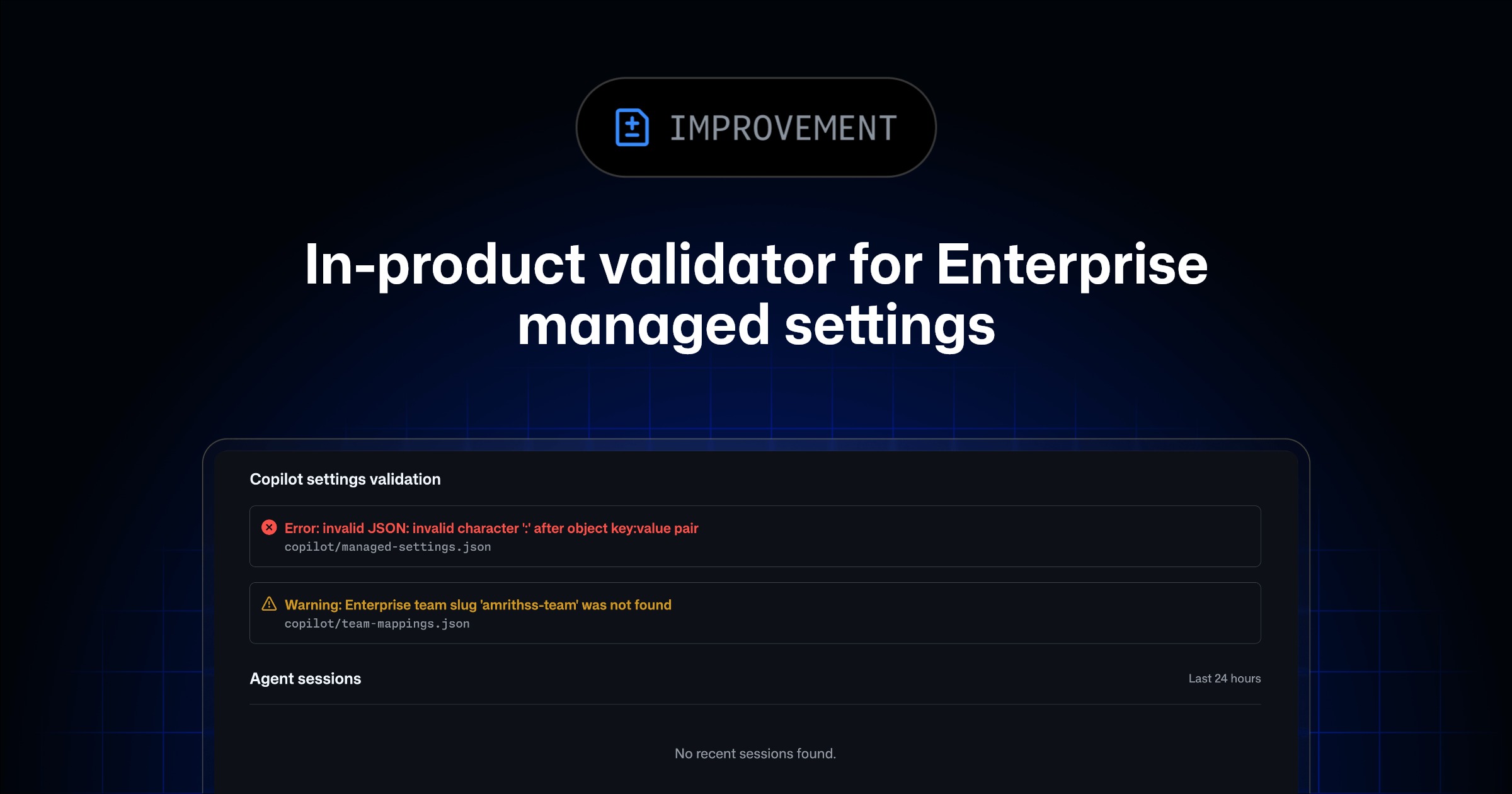
GitHub Copilot adds in-product settings validator
GitHub Copilot now validates enterprise managed settings directly in the UI, catching malformed JSON and invalid team mappings before they break policy enforcement. This shifts validation from a silent failure mode to an explicit feedback loop, saving admins from debugging why their AI controls aren't applying. By pointing to specific files and JSON paths, it reduces the friction of managing .github-private repositories at scale. It’s a pragmatic fix for a common enterprise pain point rather than a new capability.
GitHub Changelog
 © GitHub Changelog
Coding Toolscoding
GitHub Copilot metrics now track PR review stages
GitHub finally exposes the hidden latency in pull request workflows through its Copilot usage metrics API. By breaking down merge times into median and p90 durations for ready-to-first-review, first-to-final review, and final-to-merge stages, teams can pinpoint exactly where bottlenecks occur. This granular visibility distinguishes between waiting for initial attention versus lingering in approval queues, allowing for targeted process fixes rather than guessing. Since it ignores bot reviews, the data reflects genuine human collaboration speed, offering a clear signal on team efficiency.
GitHub Changelog
 © GitHub Changelog
Coding Toolscoding
Copilot Agentic Autofix Now Uses Memory
GitHub is connecting its agentic autofix to Copilot Memory, turning isolated bug fixes into institutional knowledge. Instead of patching a security alert once and forgetting it, the agent now records the resolution pattern for future use. This allows the system to preemptively handle similar vulnerabilities across the repository and share secure coding habits with other tools like code review agents. It shifts Copilot from a reactive fixer to a proactive teacher that learns your team's specific security posture over time.
GitHub Changelog
More in Models & Labs
Models & Labsother
llama.cpp b11193 adds Snapdragon Hexagon and ROCm 10
This release quietly expands llama.cpp's hardware support to include Qualcomm's Hexagon NPU on Linux arm64, a significant step for local inference on Snapdragon devices. It also updates CUDA builds to version 13.4 and introduces ROCm 10.0 binaries, keeping the project aligned with the latest NVIDIA and AMD driver ecosystems. KleidiAI on Apple Silicon is temporarily disabled in this build, likely due to stability checks rather than a feature rollback. For developers targeting edge AI or diverse GPU stacks, this update ensures broader compatibility without requiring custom compilation.
llama.cpp Releases
 © Lev Selector
Models & Labsmodels
NVIDIA NVFP4 and SoL-Pi Token Efficiency
NVIDIA introduced the NVFP4 4-bit format and SoL-Pi technology, which uses 2x fewer tokens for improved efficiency.
Lev Selector
© Lev SelectorModels & Labsmodels
Claude Opus 5.5 and GPT-6 Sol Released
Anthropic released Claude Opus 5.5 on September 22, while OpenAI launched GPT-6 Sol and Luna variants, advancing frontier model capabilities.
Lev Selector