Coding Tools
Gemini 4 Carbon arrives in GitHub Copilot
GitHub Changeloghigh confidence
Why it matters
- →Developers gain immediate access to Google’s latest reasoning model without leaving their IDE.
- →Security-focused code generation capabilities are now integrated into standard enterprise workflows.
- →Competition intensifies as Microsoft embeds rival models directly into its primary developer platform.
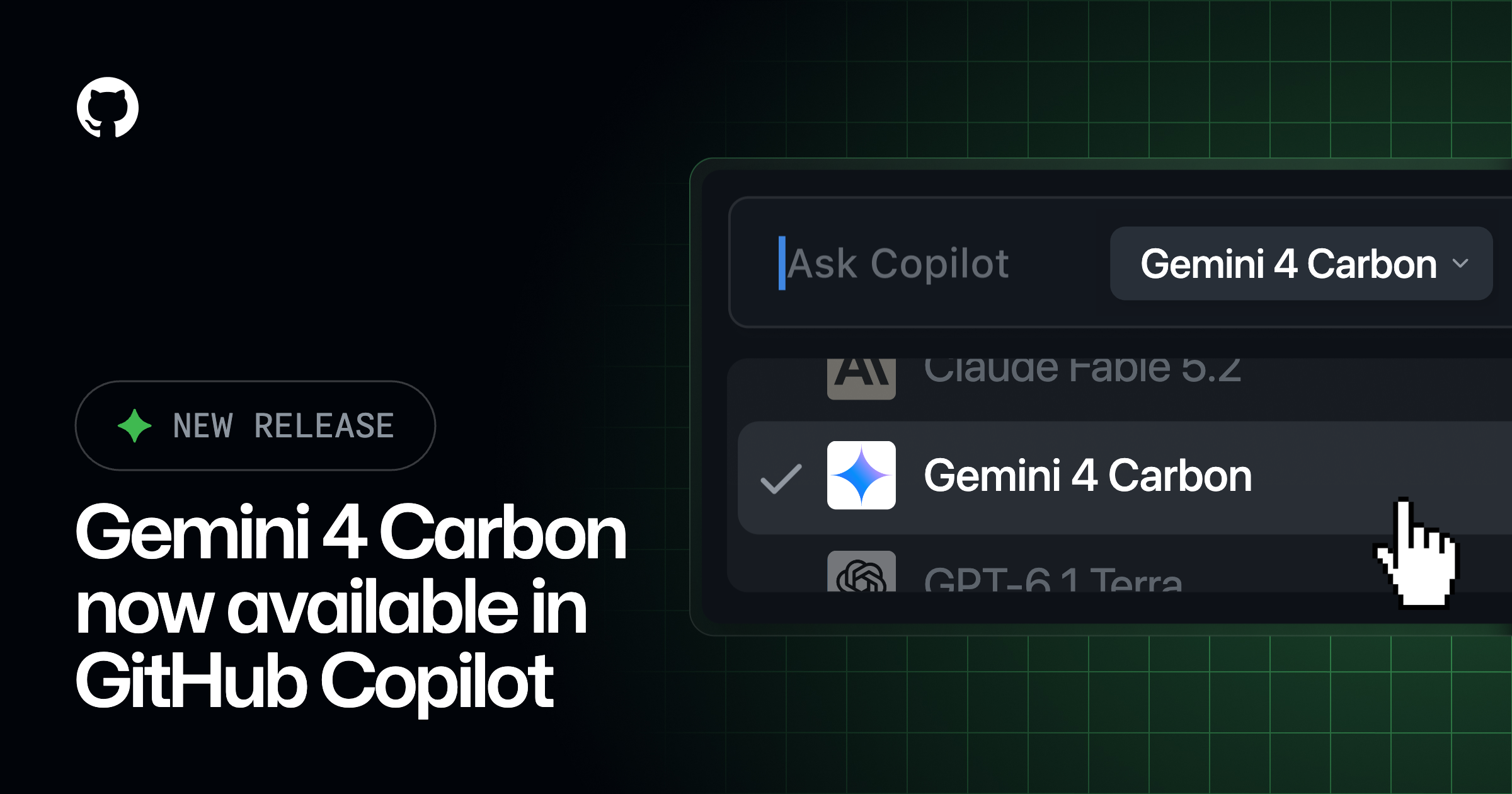
GitHub has made Google's Gemini 4 Carbon model generally available within GitHub Copilot for Pro+, Max, Business, and Enterprise users. The model is optimized for complex coding, agentic workflows, and secure code generation, accessible via the model picker in VS Code, JetBrains IDEs, Xcode, and other supported environments. Administrators can manage access through Copilot settings, with new models automatically enabled by default. This rollout expands the available AI backend options for developers using GitHub's ecosystem.
Read originalThe story around this
Earlier coverage that leads up to this article, and what followed. Lines connect each piece to the closest one after it, converging here.
How we got here
- 1Gemini 3.7 Flash Now in GitHub Copilot
GitHub Changelog · August 13, 2026 · Same story
- 2Google Gemini 4 Argon and OpenAI DevDay announcements
Wes Roth · October 1, 2026 · Related
- 3Gemini 4 Argon arrives in GitHub Copilot
GitHub Changelog · October 13, 2026 · Same story
What happened next
- 4Google Releases Gemini 4 Carbon Model
The AI Daily Brief · November 12, 2026 · Related
Follow this story
Open the full story →Google launches Gemini 4 Carbon for cybersecurity
11 developments
- Oct 28 · The Verge AI
Google launches Gemini 4 Carbon for cybersecurity - Oct 29 · Matthew Berman
Google Gemini 4 Carbon wins benchmarks↳ Gemini 4 Carbon wins recent benchmark leaderboards. - Oct 29 · The Rundown AI
Google Gemini 4 Carbon tops benchmarks - Oct 30 · The AI Daily Brief
Google's Gemini 4 Carbon Tops New AI Leaderboard - Oct 30 · Lev Selector
Google Gemini 4 Carbon Leads LM Arena Leaderboard↳ Gemini 4 Carbon tops the LMSYS Chatbot Arena leaderboard. - Oct 30 · Matt Wolfe
Google Releases Gemini 4 Carbon for Cost-Efficient Inference↳ Gemini 4 Carbon is optimized for cost-efficient inference tasks. - Nov 2 · AI Explained
Google Launches Gemini 4 Carbon for Efficiency - Nov 10 · The Verge AI
Google launches Gemini 4 Carbon with agent swarm↳ Gemini 4 Carbon includes an agent swarm feature for orchestrating multiple agents from a single prompt. - Nov 10 · Sam Witteveen
Gemini 4 Carbon Launches for General Access - Nov 10 · GitHub Changelog
Gemini 4 Carbon arrives in GitHub Copilot (This article)↳ Gemini 4 Carbon is now available in GitHub Copilot for developers. - Nov 10 · AI Explained
Google Launches Gemini 4 Carbon for High-Throughput Tasks
More from GitHub Changelog
 © GitHub Changelog
Coding Toolscoding
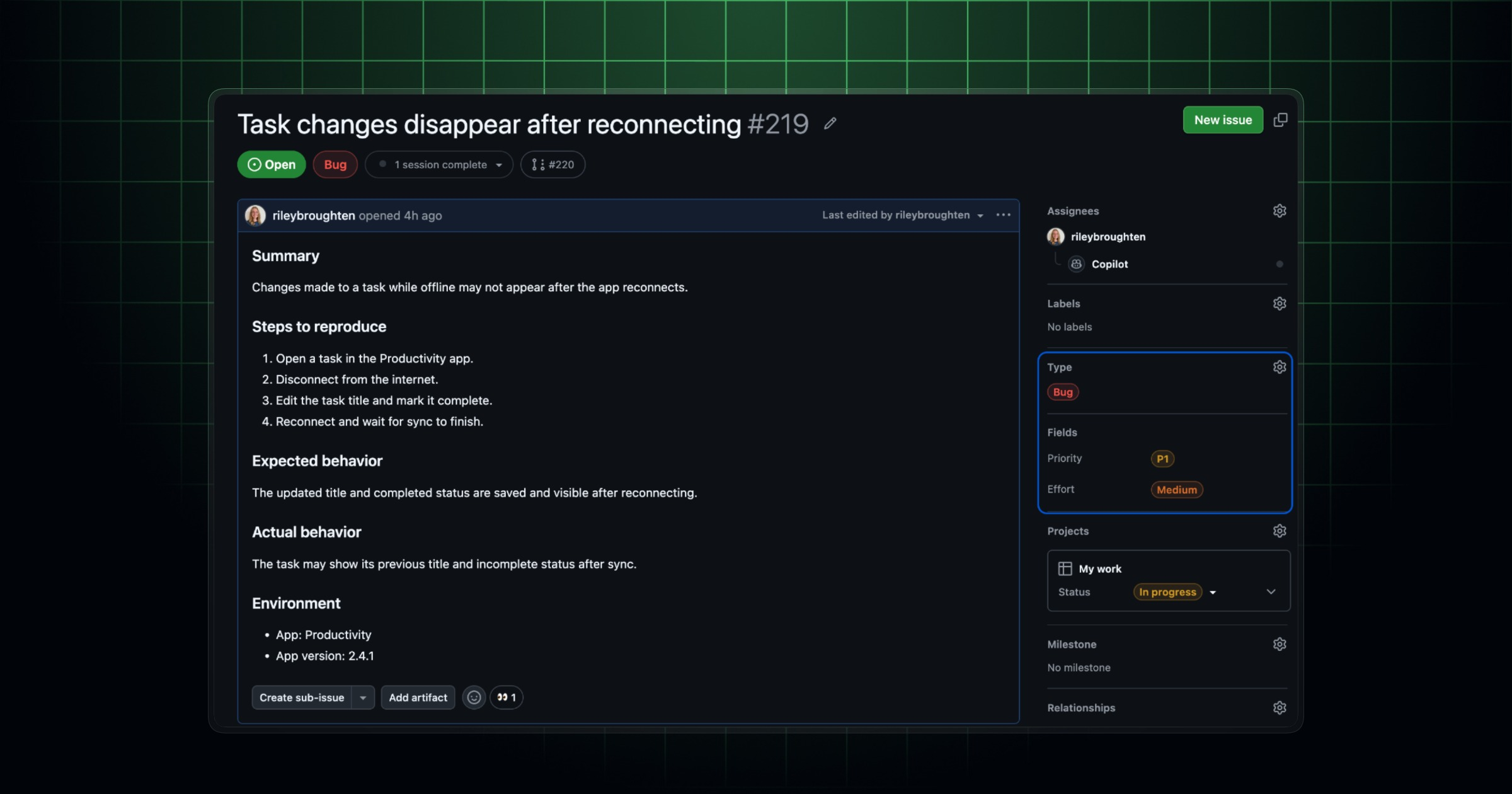
GitHub expands issue types to personal accounts
GitHub finally brings enterprise-grade planning structures to individual developers. Personal repositories now support customizable issue types and fields, allowing solo maintainers to standardize workflows with up to 25 distinct categories. This closes a long-standing gap where only organizations could enforce structured data schemas for bug tracking and feature management. The move signals that GitHub is treating personal open-source projects with the same operational seriousness as corporate codebases.
GitHub Changelog
 © GitHub Changelog
Coding Toolscoding
GitHub Apps manage Copilot seats
GitHub finally lets automation control who gets Copilot access. By adding an Enterprise Copilot license management permission, apps can now assign and revoke seats programmatically across enterprise teams. This closes the loop on automated provisioning workflows that were previously blocked by API limitations. It shifts seat management from manual admin tasks to code-driven policy enforcement.
GitHub Changelog
© GitHub ChangelogCoding Toolscoding
MSBuild auto-config in C++ language server
Microsoft finally kills the friction of manual setup for MSBuild projects in their C++ language server. By bundling the compile commands extractor directly into the tool, Copilot CLI now generates compilation databases automatically on project open. This eliminates the previous need for agents to hunt down and run separate configuration skills, saving tokens and reducing setup time. It’s a quiet but necessary fix that makes local C++ development feel as seamless as it should be.
GitHub Changelog
More in Coding Tools
Coding Toolscoding
Claude Code v2.1.323 adds experimental Code Mode and plugin safety
This release quietly introduces Code Mode, an opt-in feature where Claude writes JavaScript to call its own tools, marking a shift toward more autonomous agent-like behavior within the CLI. The update also hardens the plugin ecosystem by enforcing version ranges and adding strict TypeScript type checking for hooks, which should significantly reduce instability from third-party extensions. Beyond these features, the changelog is dominated by critical fixes for authentication drift in background sessions and memory leaks when handling large files, stabilizing the tool for heavy enterprise use.
Claude Code Releases
Coding Toolscoding
llama.cpp b12336 fixes HunyuanVL crash
This release quietly patches a critical memory overflow in the mtmd module that caused crashes when loading HunyuanVL models. The issue stemmed from F64 position embeddings overflowing an F32 buffer, a subtle bug that broke multimodal inference for users relying on this specific architecture. By enforcing strict F32 requirements, llama.cpp stabilizes support for Tencent's vision-language model without adding new features or changing the core API. It’s a necessary maintenance update that keeps local multimodal workflows from breaking unexpectedly.
llama.cpp Releases
Coding Toolscoding
llama.cpp b12343 adds qwen3.5 and ROCm 10
This release quietly extends llama.cpp’s hardware coverage with ROCm 10.0 binaries for both Linux and Windows, finally bringing AMD RDNA/CDNA users into the fold without manual compilation. The standout feature is native support for Qwen3.5 models via tensor merging during conversion, a necessary step as this new architecture gains traction in the open-source community. By shipping pre-built CUDA 13 binaries alongside the older 12.x versions, the project ensures forward compatibility with newer NVIDIA GPUs out of the box. There are no new quantization algorithms or performance breakthroughs here; it is purely an infrastructure update to keep pace with the rapidly shifting landscape of model architectures and GPU drivers.
llama.cpp Releases