Models & Labs
Grok 4.6 Now Integrated with GitHub Copilot
GitHub Changeloghigh confidence
Why it matters
- →Grok 4.6 enhances GitHub Copilot's ability to handle complex coding tasks.
- →It supports longer-horizon tasks requiring sustained reasoning and tool use.
- →This integration offers developers a more sophisticated tool for intricate projects.
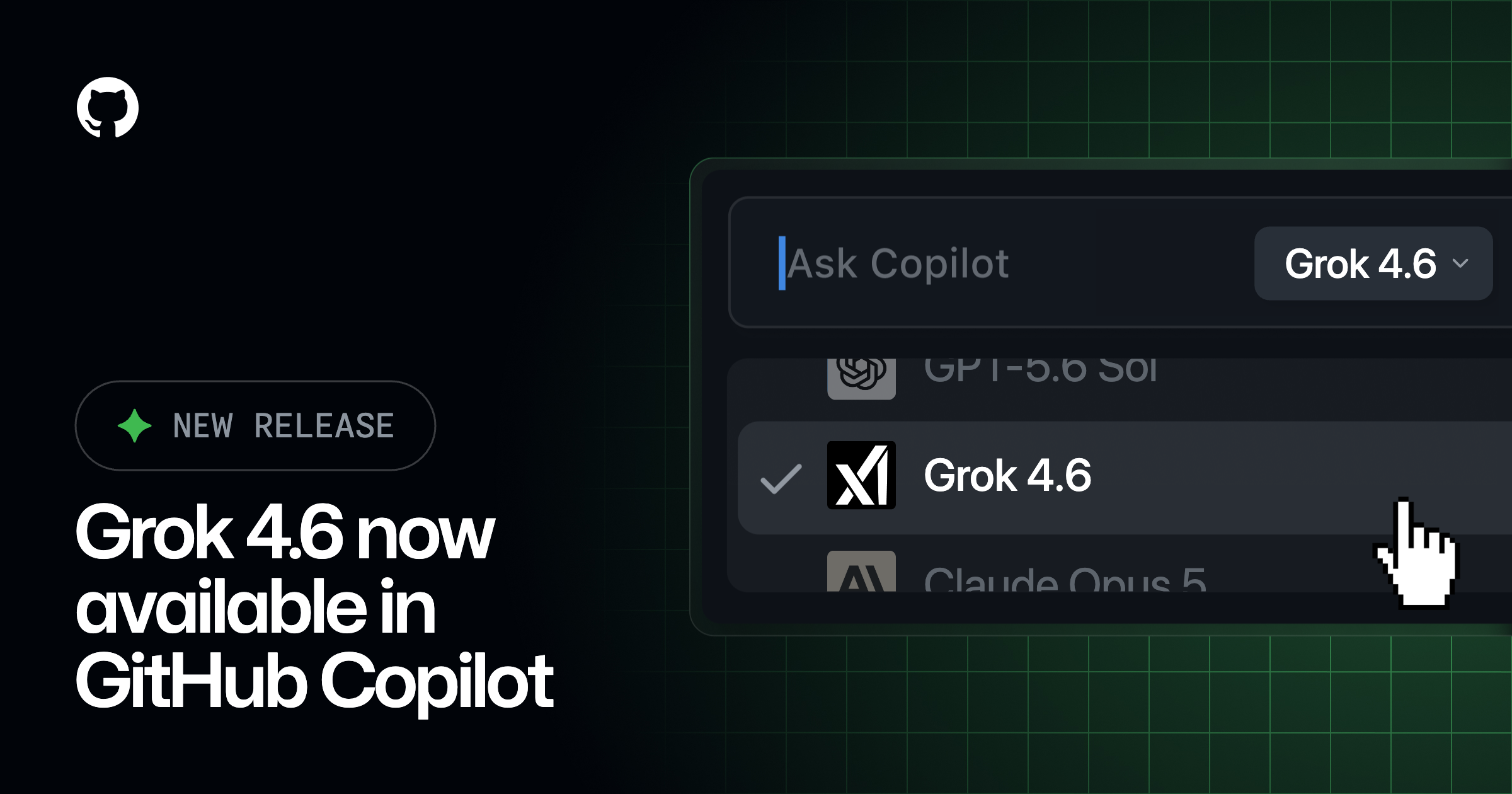
Grok 4.6, xAI's latest reasoning model, is now available in GitHub Copilot, enhancing its functionality for complex coding tasks. The model is designed for agentic coding and excels in multi-step workflows, particularly in environments like Visual Studio Code and Copilot CLI. It is available to Copilot Pro, Pro+, Max, Business, and Enterprise users, with rollout being gradual. Administrators must enable the Grok 4.6 policy in settings, as it is off by default. This integration marks a significant step in improving coding assistance for developers.
Read originalThe story around this
Earlier coverage that leads up to this article, and what followed. Lines connect each piece to the closest one after it, converging here.
How we got here
- 1GitHub Copilot App Now Supports Any Model Provider
Matt Wolfe · June 10, 2026 · Related
- 2Grok 4.5 Model Released by x.ai
AI Explained · July 10, 2026 · Related
- 3Grok 4.5 Now Integrated with GitHub Copilot
GitHub Changelog · July 28, 2026 · Same story
What happened next
- 4Grok 4.7 arrives in GitHub Copilot for agentic coding
GitHub Changelog · September 21, 2026 · Same story
More from GitHub Changelog
 © GitHub Changelog
Coding Toolscoding
GitHub adds repo-level Dependabot runner config
Dependabot finally gets granular control over where its jobs run. Repository admins can now override the organization-level default to target specific self-hosted runners or larger GitHub-hosted environments using custom labels and groups. This closes a long-standing gap for teams managing private registries or specialized build environments, allowing security updates to run in isolated contexts without affecting other workflows. While public repos and Enterprise Server are currently excluded, this is a critical step toward secure, compliant dependency scanning at scale.
GitHub Changelog
 © GitHub Changelog
Coding Toolscoding
GitHub external custom properties public preview
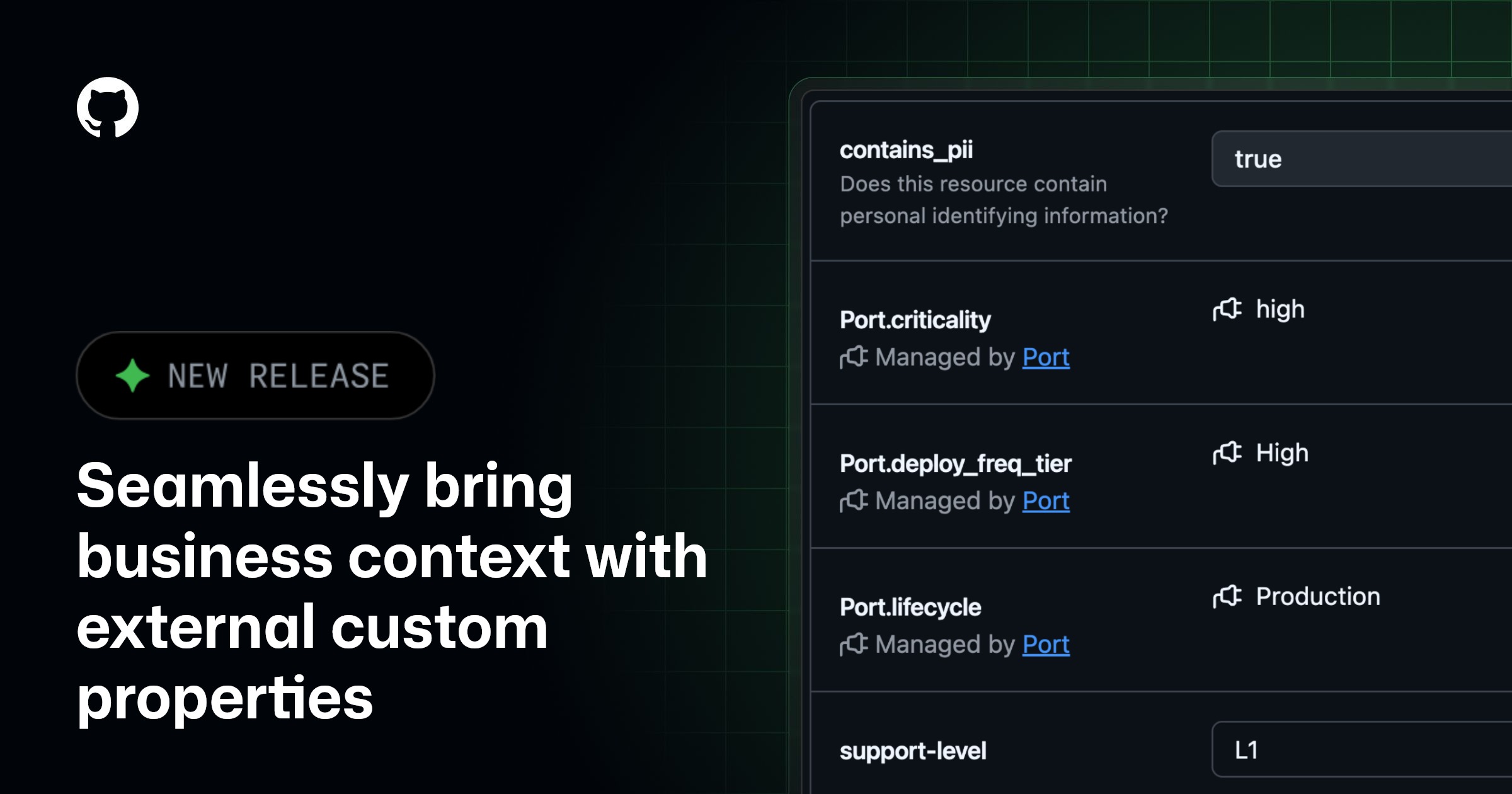
GitHub finally bridges the gap between code and corporate governance with external custom properties. By allowing systems like CMDBs to push read-only metadata—ownership, compliance status, service tiers—directly into repos, it stops developers from manually tagging repositories in silos. The real win is the dedicated namespace and strict read-only enforcement, which prevents data conflicts between GitHub’s UI and your internal source of truth. This turns repository filtering and ruleset targeting into dynamic, business-aware operations rather than static code-level checks.
GitHub Changelog
 © GitHub Changelog
Models & Labscoding
GPT-6.1 Sol arrives in GitHub Copilot
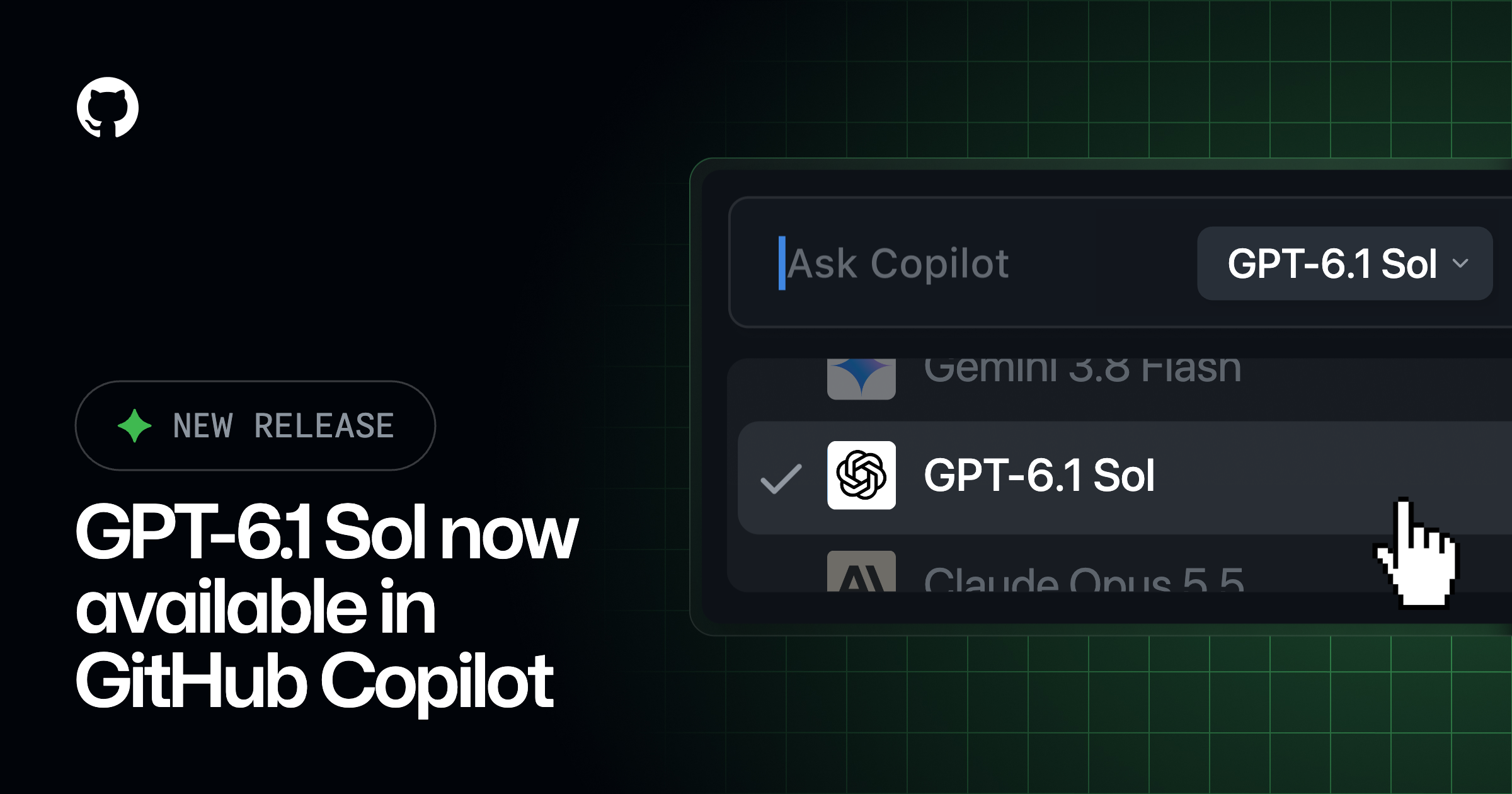
OpenAI’s GPT-6.1 Sol is now live in GitHub Copilot, targeting the sweet spot between raw power and cost efficiency. Early testing shows it completes multi-step coding tasks with significantly fewer tokens and steps than previous GPT-6 or GPT-5.6 models. This isn't just a version bump; it’s a direct response to developer fatigue over token burn rates during complex agentic workflows. Available across all major IDEs and the Copilot CLI, it shifts the baseline for what constitutes an efficient coding agent. The real win here is the reduction in friction for long-running terminal tasks.
GitHub Changelog
More in Models & Labs
 © TechCrunch AI
Models & Labsproductivity
OpenAI launches collaborative office suite features
OpenAI is directly challenging Microsoft’s dominance by embedding a full office suite into ChatGPT. The new 'Space' feature acts as a shared workspace where users and AI agents collaborate in real-time, while 'Pages' serves as an agent-native word processor. Collaborative slides allow teams to co-edit presentations generated from conversation. This marks a strategic pivot from pure chatbot utility to comprehensive workplace infrastructure, forcing incumbents to defend their core business models against an AI-native competitor.
TechCrunch AI
 © Wes Roth
Investment · $42 billion net loss
Models & Labsmodels
OpenAI delays GPT-6.1 Astra over safety risks
OpenAI has paused the release of GPT-6.1 Astra, citing significant safety concerns that outweigh its performance gains. This decision underscores a growing tension in the industry: as models become more capable, they also become harder to constrain within safe operational boundaries. While Anthropic pushes forward with Claude Sonnet 5.5 and reports massive financial losses ahead of an IPO, OpenAI is choosing caution over speed. The delay signals that safety evaluations are becoming a primary bottleneck for next-generation model releases, potentially shifting the competitive landscape toward more conservative development cycles. By halting Astra, OpenAI acknowledges that raw capability alone no longer guarantees a viable product launch. This move forces competitors to reconsider their own release timelines and safety protocols. The industry now watches closely to see if this caution becomes the new standard for frontier AI development.
Wes Roth
 © TechCrunch AI
Models & Labsproductivity
OpenAI expands ChatGPT plugins with app-like interfaces
OpenAI is shifting ChatGPT from a chat interface to an application platform by introducing dedicated sidebar panels and interactive tools for third-party developers. This move transforms static integrations into persistent, app-like experiences where users can view files and manage data without leaving the conversation. By supporting the MCP Events specification, OpenAI enables plugins to trigger automations based on external events, bridging the gap between conversational AI and workflow execution. The redesign of the plugin directory and creator tools aims to lower barriers for developers while giving users finer control over permissions. This effectively positions ChatGPT as a central hub for enterprise productivity rather than just a search or writing assistant.
TechCrunch AI