Coding Tools
Copilot API flags telemetry and version gaps
GitHub Changeloghigh confidence
Why it matters
- →Enterprise admins can now programmatically identify and fix data gaps in Copilot usage reports.
- →Distinguishes between version issues and telemetry blocks, reducing support overhead.
- →Improves accuracy of AI adoption metrics by exposing hidden inactive users.
GitHub has updated the Copilot usage metrics API to include diagnostic fields identifying users with missing client telemetry or outdated IDE/extension versions. New per-user indicators, such as client_telemetry_present and usage_metrics_requirements, appear in enterprise and organization reports, alongside daily aggregate counts for affected users. These additions allow administrators to pinpoint causes of data gaps, including disabled telemetry, version mismatches, or network restrictions, without relying on support tickets. The update is available to users with the View Copilot Metrics permission and requires the Copilot usage metrics policy to be enabled.
Read originalThe story around this
Earlier coverage that leads up to this article, and what followed. Lines connect each piece to the closest one after it, converging here.
How we got here
- 1GitHub Copilot app now in usage metrics API
GitHub Changelog · July 17, 2026 · Same story
- 2GitHub Copilot Expands Usage Metrics Reporting
GitHub Changelog · July 28, 2026 · Same story
Follow this story
Open the full story →GitHub Copilot API adds BYOK and custom model tracking
More from GitHub Changelog
 © GitHub Changelog
Coding Toolscoding
GitHub Copilot Code Review API and UI updates
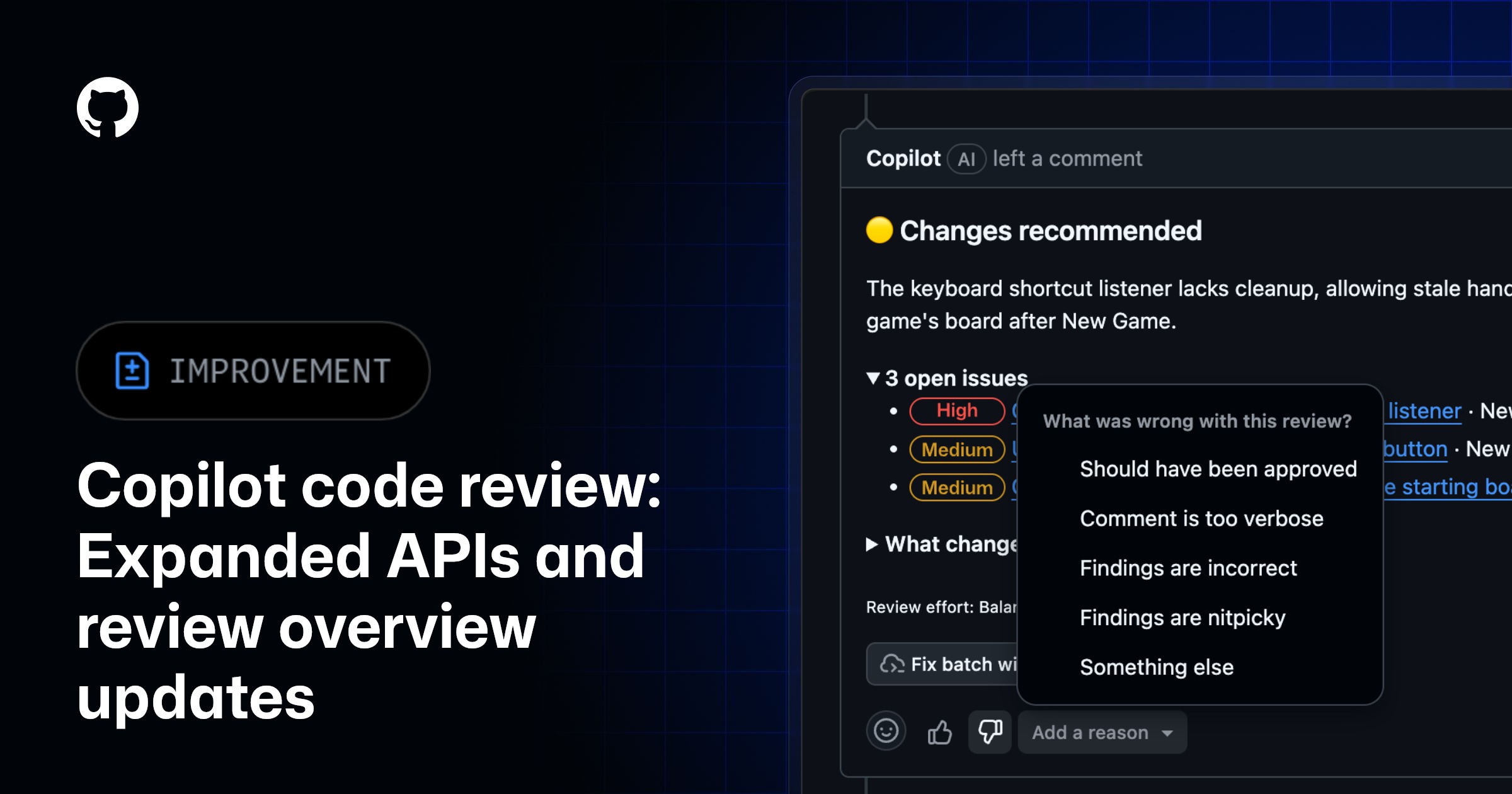
GitHub is finally exposing Copilot code review configuration to the REST and GraphQL APIs, closing a major gap for enterprise automation. Administrators can now programmatically control review effort, enablement, and custom instructions across organizations and repositories, moving beyond manual web interface tweaks. The update also refines the user experience with compact overviews, explicit attribution of AI sources like MCP servers, and better handling of bot-authored PRs. This shift makes Copilot Review a first-class citizen in CI/CD pipelines rather than just a UI feature.
GitHub Changelog
 © GitHub Changelog
More in Coding Tools
Coding Toolscoding
Claude Code v2.1.319: MCP backgrounding and gateway controls
This release finally brings proper asynchronous handling to Model Context Protocol tasks, allowing Claude Code to offload long-running tool calls to the background instead of blocking the main thread. For enterprise users, the new pooled budget rules and JSON logging make the Claude apps gateway significantly more manageable for large teams. The update also tightens error reporting in auto mode, ensuring developers get clear reasons when actions are denied rather than silent failures. It’s a pragmatic patch that improves reliability for complex agent workflows.
Claude Code Releases
Coding Toolscoding
llama.cpp b12173 adds OpenCL repeat ops
This release quietly patches a gap in llama.cpp's OpenCL backend by adding support for the 'repeat' operation across f16, i32, i16, and bf16 types. For users relying on AMD or Intel GPUs via OpenCL rather than Vulkan or ROCm, this means fewer fallbacks to slower CPU execution for models that use these tensor operations. It’s a targeted fix that improves stability and performance on non-NVIDIA hardware without changing the core inference engine. The update also includes standard binaries for CUDA 13 and ROCm 10.0, keeping the stack current with latest driver ecosystems.