Coding Tools
llama.cpp b11097 adds CUDA 13 and ROCm 10.0 support
llama.cpp Releaseshigh confidence
Why it matters
- →Users with newer NVIDIA GPUs can now use CUDA 13 binaries without compiling from source.
- →AMD ROCm 10.0 support is added, broadening compatibility for Linux-based AI workloads.
- →Side-by-side CUDA 12 and 13 builds reduce friction for developers managing mixed hardware environments.
llama.cpp has released version b11097, adding pre-compiled binaries for CUDA 13 (up to 13.4) and ROCm 10.0 across Linux and Windows platforms. The update also includes builds for OpenVINO, SYCL, and Vulkan, maintaining support for older CUDA 12 versions alongside the new releases. This expansion allows users with modern NVIDIA and AMD hardware to run local inference without manual compilation. The release reinforces llama.cpp's position as a universal runtime for diverse GPU architectures.
Read originalMore from llama.cpp Releases
Coding Toolscoding
llama.cpp adds env var control for server args
This release solves a real operational headache: configuring llama-server parameters like temperature and penalties via environment variables instead of command-line flags. By supporting LLAMA_ARG_* prefixes, it enables clean integration with systemd EnvironmentFile directives, making deployment on Linux servers significantly more robust and reproducible. The update also refreshes documentation using llama-gen-docs to keep the readme accurate. While no new inference engines are added, this is a practical step toward treating local LLM serving as standard infrastructure rather than a manual script.
llama.cpp Releases
Models & Labsother
llama.cpp b11080 release with ROCm 10 and CUDA 13
This update quietly extends llama.cpp’s hardware support to ROCm 10.0 and CUDA 13.4 across Linux and Windows, keeping the library competitive as NVIDIA pushes newer driver stacks. The test suite also gains regex filtering for backend operations, a practical improvement for developers debugging specific inference paths. While no new model architectures are introduced, this release ensures compatibility with the latest GPU ecosystems without forcing users to wait for major version bumps.
More in Coding Tools
 © GitHub Changelog
Coding Toolscoding
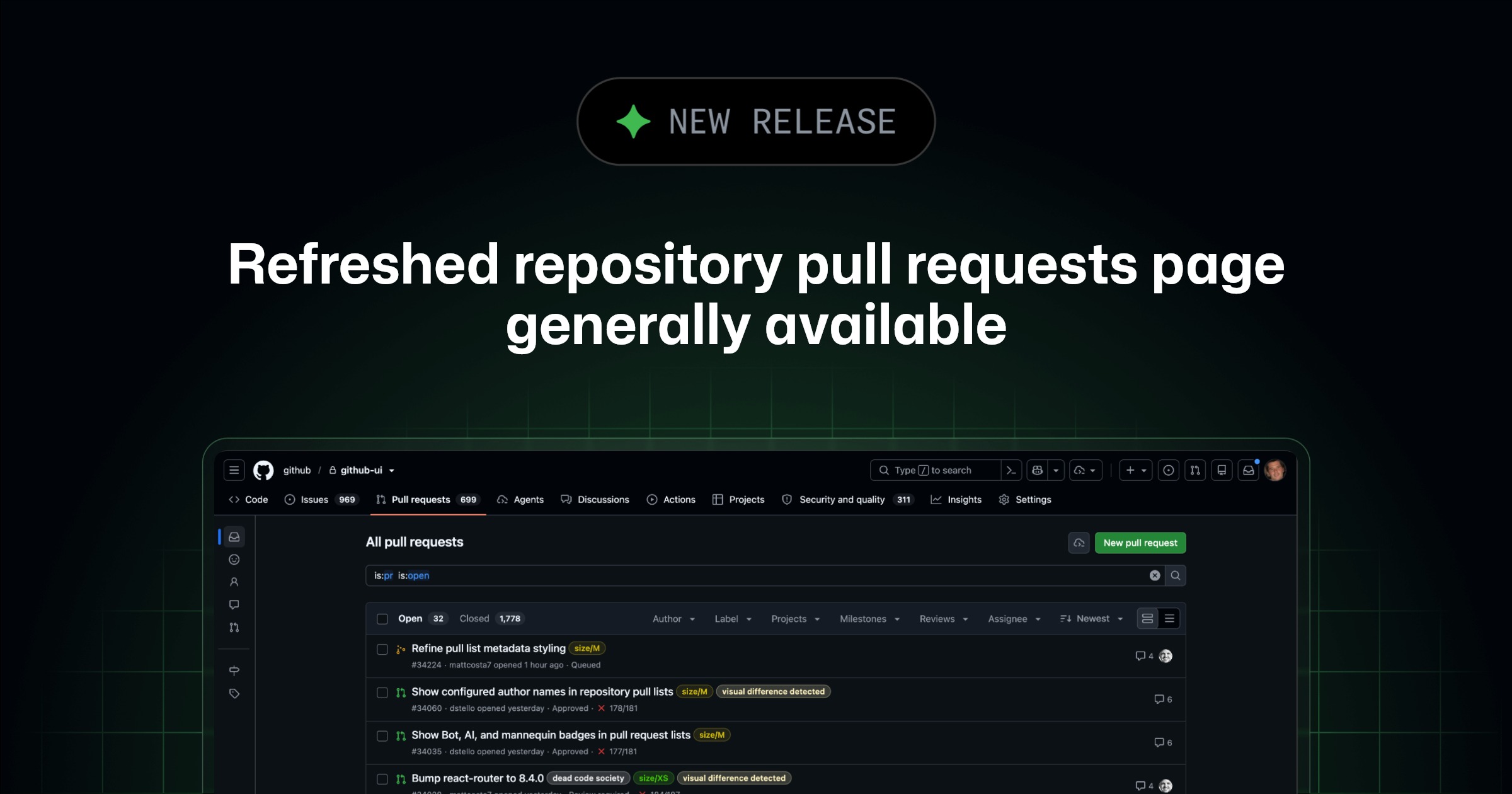
GitHub PR page GA with bulk actions
GitHub’s redesigned pull requests interface has moved from preview to general availability, shifting the focus from basic listing to active triage. The update brings bulk actions like closing or labeling multiple PRs simultaneously, a feature long requested by maintainers drowning in review queues. Advanced search now supports nested logic and AND/OR operators, while collapsible sidebars and compact modes help developers scan more context without endless scrolling. This isn't a new AI model, but it directly addresses the workflow bottleneck of code review management for millions of developers.
GitHub Changelog
 © GitHub Changelog