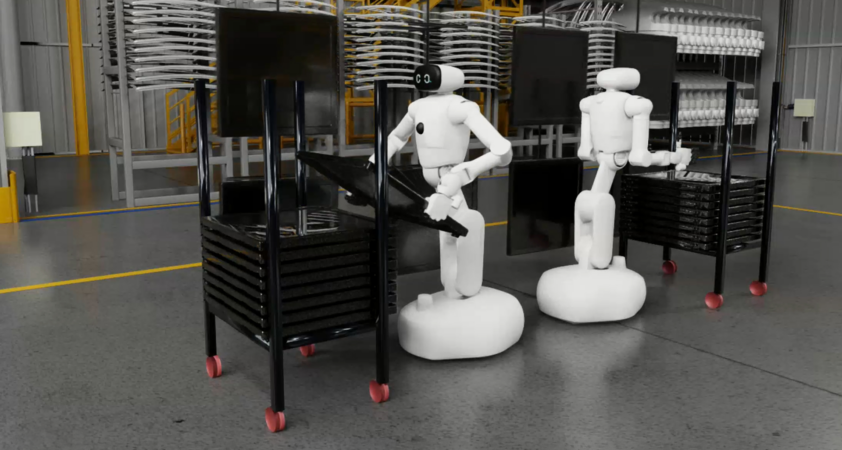
NVIDIA and LG Group are collaborating to build an AI factory designed to advance AI-driven businesses in robotics, autonomous driving, and data center technologies. This initiative combines NVIDIA's AI infrastructure with LG's manufacturing expertise to create a unified workflow for developing physical AI systems. The partnership aims to establish a new global standard for smart factories, integrating AI with real-time data connectivity. LG plans to enhance its home robots and industrial AI projects using NVIDIA's robotics frameworks, marking a significant step in AI transformation.
Read original
© NVIDIA BlogThe UK is making significant strides in its ambition to become a leader in AI, leveraging NVIDIA's technologies to build a robust AI infrastructure. This includes the deployment of Isambard-AI, the UK's most powerful computer, and the expansion of AI cloud providers. Startups like Cosine and Cursive are utilizing these resources to push the boundaries in fields such as coding and autonomous systems. NVIDIA's investment and collaboration with UK entities are fostering a thriving AI ecosystem, positioning the UK as a hub for AI innovation and development.
© NVIDIA BlogNVIDIA and Doosan Group are deepening their collaboration to enhance physical AI and AI factory infrastructure. By integrating NVIDIA's advanced computing platforms with Doosan's industrial expertise, the partnership aims to revolutionize robotics and power solutions. Doosan Robotics will leverage NVIDIA's Isaac Sim and Jetson Thor to develop more adaptable and task-specialized robots. Meanwhile, Doosan Enerbility will explore power solutions for AI factories, and Doosan Corporation Electro-Materials will support AI data centers with advanced PCB materials. This collaboration signifies a significant step towards more autonomous and efficient industrial systems.
© NVIDIA BlogNVIDIA's RTX Spark superchip is poised to revolutionize gaming and AI applications on Windows PCs, delivering exceptional performance in sleek laptops and compact desktops. By incorporating NVIDIA's latest advancements like DLSS 4.5 Ray Reconstruction, RTX Spark allows gamers to experience AAA titles with impressive resolutions and frame rates. The launch in South Korea, a pivotal region for esports and gaming, highlights its potential to reshape the industry, with leading developers such as KRAFTON and NC already integrating it into their games. This innovation not only elevates gaming experiences but also opens new avenues for AI-driven interactions within games.
© SiftedZaro, a promising startup from London, has successfully raised $5.1 million to advance its AI agent technology. The funding round, led by Cherry Ventures, also saw participation from influential figures like Thomas Wolf of Hugging Face and Thomas Dohmke of Github. This investment reflects the increasing momentum behind AI agents, as Zaro aims to simplify the creation of custom AI solutions for businesses. With this financial boost, Zaro is well-positioned to enhance its platform and expand its influence in the market. The involvement of such notable investors highlights the potential impact of Zaro's technology. This development marks a significant step forward for Zaro in the competitive AI landscape.
© TechCrunch AIApple's latest AI initiative, Siri AI, marks a significant shift in its approach to artificial intelligence. By embedding AI capabilities directly into its software, Apple aims to enhance user experience across its devices, leveraging a partnership with Google Gemini. This move positions Apple as a consumer-friendly AI company, contrasting with competitors who are heavily investing without clear consumer focus. While Siri AI won't be available until later this year, Apple's strategy of integrating AI at the operating system level could challenge competitors reliant on the App Store for distribution.
© TechCrunch AIOpenAI's confidential IPO filing represents a pivotal moment for the AI sector, potentially leading to one of the most significant public offerings of the decade. In contrast, Tools for Humanity, another venture by OpenAI CEO Sam Altman, is reportedly reducing its workforce due to revenue challenges. The company, known for its Worldcoin initiative that uses iris scans for identity verification, has encountered regulatory and ethical issues in countries like Kenya and South Korea. This situation illustrates the differing paths of Altman's ventures, with OpenAI moving towards public growth while Tools for Humanity navigates operational difficulties and international scrutiny.