Models & Labs
Musubi launches open PolicyLM for real-time moderation
TechCrunch AIhigh confidence
Why it matters
- →Decision models offer a cheaper, faster alternative to full LLMs for binary classification tasks like moderation.
- →Open-weight availability allows developers to run moderation locally without relying on external APIs.
- →The ability to update policies via prompt rather than retraining reduces operational overhead for platform managers.

Musubi has released PolicyLM-1.7B, an open-weight decision model designed for real-time content moderation. The model applies plain English policies to text in under 50 milliseconds by outputting binary judgments rather than generated text, allowing it to run at the speed and cost of traditional classifiers while maintaining LLM flexibility. Co-founder Filip Jankovic states the tool enables proactive labeling without requiring retraining when policies change, positioning it as a scalable alternative to existing moderation infrastructure.
Read originalThe story around this
Earlier coverage that leads up to this article, and what followed. Lines connect each piece to the closest one after it, converging here.
How we got here
- 1Instagram's Mosseri on AI Content in Feeds
The Verge AI · July 10, 2026 · Background
- 2Reddit Introduces AI Moderation Tools
The Verge AI · August 5, 2026 · Background
- 3Together AI Enables A/B Testing for LLMs
Together AI Blog · August 17, 2026 · Background
- 4Granite 4.2 LLMs Introduced by IBM and Hugging Face
Hugging Face Blog · August 25, 2026 · Background
- 5Hugging Face Explores Boundary-Aware AI Safety
Hugging Face Blog · September 8, 2026 · Background
- 6Together AI: Fine-tune Jev-like classifier for $17
Together AI Blog · September 23, 2026 · Background
What happened next
- 7Meta deploys LLM to detect 'signposting' in ads
TechCrunch AI · October 7, 2026 · Background
More from TechCrunch AI
 © TechCrunch AI
Investment · $90M
Market & Regulationbusiness
Nous Research raises $90M at $1.5B valuation for AI agents
Nous Research has secured a $90 million Series B round, pushing its valuation to $1.5 billion as it pivots from open-source developer tools to enterprise AI agents. Backed by heavyweights like Nvidia and Union Square Ventures, the startup aims to monetize its Hermes Agent, which already accounts for roughly 2.5% of global AI token usage. This funding signals a clear shift toward high-margin B2B deployments, targeting companies that need private, multi-step workflow automation rather than just chat interfaces.
TechCrunch AI
 © TechCrunch AI
Models & Labsagents
Microsoft launches Nvidia Spark AI PCs with agent-ready Windows 11
Microsoft is finally shipping the hardware promised alongside Nvidia’s RTX Spark chip, targeting developers who want to run local AI agents without cloud dependency. The Surface Laptop Ultra and Dev Box feature unified memory and specialized cooling designed specifically for on-device model orchestration. More importantly, Windows 11 now includes Execution Containers, a sandboxing layer that lets multiple AI agents operate safely alongside user data. This moves the platform from just hosting models to actively managing agent context and actions locally. It signals a shift where the OS itself becomes the runtime environment for autonomous software.
TechCrunch AI
 © TechCrunch AI
Agentsagents
Meta Muse expands to iPad with new connectors
Meta’s AI agent Muse hits the iPad just a month after its mobile debut, accelerating its push into personal automation. The update adds critical connectors for small businesses like Asana and QuickBooks, alongside retail partners including Best Buy and Walmart. This rapid expansion signals Meta’s intent to make Muse a central hub for both productivity and commerce. However, the agent still faces friction as websites frequently block these automated interactions. The move highlights the growing competition in the consumer AI agent space.
TechCrunch AI
More in Models & Labs
 © GitHub Changelog
Models & Labscoding
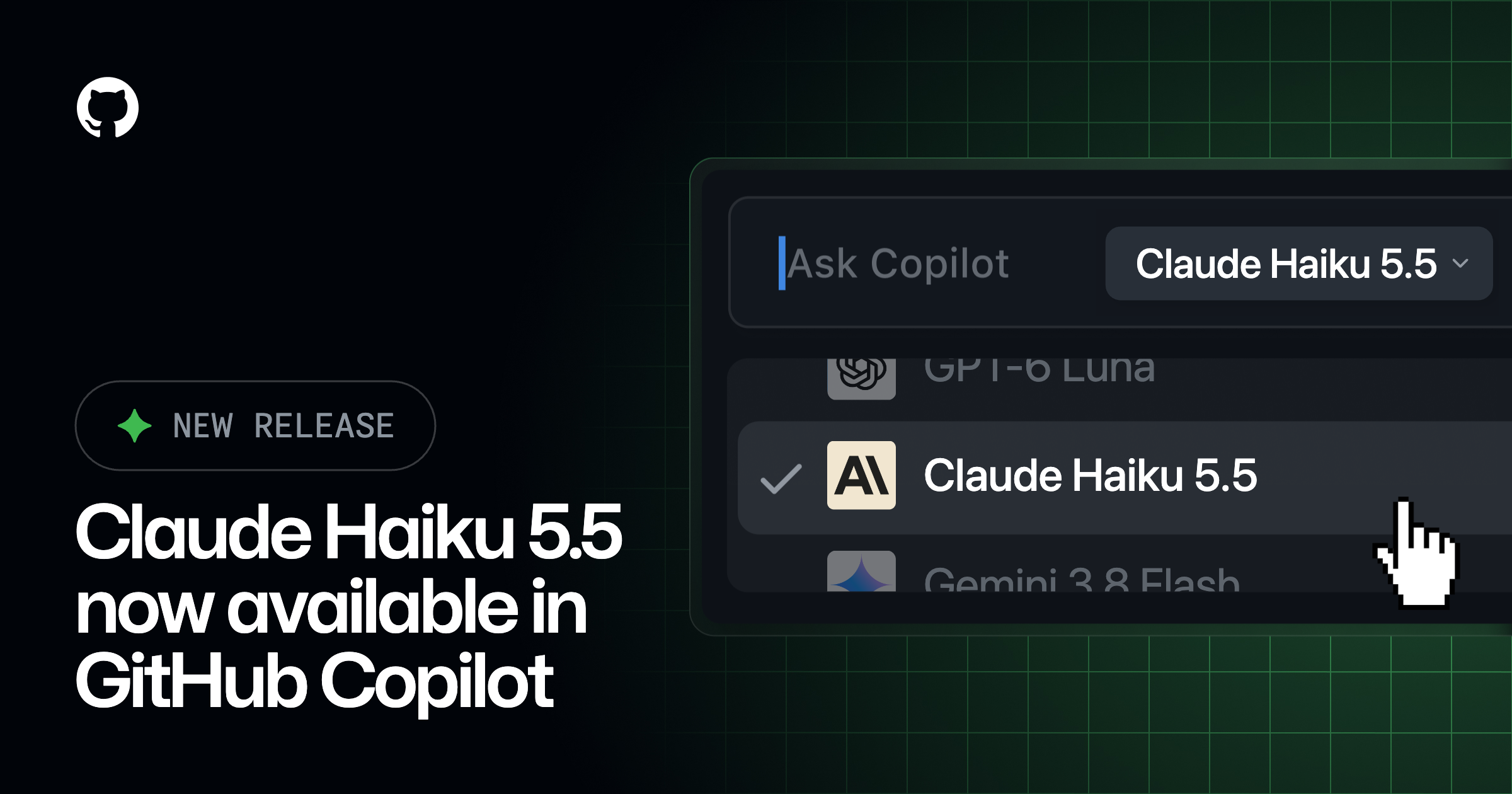
Claude Haiku 5.5 arrives in GitHub Copilot
Anthropic’s latest lightweight model is now live inside GitHub Copilot, targeting high-volume coding tasks like subagents and terminal work. Early benchmarks suggest it matches Sonnet 5 on many coding challenges while consuming significantly fewer tokens and steps. This availability across VS Code, JetBrains, and mobile apps gives developers a faster, cheaper option for routine edits without sacrificing quality. The gradual rollout means most users will see it soon, with admin controls allowing enterprises to manage access via model policies.
GitHub Changelog
 © The Verge AI
Models & Labsother
Microsoft Surface Laptop Ultra launches with Nvidia RTX Spark
The Surface Laptop Ultra marks the commercial debut of Nvidia’s RTX Spark, an Arm-based chip designed to bring serious local AI inference to Windows laptops. Starting at $2,599, this device signals a shift toward premium hardware capable of running large models locally, moving beyond cloud dependency for enterprise and creative workflows. Microsoft pairs this with 'Hybrid Intelligence' features in Copilot, allowing the agent to access local files and take OS-level actions like filing taxes or managing emails. This isn't just a new laptop; it's the first concrete proof that Arm-based PC silicon can handle the thermal and memory demands of 120B+ parameter models on-device.
The Verge AI
 © The Verge AI
Models & Labsagents
Microsoft Copilot gains local file access and OS actions
Microsoft is shifting Copilot from a chat interface to an active agent capable of manipulating local files and system settings. The new 'Hybrid Intelligence' approach combines cloud reasoning with local execution, allowing the AI to search folders, rename documents, and draft emails without leaving the desktop environment. This moves beyond simple text generation into tangible OS-level automation, effectively turning Copilot into a personal assistant that can handle multi-step workflows like tax filing preparation. The capability arrives over the next few months, marking a significant step toward autonomous desktop agents.
The Verge AI