Coding Tools
Together AI: Fine-tune Jev-like classifier for $17
Together AI Bloghigh confidence
Why it matters
- →Demonstrates that specialized classification can be cheaper and faster than prompting large foundation models.
- →Provides a reproducible pipeline for deploying task-specific AI endpoints at near-zero marginal cost.
- →Lowers the barrier to entry for developers needing deterministic, high-throughput text analysis.
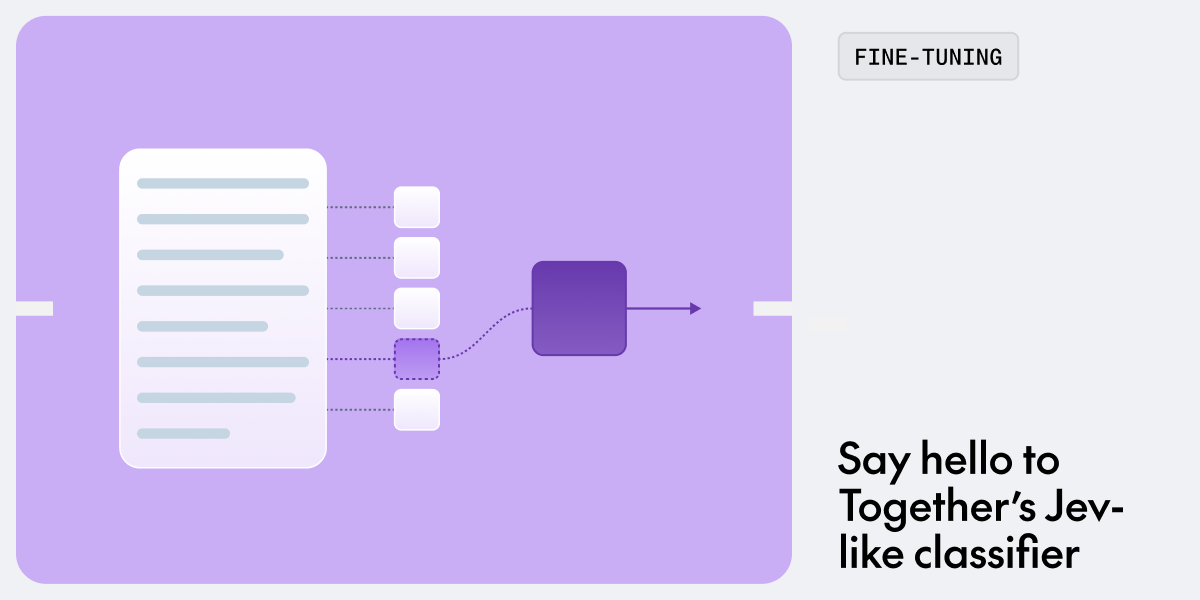
Together AI has published a tutorial on fine-tuning its Tev1-4B-experimental model, a Jev-like classifier built on Qwen3.5 4B. The process involves sampling 38,000 examples from six Hugging Face datasets to train the model for specific classification tasks like intent detection or boolean policy checks. Training takes approximately 25 minutes and costs around $17, after which the model is deployed as a dedicated HTTP endpoint on Together's serverless platform. This allows developers to integrate fast, low-cost classification directly into applications without relying on expensive general-purpose LLMs.
Read originalMore from Together AI Blog

More in Coding Tools
Coding Toolscoding
Claude Code v2.1.281 fixes session stability and adds Bedrock guardrails
This release stabilizes Claude Code's core reliability by fixing persistent bugs in session resumption and prompt caching that previously caused data loss or infinite loops. It also tightens enterprise security with new Bedrock upstream support for IAM role assumption and mandatory guardrail application. The update addresses critical edge cases like proxy stream drops and oversized tool calls, ensuring smoother operation in complex development environments.
Claude Code Releases
Coding Toolscoding
llama.cpp b11140 optimizes sparse attention on CUDA
This release targets a specific bottleneck in long-context inference by optimizing the sparse flash attention prefill step for NVIDIA GPUs. By templating kernels to unroll loops at compile time, batched sparse operations drop from 586 microseconds to 244 microseconds on 49k context windows. This isn't just a generic speed bump; it makes handling very long documents significantly more efficient for users relying on sparse attention mechanisms. The change is already baked into the standard CUDA builds, requiring no special flags.
llama.cpp Releases
Coding Toolscoding
llama.cpp b11146 adds CUDA 13 and Snapdragon support
The latest llama.cpp build brings immediate relevance to users on bleeding-edge NVIDIA hardware with native CUDA 13.4 support across Linux and Windows, closing the gap for those testing next-gen GPU architectures. More notably, it finally addresses the mobile inference landscape by including a dedicated build for Linux arm64 Snapdragon devices, covering CPU, Adreno GPU, and Hexagon NPU paths. This moves local AI beyond just desktop GPUs into the realm of high-performance edge computing on Qualcomm silicon. While Apple Silicon builds have KleidiAI disabled in this specific release, the expansion to ARM-based mobile NPUs marks a significant shift in where llama.cpp can run efficiently.
llama.cpp Releases