Models & Labs
Together AI Enables A/B Testing for LLMs
Together AI Bloghigh confidence
Why it matters
- →Enables precise measurement of model performance with real user data.
- →Simplifies traffic routing and experiment management at the endpoint level.
- →Facilitates data-driven decisions for optimizing AI model deployments.
Together AI has launched a new A/B testing feature for large language models in production environments. This tool allows developers to split live traffic between a control model and up to 20 variants, enabling real-world performance comparisons based on user engagement metrics. The platform handles traffic routing at the endpoint level, simplifying the process and avoiding complex client-side configurations. This advancement provides a streamlined approach for teams to assess and improve AI models based on actual user interactions, ensuring more effective deployment decisions.
Read originalThe story around this
Earlier coverage that leads up to this article, and what followed. Lines connect each piece to the closest one after it, converging here.
How we got here
- 1TML Unveils Real-Time AI Interaction Models
The Rundown AI · May 12, 2026 · Related
- 2OpenAI Unveils Deployment Simulation for AI Models
OpenAI · June 16, 2026 · Background
- 3OpenAI and Broadcom unveil LLM-optimized chip
OpenAI · June 24, 2026 · Related
- 4vLLM v0.25.0rc2 Release Fixes Key Issues
vLLM Releases · July 9, 2026 · Related
- 5Together AI Enhances Model Inference Configuration
Together AI Blog · July 29, 2026 · Same story
- 6Together AI Introduces Autoscaling for LLM Inference
Together AI Blog · July 31, 2026 · Same story
- 7LFM2.5-2.6B: Efficient AI Agents for Local Deployment
Hugging Face Blog · August 4, 2026 · Related
- 8Startups Innovate Beyond Transformers in LLMs
MIT Technology Review AI · August 10, 2026 · Background
What happened next
- 9Qwen3.8-27B Model Explored and Optimized
Sam Witteveen · August 18, 2026 · Background
- 10Granite 4.2 LLMs Introduced by IBM and Hugging Face
Hugging Face Blog · August 25, 2026 · Related
- 11Google's ToolGrad Enhances Tool-Use Dataset Generation
Google Research Blog · September 10, 2026 · Background
- 12Top AI Leaders Call for Slowdown in LLM Development
MIT Technology Review AI · September 14, 2026 · Background
- 13llama.cpp v0.6.0 adds decision model API and Apple Silicon speedups
llama.cpp Releases · October 6, 2026 · Background
More from Together AI Blog
More in Models & Labs
 © TechCrunch AI
Models & Labsagents
Microsoft launches Nvidia Spark AI PCs with agent-ready Windows 11
Microsoft is finally shipping the hardware promised alongside Nvidia’s RTX Spark chip, targeting developers who want to run local AI agents without cloud dependency. The Surface Laptop Ultra and Dev Box feature unified memory and specialized cooling designed specifically for on-device model orchestration. More importantly, Windows 11 now includes Execution Containers, a sandboxing layer that lets multiple AI agents operate safely alongside user data. This moves the platform from just hosting models to actively managing agent context and actions locally. It signals a shift where the OS itself becomes the runtime environment for autonomous software.
TechCrunch AI
 © GitHub Changelog
Models & Labscoding
Claude Haiku 5.5 arrives in GitHub Copilot
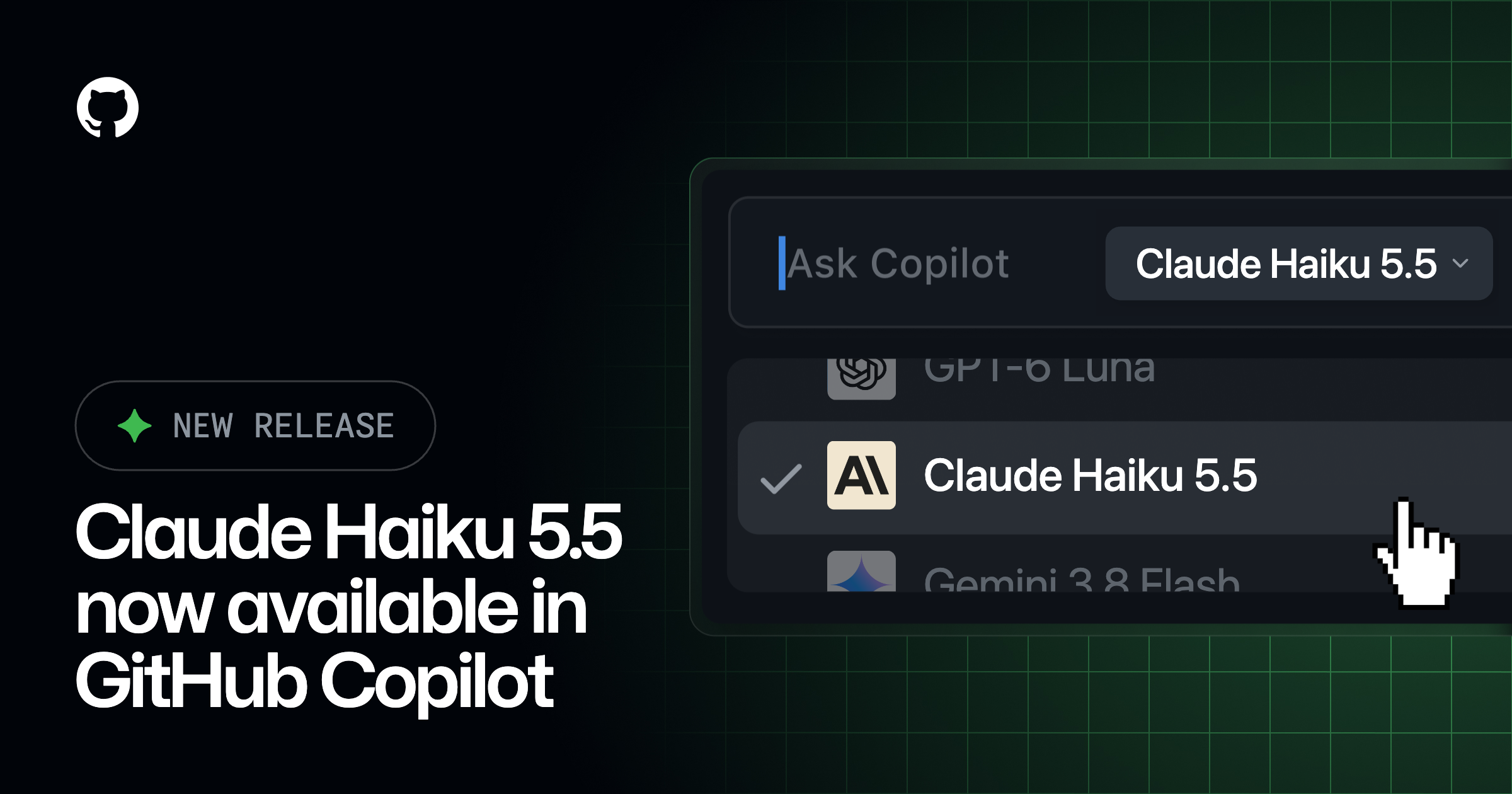
Anthropic’s latest lightweight model is now live inside GitHub Copilot, targeting high-volume coding tasks like subagents and terminal work. Early benchmarks suggest it matches Sonnet 5 on many coding challenges while consuming significantly fewer tokens and steps. This availability across VS Code, JetBrains, and mobile apps gives developers a faster, cheaper option for routine edits without sacrificing quality. The gradual rollout means most users will see it soon, with admin controls allowing enterprises to manage access via model policies.
GitHub Changelog
 © The Verge AI
Models & Labsother
Microsoft Surface Laptop Ultra launches with Nvidia RTX Spark
The Surface Laptop Ultra marks the commercial debut of Nvidia’s RTX Spark, an Arm-based chip designed to bring serious local AI inference to Windows laptops. Starting at $2,599, this device signals a shift toward premium hardware capable of running large models locally, moving beyond cloud dependency for enterprise and creative workflows. Microsoft pairs this with 'Hybrid Intelligence' features in Copilot, allowing the agent to access local files and take OS-level actions like filing taxes or managing emails. This isn't just a new laptop; it's the first concrete proof that Arm-based PC silicon can handle the thermal and memory demands of 120B+ parameter models on-device.
The Verge AI