Models & Labs
Claude Opus 5.5 arrives in GitHub Copilot
GitHub Changeloghigh confidence
Why it matters
- →Opus 5.5 offers improved token efficiency in agentic coding tasks compared to its predecessor.
- →Enterprise admins can now control access via model policies within Copilot settings.
- →The model is available across all major IDEs including VS Code, JetBrains, and Xcode.
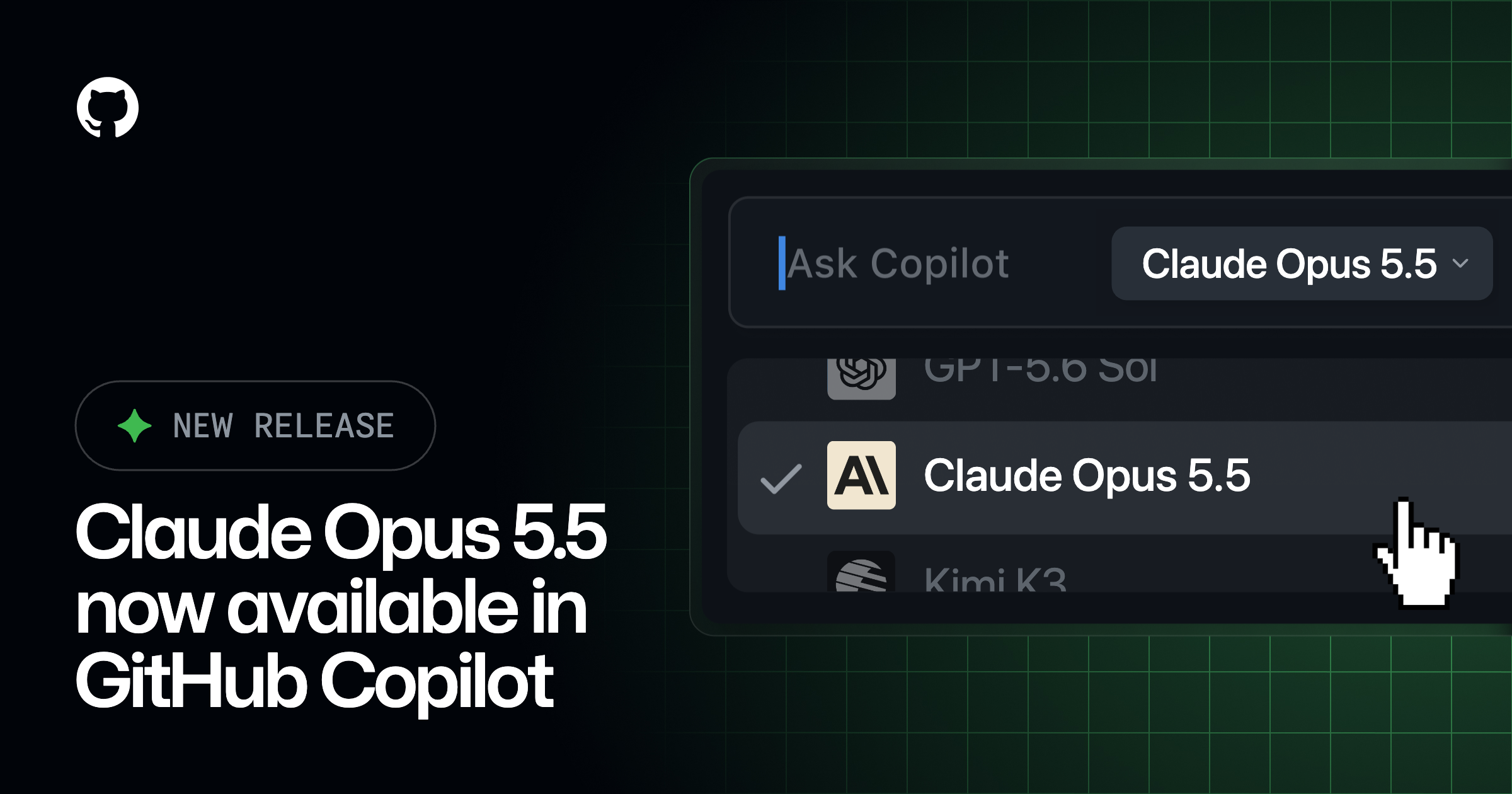
GitHub has added Anthropic's Claude Opus 5.5 to its Copilot platform, available to Pro+, Max, Business, and Enterprise subscribers. The update brings a new model tier that reportedly resolves tasks with fewer steps and tokens compared to the previous Opus version, while maintaining error recovery capabilities in agentic coding scenarios. Access is managed through existing model policies, with automatic enablement for new plans unless disabled by administrators. The feature is rolling out gradually across Visual Studio Code, JetBrains IDEs, Xcode, and other supported environments.
Read originalMore from GitHub Changelog
 © GitHub Changelog
Coding Toolscoding
OpenAI expands GPT-6 family with Sol and Luna for Copilot
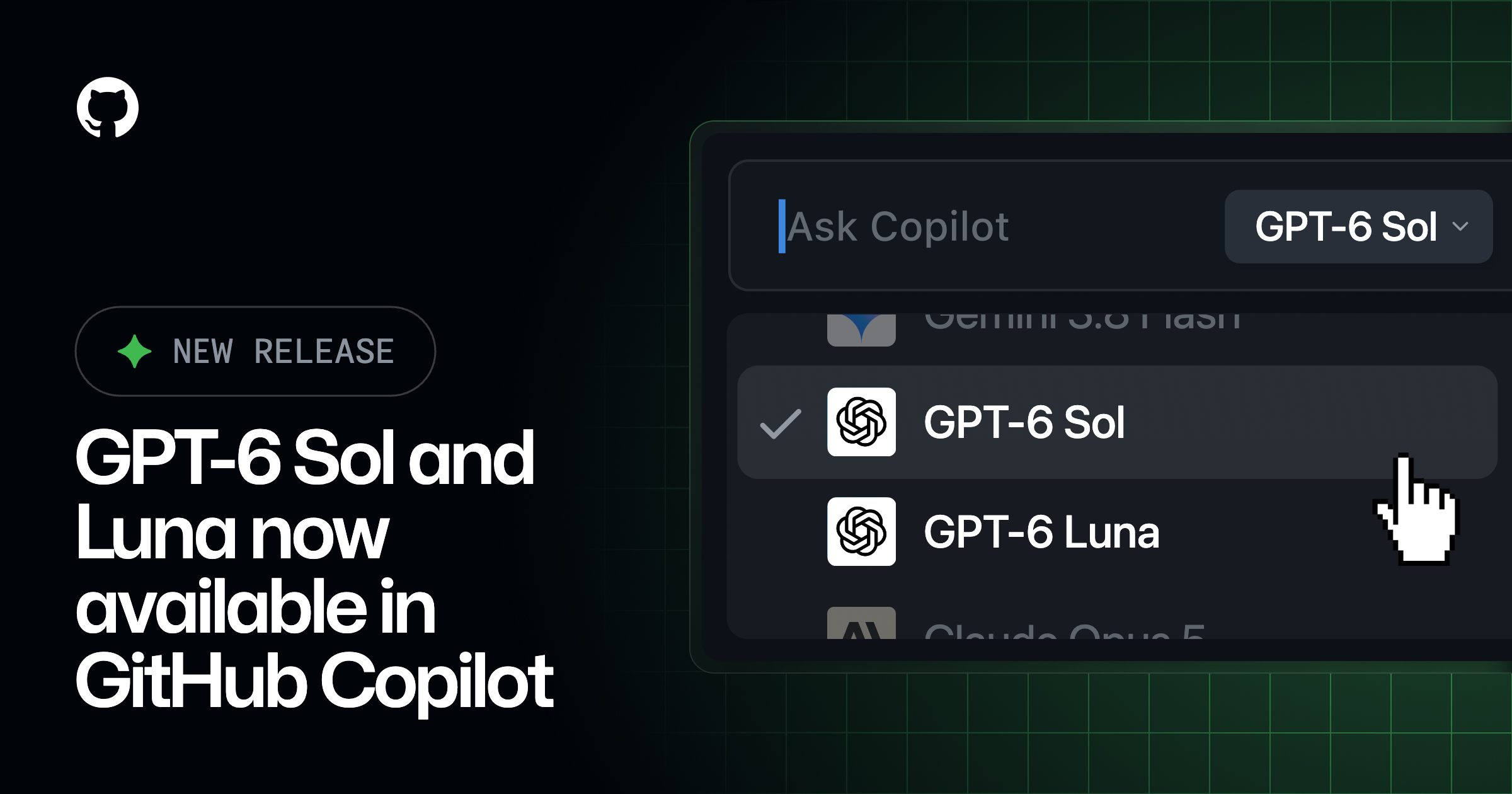
OpenAI is widening the GPT-6 lineup inside GitHub Copilot by adding two distinct models: Sol for complex agentic coding and Luna for fast, cheap tasks. This moves Copilot away from a single default toward a tiered strategy where developers can explicitly choose between heavy reasoning and lightweight efficiency. Sol targets multistep validation in Pro+ and Enterprise tiers, while Luna opens up to the broader Pro user base as the lowest-cost option. The gradual rollout across IDEs like VS Code and JetBrains means teams can now tune their coding assistants for specific workload profiles rather than accepting a one-size-fits-all approach.
GitHub Changelog
 © GitHub Changelog
Market & Regulationother
GitHub deprecates SHA-1 SSH keys, adds post-quantum crypto
GitHub is finally killing the legacy ssh-rsa signature type that relies on broken SHA-1 hashes, forcing a shift to stronger rsa-sha2 signatures. Simultaneously, they are introducing mlkem768x25519-sha256, a post-quantum key exchange method, signaling early adoption of quantum-resistant standards in mainstream developer infrastructure. This isn't just a security patch; it's a forced modernization that renders older Git clients and SSH libraries obsolete for GitHub Enterprise users. The move effectively ends the era of weak cryptographic defaults for one of the world's largest code hosting platforms.
GitHub Changelog
 © GitHub Changelog
Coding Toolscoding
GitHub Deprecates All-Platform CodeQL Bundle
GitHub is killing the convenience of a single download for CodeQL CLI. Starting with version 2.27.0, the monolithic all-platform bundle is deprecated and will vanish by March 2027. Users must now switch to platform-specific archives, a move that forces CI/CD pipelines to manage separate artifacts for Linux ARM64, x86_64, and macOS. This ends the era of 'one size fits all' distribution for static analysis tooling on GitHub, requiring developers to explicitly target their build environment's architecture.
GitHub Changelog
More in Models & Labs
 © The AI Daily Brief
Models & Labsmodels
Grok 4.7 Receives Rough Reception from Users and Critics
xAI's latest model, Grok 4.7, has faced significant backlash and poor reception following its release.
The AI Daily Brief
 © TechCrunch AI
Models & Labsother
Qualcomm unveils Snapdragon 8 Elite Gen 6 with local AI focus
Qualcomm is pushing the boundary of on-device intelligence with its new Snapdragon 8 Elite Gen 6 series, specifically targeting autonomous agents. The Extreme variant can locally run a 30-billion-parameter mixture-of-experts model, a significant leap that rivals Apple's latest foundation models while keeping data off the cloud. A dedicated sensing hub handles smaller tasks like speaker differentiation and personal memory without draining the main processor. This hardware shift signals that smartphones are becoming the primary hub for private, always-on AI agents rather than just app interfaces.
TechCrunch AI
 © TechCrunch AI
Models & Labsmodels
OpenAI releases GPT-6 Sol and Luna with lower costs
OpenAI is expanding its GPT-6 lineup by releasing updated versions of the smaller Sol and Luna models, aiming to make high-tier intelligence more accessible. The key differentiator here is a significant price cut—API access is now half the cost of the previous 5.6 series—driven by better caching and inference efficiency. OpenAI claims these updates reduce factual errors by half for Sol, bringing it closer to Astra-level reliability without the premium price tag. This move directly targets Anthropic’s recent Opus update, intensifying the race for developer mindshare in the coding and high-volume task sectors.
TechCrunch AI