Models & Labs
Claude Opus 4.8 now in GitHub Copilot
GitHub Changeloghigh confidence
Why it matters
- →Claude Opus 4.8 enhances code understanding and generation, improving developer productivity.
- →The model's ability to handle complex problems and large codebases is a significant advancement.
- →Its integration into GitHub Copilot across multiple platforms broadens accessibility for developers.
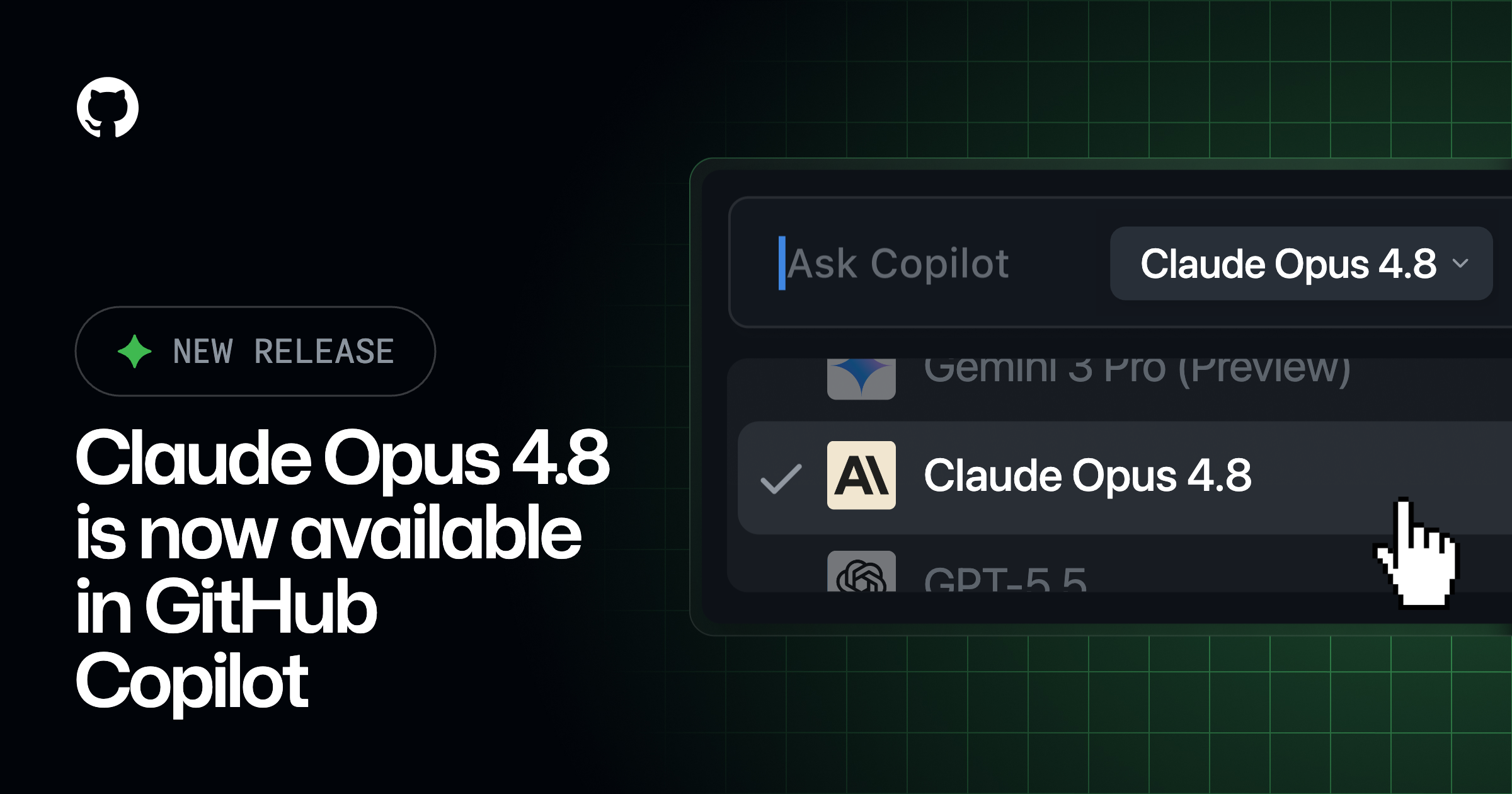
Anthropic's Claude Opus 4.8 model is now available in GitHub Copilot, offering improved code understanding and generation capabilities. This model is particularly adept at handling complex problem-solving and navigating large codebases. It is accessible to Copilot Pro+, Business, and Enterprise users across multiple platforms such as Visual Studio Code and JetBrains. The rollout will be gradual, and users are encouraged to check back if they don't see it immediately. This integration aims to enhance the coding experience for developers using GitHub Copilot.
Read originalMore from GitHub Changelog

More in Models & Labs
Models & Labsmodels
llama.cpp b10955 release addresses heap corruption
The latest release of llama.cpp, b10955, tackles a critical issue of heap corruption by disabling the ggml-cpu precompiled header and fixing CACHE_LINE_SIZE ambiguity. This update ensures consistent CACHE_LINE_SIZE values across C++ kernels and C work-buffer sizing code, preventing heap-buffer-overflow and subsequent crashes. By restoring the natural include order and removing the std::hardware_destructive_interference_size branch, the update makes the value deterministic and include-order independent. This release is a technical fix that stabilizes the runtime environment for developers using llama.cpp.
llama.cpp Releases
Models & Labsmodels
llama.cpp b10956 release enhances SYCL backend
The latest llama.cpp release, b10956, introduces significant improvements to the SYCL backend, particularly for handling large k values in TOP_K operations. By implementing a radix select method, the update allows for efficient GPU-resident processing, avoiding previous limitations that forced operations to fall back to the CPU. This change enhances performance, especially in scenarios requiring large k values, such as qwen4exp's sparse-attention indexer. The update ensures that operations are more efficient and scalable, providing a notable boost in processing speed without regressing any measured shapes.