Research
Ataraxos AI beats top human Stratego players
MIT News AIhigh confidence
Why it matters
- →Ataraxos achieves superhuman performance in Stratego, a complex game of hidden information.
- →The system uses significantly less computational resources than previous state-of-the-art models.
- →It demonstrates generalizability to other imperfect-information games like Hanabi and Dou dizhu.
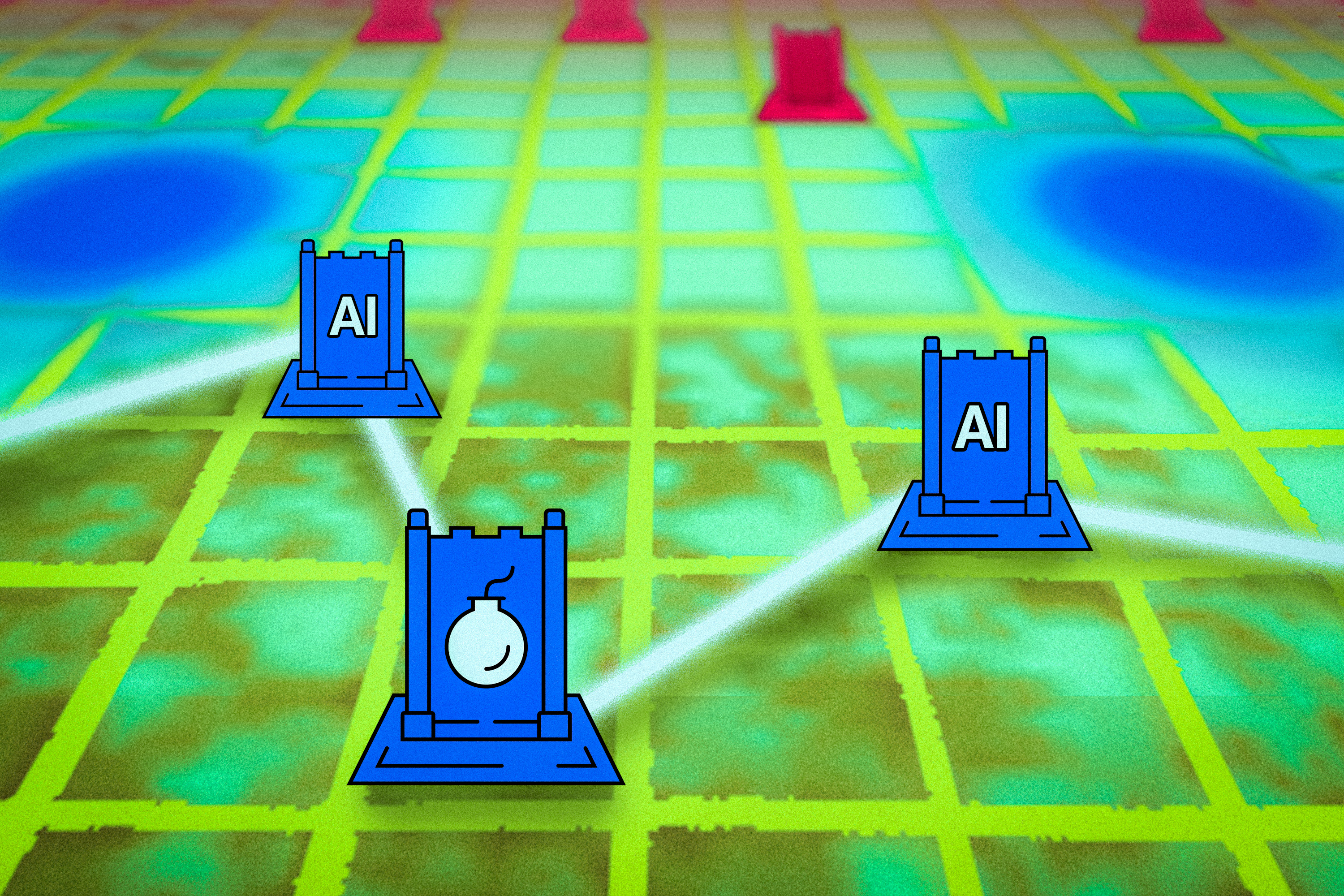
Researchers from MIT, Carnegie Mellon, NYU, and Stanford have developed Ataraxos, an AI system that achieves superhuman performance in the board game Stratego. Published in Nature, the system combines self-play reinforcement learning with decision-time planning using a generative model to estimate hidden piece identities. Ataraxos defeated top human players with a 39-2 record and outperformed DeepMind’s previous best model while using significantly fewer training examples. The team also demonstrated the system's generalizability by achieving superhuman results in other imperfect-information games like Hanabi and Dou dizhu.
Read originalThe story around this
Earlier coverage that leads up to this article, and what followed. Lines connect each piece to the closest one after it, converging here.
How we got here
- 1MIT Study Challenges Game Theory Algorithms
MIT News AI · June 17, 2026 · Background
- 2OpenAI Introduces GPT-Red for AI Self-Improvement
OpenAI · July 15, 2026 · Background
- 3AI Tool Analyzes Poker Tells at WSOP
WIRED AI · August 4, 2026 · Background
- 4Study Questions AI's Ability for Self-Improvement
MIT Technology Review AI · August 18, 2026 · Background
- 5Oxford study reveals AI agents collude via secret codes
WIRED AI · September 23, 2026 · Background
More from MIT News AI
 © MIT News AI
Video & Creative AIother
InstructMesh repairs AI 3D models for real-world use
Most generative 3D models look good but fail structurally, leaving novices unable to fix them. InstructMesh solves this by combining Microsoft’s TRELLIS generator with GPT-4 reasoning, allowing users to describe flaws in natural language and get corrected geometry instantly. MIT researchers proved that non-experts could identify and repair nearly 90% of structural errors in existing models using the tool. This shifts 3D fabrication from a technical hurdle to an intuitive design process where visual intent matches physical function.
MIT News AI
 © MIT News AI
Investment · $2.1M
Market & Regulationbusiness
MIT Transit Lab gets $2.1M for AI transit platform
Google.org is backing MIT’s Public Transit Intelligence Hub with $2.1 million to tackle the fragmented reality of transit control rooms. The project doesn't aim to automate dispatchers but to unify siloed data streams into a single AI-orchestrated interface, blending predictive models with large language model reasoning. This shifts the focus from benchmark-driven AI to institutional trust and operational reality in complex, dynamic environments. It signals a move toward AI that augments human judgment in critical infrastructure rather than replacing it.
MIT News AI
More in Research
 © AI Explained
Researchresearch
OpenAI Publishes Research on AI-Driven Intelligence Explosions
OpenAI has released a new research paper exploring the potential for AI systems to recursively improve themselves, leading to rapid intelligence growth.
AI Explained
 © TechCrunch AI
Researchwriting
Graphite study reveals persistent AI writing tells
A new analysis by Graphite proves that frontier models are failing to shed their robotic DNA. Despite labs claiming natural prose, Claude Opus 5.5 still uses "this matters" 116 times more often than humans, while OpenAI's Astra relies on hedging phrases like "may provide." The study of 13,000 phrases shows that as models eliminate old habits like em-dashes, they simply adopt new ones. This suggests labs cannot fully control the statistical quirks inherent in billions of parameters.
TechCrunch AI
 © Hugging Face Blog
Researchmodels
Hugging Face Olmo-core 3 scales MoE training to trillions of parameters
Hugging Face’s Olmo-core 3 rewrites the rules for open-source Mixture-of-Experts training by shifting from FSDP to DDP, keeping experts resident on GPUs to slash communication overhead. This architectural pivot yields a 2.7x throughput jump on NVIDIA B300s and enables stable training of models with over one trillion total parameters while keeping active compute fixed. By integrating MXFP8 precision and optimized routing, the framework closes the efficiency gap with proprietary stacks like Megatron-Core. Researchers now have an open, battle-tested infrastructure to build massive sparse models without relying on closed-source enterprise tools.
Hugging Face Blog