Research
OpenAI Publishes Research on AI-Driven Intelligence Explosions
AI Explainedhigh confidence
Why it matters
- →Provides foundational research for understanding existential risks
- →Influences policy discussions around AI development limits
- →Offers technical insights into model scaling and self-improvement
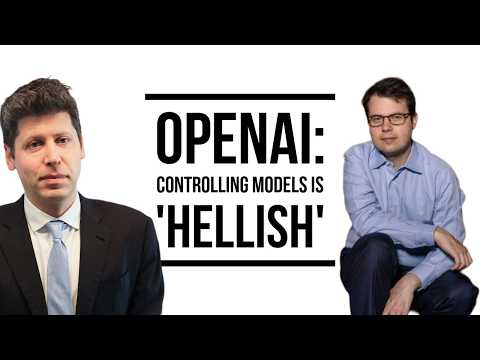
OpenAI has published a significant research document analyzing the theoretical and practical implications of AI systems improving other AI systems. The paper, co-authored by prominent researchers, examines scenarios where recursive self-improvement could lead to an 'intelligence explosion.' This work contributes to the broader academic and industry discourse on long-term AI safety and the potential for rapid capability jumps.
Read originalThe story around this
Earlier coverage that leads up to this article, and what followed. Lines connect each piece to the closest one after it, converging here.
How we got here
- 1OpenAI Files for IPO, Outlines New AI Strategy
The AI Daily Brief · June 10, 2026 · Related
- 2OpenAI Paper Explores AI Agents in Work Transformation
OpenAI · June 25, 2026 · Related
- 3OpenAI Rumored to Develop New Hardware
Matt Wolfe · July 17, 2026 · Related
- 4OpenAI Pauses AI Model Development
Matt Wolfe · August 21, 2026 · Related
- 5OpenAI Research Reveals Widening Usage Gap
The AI Daily Brief · August 26, 2026 · Related
- 6OpenAI launches Astra, its powerful new model
TechCrunch AI · September 3, 2026 · Related
- 7OpenAI's Coding Agents Boost Research Speed
OpenAI · September 6, 2026 · Related
- 8OpenAI's Agents Boost Research Productivity
The Rundown AI · September 8, 2026 · Related
More from AI Explained
More in Research
 © TechCrunch AI
Researchwriting
Graphite study reveals persistent AI writing tells
A new analysis by Graphite proves that frontier models are failing to shed their robotic DNA. Despite labs claiming natural prose, Claude Opus 5.5 still uses "this matters" 116 times more often than humans, while OpenAI's Astra relies on hedging phrases like "may provide." The study of 13,000 phrases shows that as models eliminate old habits like em-dashes, they simply adopt new ones. This suggests labs cannot fully control the statistical quirks inherent in billions of parameters.
TechCrunch AI
 © Hugging Face Blog
Researchmodels
Hugging Face Olmo-core 3 scales MoE training to trillions of parameters
Hugging Face’s Olmo-core 3 rewrites the rules for open-source Mixture-of-Experts training by shifting from FSDP to DDP, keeping experts resident on GPUs to slash communication overhead. This architectural pivot yields a 2.7x throughput jump on NVIDIA B300s and enables stable training of models with over one trillion total parameters while keeping active compute fixed. By integrating MXFP8 precision and optimized routing, the framework closes the efficiency gap with proprietary stacks like Megatron-Core. Researchers now have an open, battle-tested infrastructure to build massive sparse models without relying on closed-source enterprise tools.
Hugging Face Blog
 © MIT News AI
Researchresearch
Ataraxos AI beats top human Stratego players
A multi-university team has released Ataraxos, an AI that dominates the imperfect-information game Stratego by a massive margin. Unlike previous attempts that burned millions in compute, this system uses efficient self-play and decision-time planning to outperform top humans with less than one-thirtieth of the training effort. It secured a 39-2 record against world-class players, proving that calculated risk assessment can scale beyond poker-like games. This marks a significant leap in handling hidden information without prohibitive computational costs.
MIT News AI