Models & Labs
llama.cpp b10069 Release Enhances OpenCL Support
llama.cpp Releaseshigh confidence
Why it matters
- →Enhances OpenCL support for Adreno GPUs, improving performance.
- →Streamlines codebase by removing unnecessary tests and comments.
- →Supports diverse hardware configurations, aiding developers.
The b10069 release of llama.cpp introduces several enhancements to OpenCL support, particularly for Adreno GPUs. This update includes support for broadcast in Adreno MUL_MAT and adjustments to honor view offsets, aimed at improving multi-stream operations on llama-server. Additionally, the release provides general GEMM/GEMV support for broadcast, removing unnecessary tests and comments to streamline the codebase. These changes are part of ongoing efforts to enhance performance and compatibility across different hardware platforms.
Read originalThe story around this
Earlier coverage that leads up to this article, and what followed. Lines connect each piece to the closest one after it, converging here.
How we got here
- 1llama.cpp b9852 release expands OpenCL support
llama.cpp Releases · July 2, 2026 · Same story
What happened next
- 2llama.cpp b10813 Release Enhances OpenCL Support
llama.cpp Releases · September 5, 2026 · Same story
More from llama.cpp Releases
Coding Toolscoding
llama.cpp b11532 adds ModernBERT and CUDA 13
This release quietly fixes a critical accuracy gap for ModernBERT encoders by implementing exact GELU activation, ensuring semantic embeddings match the original PyTorch models rather than approximations. It also brings native support for CUDA 13.4 across Linux and Windows, closing the driver compatibility lag that has plagued NVIDIA users on newer hardware stacks. While KleidiAI builds are temporarily disabled on Apple Silicon, the broader expansion to ROCm 10.0 and Snapdragon NPU keeps llama.cpp as the most versatile local inference runtime available today.
llama.cpp Releases
Coding Toolscoding
llama.cpp b11533 fixes Adreno A6X crashes
This release targets a specific but painful stability issue for Android users running llama.cpp on Qualcomm Adreno A6X GPUs. The kernel compiler was crashing due to argument limits in the iot device backend, effectively breaking local inference on those chips. By skipping the problematic kernel and adding explicit detection for the Adreno 623, the team restores functionality where it previously failed hard. It’s a narrow fix, but essential for anyone trying to run models on mid-range Android hardware without hitting compiler errors.
llama.cpp Releases
Coding Toolscoding
llama.cpp b11534 optimizes CUDA SSM and adds ROCm 10
This release quietly sharpens llama.cpp’s performance on NVIDIA GPUs by fusing state snapshot copies into the recurrent cache during SSM scans. It also removes redundant CUDA copies in specific non-speculative decoding scenarios, shaving off latency where it counts. On the AMD side, ROCm 10.0 support arrives alongside stable builds for CUDA 12.8 and 13.4, keeping the library competitive across hardware vendors. KleidiAI on Apple Silicon is temporarily disabled, a minor setback for Mac users until that integration is stabilized. The net result is faster inference for SSM-based models without changing the user experience.
llama.cpp Releases
More in Models & Labs
 © Lev Selector
Models & Labsmodels
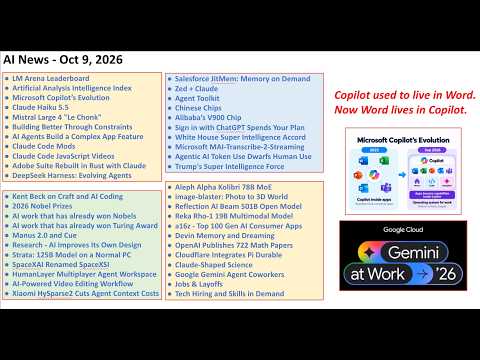
Mistral Large 4 and Claude Haiku 5.5 Released
Mistral releases Large 4 'Le Chonk' while Anthropic launches Claude Haiku 5.5, continuing the trend of cheaper, faster frontier models.
Lev Selector
 © Matt Wolfe
Models & Labsmodels
OpenAI Introduces GPT-6 and Intelligent UI
OpenAI announced GPT-6 for everyone, featuring an 'Intelligent UI' that adapts to user context and workflow needs.
Matt Wolfe
© Matt WolfeModels & Labsmodels
Mistral Releases Large Model 4
French AI startup Mistral has released Mistral Large 4, its latest flagship model competing with top-tier US counterparts.
Matt Wolfe