Models & Labs
OpenAI Introduces GPT-6 and Intelligent UI
Matt Wolfehigh confidence
Why it matters
- →Represents a major generational leap in OpenAI's flagship model
- →Introduces adaptive UI paradigms for AI interaction
- →Broad availability suggests enterprise readiness

OpenAI has unveiled GPT-6, marking a significant step in its model progression with broader availability. A key feature highlighted is the 'Intelligent UI,' which dynamically adjusts the interface based on the complexity of the task and user interaction patterns. This update signals OpenAI's shift towards more adaptive, context-aware user experiences rather than static chat interfaces.
Read originalThe story around this
Earlier coverage that leads up to this article, and what followed. Lines connect each piece to the closest one after it, converging here.
How we got here
- 1OpenAI Unveils GPT-5.6 with Enhanced Capabilities
OpenAI · July 9, 2026 · Same story
- 2OpenAI Launches GPT-5.6 with New Features
The Rundown AI · July 10, 2026 · Same story
- 3OpenAI Unveils GPT-5.6 and ChatGPT Work App
The AI Advantage · July 10, 2026 · Same story
- 4OpenAI Releases GPT-5.6 with Enhanced Capabilities
Matt Wolfe · July 11, 2026 · Same story
- 5GPT-5.6 Enhances AI Efficiency and Intelligence
OpenAI · July 29, 2026 · Same story
- 6OpenAI launches GPT-6 with interactive 'Intelligent UI'
WIRED AI · October 7, 2026 · Same story
- 7OpenAI launches GPT-6 with interactive Intelligent UI
TechCrunch AI · October 7, 2026 · Same story
- 8ChatGPT adds interactive UI elements with GPT-6
The Verge AI · October 7, 2026 · Same story
More from Matt Wolfe
© Matt WolfeOpen Sourceother
Meta Open-Sources Muse AI Gadgets
Meta has open-sourced the code and designs for its Muse AI-powered smart home gadgets.
Matt Wolfe
© Matt WolfeCoding Toolscoding
OpenAI Releases Decisions API and Auto-Review
OpenAI launched the Decisions API for structured outputs and a free auto-review feature for Codex users.
Matt Wolfe
© Matt WolfeAgentsproductivity
Google Launches Gemini Agent and Offline Notetaker
Google introduced the Gemini Agent for work tasks and a new offline-capable AI notetaking app.
Matt Wolfe
More in Models & Labs
Models & Labsmodels
llama.cpp b11535 release with ROCm 10 and CUDA 13
This release quietly cements llama.cpp as the universal inference runtime by adding default support for ROCm 10.0 and CUDA 13.4 across Linux and Windows. AMD GPU users finally get parity with NVIDIA's latest driver stack without manual configuration, while Apple Silicon KleidiAI builds are temporarily disabled to resolve stability issues. The inclusion of Snapdragon NPU support on Linux signals a serious push into edge AI hardware beyond just x86 and ARM CPUs. It is less about new features and more about ensuring the toolchain keeps pace with the rapidly evolving GPU landscape.
llama.cpp Releases
Models & Labscoding
llama.cpp b11540 adds ROCm 10 and CUDA 13 support
This release quietly closes the hardware gap for local inference by adding default builds for ROCm 10.0 and CUDA 13.4 across Linux and Windows. AMD users finally get parity with NVIDIA in the binary distribution, while CUDA 13 support future-proofs setups on newer drivers. The inclusion of Snapdragon and OpenVINO binaries further broadens the hardware surface area without requiring custom compilation. It is a pragmatic update that makes llama.cpp the most accessible runtime for diverse local AI hardware.
llama.cpp Releases
 © Lev Selector
Models & Labsmodels
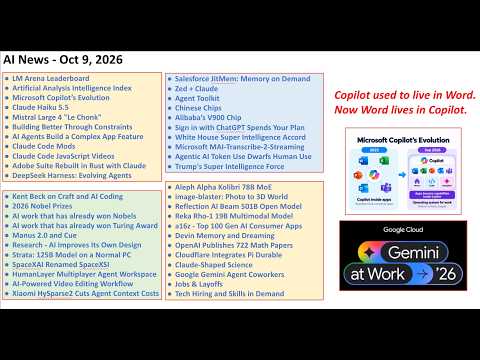
Mistral Large 4 and Claude Haiku 5.5 Released
Mistral releases Large 4 'Le Chonk' while Anthropic launches Claude Haiku 5.5, continuing the trend of cheaper, faster frontier models.
Lev Selector