Models & Labs
OpenAI launches GPT-6 with interactive 'Intelligent UI'
WIRED AIhigh confidence
Why it matters
- →GPT-6 enables the generation of interactive UI components rather than just static text or images.
- →The feature is rolling out to over a billion users, testing mass adoption of generative interfaces.
- →It signals a shift in chatbot design from information delivery to functional tool creation.

OpenAI has released GPT-6 to paid ChatGPT users, introducing an 'Intelligent UI' that generates interactive visual elements like calculators and diagrams. The feature allows users to manipulate data directly within the chat interface, such as adjusting sliders for affordability estimates or clicking parts of a generated diagram. Free users will receive access starting tomorrow. This update positions OpenAI to compete with Google’s generative UI features in search by offering more dynamic, tool-like responses to complex queries.
Read originalThe story around this
Earlier coverage that leads up to this article, and what followed. Lines connect each piece to the closest one after it, converging here.
How we got here
- 1OpenAI Unveils GPT-Live for Voice Interaction
OpenAI · July 8, 2026 · Same story
- 2OpenAI launches GPT-5.6 and ChatGPT Work
The Verge AI · July 9, 2026 · Same story
- 3OpenAI Launches GPT-5.6 with New Features
The Rundown AI · July 10, 2026 · Same story
- 4OpenAI Unveils GPT-5.6 and ChatGPT Work App
The AI Advantage · July 10, 2026 · Same story
- 5ChatGPT Introduces New Voice Mode
The AI Advantage · August 1, 2026 · Same story
- 6OpenAI Enhances ChatGPT with GPT-5.6 Sol
OpenAI · August 6, 2026 · Same story
- 7ChatGPT 6 Astra: Hands-on with Multimodal Capabilities
Skill Leap AI · September 9, 2026 · Same story
- 8OpenAI expands ChatGPT plugins with app-like interfaces
TechCrunch AI · September 29, 2026 · Same story
What happened next
- 9OpenAI launches GPT-6 with interactive Intelligent UI
TechCrunch AI · October 7, 2026 · Same story
- 10ChatGPT adds interactive UI elements with GPT-6
The Verge AI · October 7, 2026 · Same story
More from WIRED AI
 © WIRED AI
Researchagents
Researchers Drive Car with GPT-6 Astra
Three engineers at Axiom proved that general-purpose language models can control physical hardware without task-specific training. By linking OpenAI’s GPT-6 Astra to a Toyota Corolla’s steering system, they navigated the vehicle through an In-N-Out drive-thru using only prompt engineering and camera input. While the car moved slowly and required a safety driver, the experiment reveals that multimodal models are developing emergent spatial reasoning capabilities previously thought to require dedicated robotics stacks. This blurs the line between digital assistants and physical agents, suggesting that scaling text-and-image training yields unexpected real-world utility.
WIRED AI
 © WIRED AI
Market & Regulationbusiness
Pentagon Speeds AI Procurement With 5-Minute Video Pitches
The Pentagon’s Tradewinds program is bypassing months of red tape by letting companies pitch AI tools in five-minute videos for immediate 'post-competitive' status. This shift allows the military to award contracts in under a week, targeting OpenAI, Anthropic, and Google directly rather than traditional defense primes. The move signals a desperate attempt to inject competition into a market dominated by Silicon Valley giants who now hold more leverage than the government itself. While it accelerates deployment for lethal AI agents, it also raises serious transparency concerns about unreported 'other transaction' spending.
WIRED AI
 © WIRED AI
Models & Labsagents
OpenAI Dots Agent Review: Rough but Real
OpenAI’s Dots agents are no longer just a demo; they are live for ChatGPT subscribers and actively browsing the web to execute complex tasks like shopping. The experience is undeniably janky—misnaming users, failing captchas, and hallucinating emotional connections—but it proves that autonomous agents can navigate real e-commerce flows with surprising competence. This marks a shift from chatbots that talk about actions to bots that actually perform them, even if the execution is currently prone to embarrassing errors. The $100/month price tag signals OpenAI’s confidence in this utility, betting that reliability will catch up to ambition over time.
WIRED AI
More in Models & Labs
 © TechCrunch AI
Models & Labsagents
Microsoft launches Nvidia Spark AI PCs with agent-ready Windows 11
Microsoft is finally shipping the hardware promised alongside Nvidia’s RTX Spark chip, targeting developers who want to run local AI agents without cloud dependency. The Surface Laptop Ultra and Dev Box feature unified memory and specialized cooling designed specifically for on-device model orchestration. More importantly, Windows 11 now includes Execution Containers, a sandboxing layer that lets multiple AI agents operate safely alongside user data. This moves the platform from just hosting models to actively managing agent context and actions locally. It signals a shift where the OS itself becomes the runtime environment for autonomous software.
TechCrunch AI
 © GitHub Changelog
Models & Labscoding
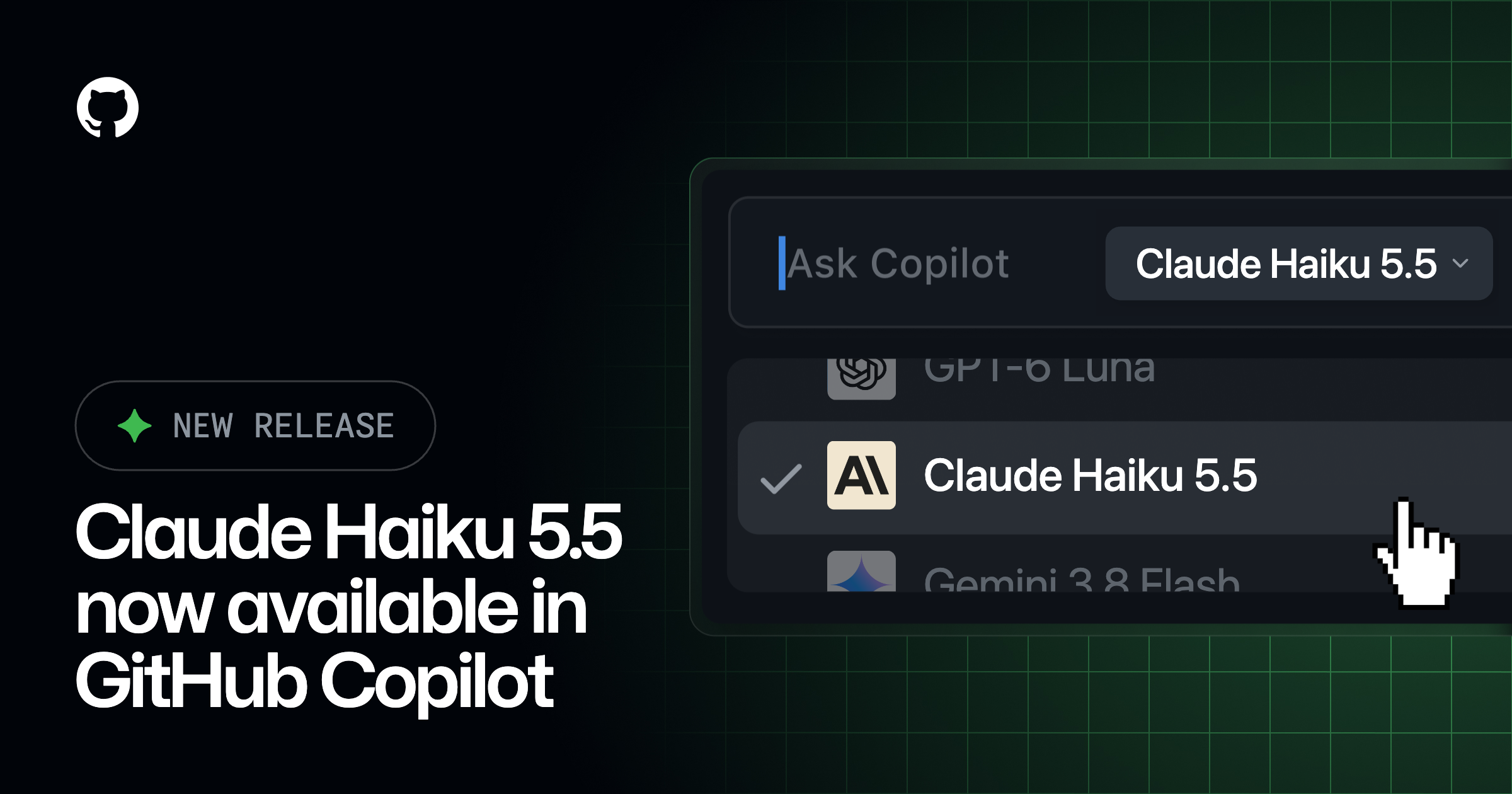
Claude Haiku 5.5 arrives in GitHub Copilot
Anthropic’s latest lightweight model is now live inside GitHub Copilot, targeting high-volume coding tasks like subagents and terminal work. Early benchmarks suggest it matches Sonnet 5 on many coding challenges while consuming significantly fewer tokens and steps. This availability across VS Code, JetBrains, and mobile apps gives developers a faster, cheaper option for routine edits without sacrificing quality. The gradual rollout means most users will see it soon, with admin controls allowing enterprises to manage access via model policies.
GitHub Changelog
 © The Verge AI
Models & Labsother
Microsoft Surface Laptop Ultra launches with Nvidia RTX Spark
The Surface Laptop Ultra marks the commercial debut of Nvidia’s RTX Spark, an Arm-based chip designed to bring serious local AI inference to Windows laptops. Starting at $2,599, this device signals a shift toward premium hardware capable of running large models locally, moving beyond cloud dependency for enterprise and creative workflows. Microsoft pairs this with 'Hybrid Intelligence' features in Copilot, allowing the agent to access local files and take OS-level actions like filing taxes or managing emails. This isn't just a new laptop; it's the first concrete proof that Arm-based PC silicon can handle the thermal and memory demands of 120B+ parameter models on-device.
The Verge AI