16 × AIAI signal, amplified
AI newsAboutSources
TelegramFollow on Telegram
AI newsAboutSources
16 × AIAI signal, amplified

An AI news engine that ingests trusted sources, scores with Claude, and posts only what clears the bar.

Follow on Telegram →

Subscribe

  • Telegram
  • RSS
  • All channels

Legal

  • Privacy
  • Imprint
© 2026 16 × AI. All rights reserved.Curated by Claude. Posts every 6 hours. No newsletter, no funnel.
Home/Models & Labs
Models & Labs

Gemini 3.5 Flash Now Available on GitHub Copilot

GitHub Changelog·May 19, 2026·high confidence

Why it matters

  • →Gemini 3.5 Flash offers near-Pro coding quality at Flash-tier speed and cost.
  • →It enhances AI-assisted coding workflows with strong tool use and fast response times.
  • →The model's integration into GitHub Copilot supports multiple popular IDEs, broadening its accessibility.
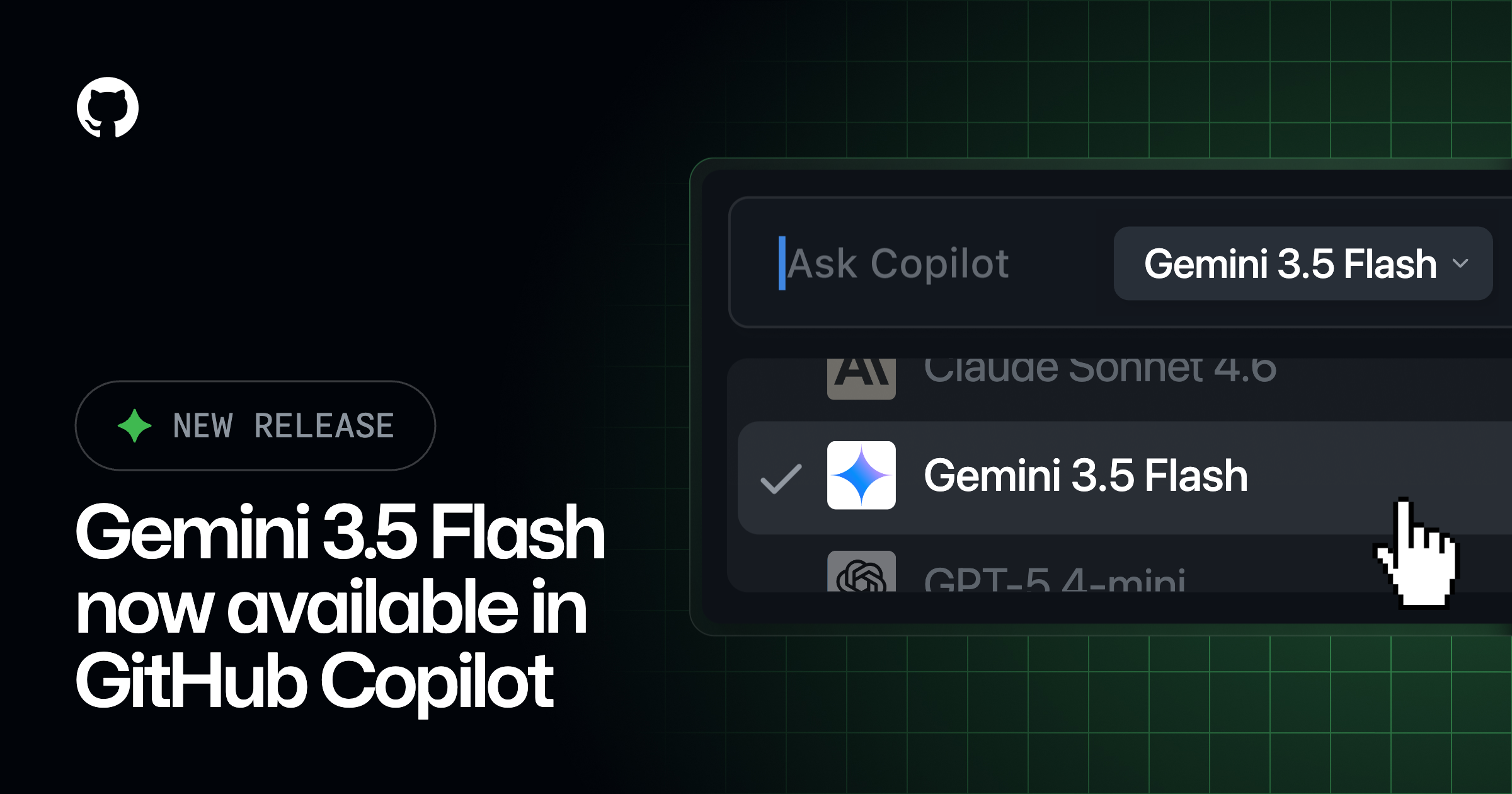
Gemini 3.5 Flash Now Available on GitHub Copilot
©GitHub Changelog

GitHub has announced the integration of Google's Gemini 3.5 Flash model into its Copilot service. This model aims to deliver near-Pro coding quality with the speed and cost efficiency of Flash-tier models. Initially available to Copilot Pro, Business, and Enterprise users, it supports IDEs like Visual Studio Code and JetBrains. The model is launching with a 14X premium request multiplier, though pricing is subject to change. This development enhances AI-assisted coding by providing a faster and more efficient tool for developers.

Read original

More from GitHub Changelog

npm Enhances Security with Staged Publishing© GitHub Changelog
Coding Toolscoding

npm Enhances Security with Staged Publishing

npm has introduced staged publishing and new install-time controls in its latest update, aiming to bolster supply-chain security. Staged publishing allows package maintainers to approve prebuilt tarballs before they become publicly available, adding a layer of human verification. This feature is particularly beneficial for CI/CD workflows, ensuring that only trusted packages are released. Additionally, new install source flags provide developers with more control over dependency sources, enhancing security by allowing explicit permissions for file, remote, and directory installs. These updates mark a significant step towards more secure package management in the npm ecosystem.

GitHub Changelog·May 22, 2026
GitHub Copilot for Eclipse Goes Open Source© GitHub Changelog
Open Sourcecoding

GitHub Copilot for Eclipse Goes Open Source

GitHub has open-sourced its Copilot plugin for Eclipse, marking a significant step in integrating AI-powered tools within the Eclipse ecosystem. By releasing the code under the MIT license, GitHub invites developers to explore, contribute, and innovate on how AI enhances developer experiences in Eclipse. This move not only promotes transparency but also encourages community-driven development, allowing developers to understand and influence the plugin's functionality. With the source code available, developers can now delve into the mechanics of Copilot's features like code completion and agentic workflows, fostering a collaborative environment for future enhancements.

GitHub Changelog·May 21, 2026
GitHub Issue Fields Now in Public Preview© GitHub Changelog
Coding Toolscoding

GitHub Issue Fields Now in Public Preview

GitHub has introduced a public preview of issue fields for all organizations, offering a new way to manage and track issues across repositories. This feature allows organizations to define typed metadata like Priority and Effort, which automatically appear on every issue, simplifying workflows and reducing the need for manual syncing. With support for single select, text, number, and date types, these fields can be integrated into project views and automated via APIs. This update is particularly beneficial for large enterprises and open source projects, providing a structured alternative to complex label systems. By adopting this feature, teams can enhance their automation capabilities and maintain consistent field values without manual intervention. GitHub plans to continue refining the feature based on user feedback, ensuring it meets the evolving needs of its users.

GitHub Changelog·May 21, 2026

More in Models & Labs

Models & Labsmodels

llama.cpp b9297 release enhances tensor support

The b9297 release of llama.cpp brings a notable enhancement with the introduction of NVFP4 MTP scale tensors, boosting its tensor processing capabilities. This update also integrates Qwen3.5 MTP tensors, which improves performance across a spectrum of hardware configurations, including Apple Silicon, Vulkan, and ROCm on Ubuntu, as well as CUDA on Windows. The release supports a wide array of architectures, from macOS to Linux and Windows, ensuring compatibility with both CPU and GPU setups. While there are no new model architectures, the inclusion of KleidiAI on Apple Silicon and ROCm 7.2 on Ubuntu highlights llama.cpp's commitment to optimizing for diverse environments. This update reinforces llama.cpp's role as a flexible inference runtime, catering to a broad range of hardware setups.

llama.cpp Releases·May 25, 2026
Models & Labsmodels

llama.cpp b9309 release fixes integer overflows

The b9309 release of llama.cpp tackles significant integer overflow issues in its perplexity calculations, co-authored by Stanisław Szymczyk. This update is vital for enhancing the accuracy and reliability of the model's performance metrics, which are crucial for developers. By resolving these overflows, the release ensures that users can depend on precise data outputs. This fix is a testament to the ongoing efforts to improve the tool's robustness, allowing developers to trust the integrity of their AI computations. While it might seem like a minor adjustment, it plays a critical role in maintaining the tool's reliability.

llama.cpp Releases·May 25, 2026
OpenAI Achieves Math Breakthrough© The AI Daily Brief
Models & Labsmodels

OpenAI Achieves Math Breakthrough

OpenAI has made a significant advancement in mathematical capabilities within its AI models.

The AI Daily Brief·May 24, 2026