Market & Regulation
UK Startup Launches 'Organic' Human-Authored Book Certification
WIRED AIhigh confidence
Why it matters
- →Establishes a formal certification framework for human-authored content in the publishing industry.
- →Differentiates verification through manual draft review rather than relying solely on AI detection algorithms.
- →Signals growing institutional pressure on publishers to address consumer concerns about AI-generated text.

British startup Books by People has received approval from the UK Intellectual Property Office to distribute a certification mark for books written exclusively by humans. The organization verifies authorship through a combination of proprietary software and manual examination of early drafts and research materials, distinguishing its approach from pure AI-detection tools. Five publishers have committed to using the mark, which will appear on book covers to signal 'organic' human authorship. This initiative emerges amid industry scandals involving suspected AI use, aiming to restore reader trust by providing a verifiable standard for human-created literature.
Read originalThe story around this
TopicAmazon Artificial Intelligence
Earlier coverage that leads up to this article, and what followed. Lines connect each piece to the closest one after it, converging here.
How we got here
- 1Authors Challenge Publisher Claims on Anthropic Settlement
TechCrunch AI · September 6, 2026 · Background
What happened next
- 2Big Five Publishers Use AI Behind Closed Doors
WIRED AI · October 9, 2026 · Background
More from WIRED AI
 © WIRED AI
Market & Regulationbusiness
Big Five Publishers Use AI Behind Closed Doors
While the Big Five publicly condemn author-generated AI, internal leaks reveal a stark hypocrisy: HarperCollins, Simon & Schuster, and Hachette are quietly deploying LLMs for publicity copy, cover art, and even rejection letters. This isn't just about efficiency; it's a cultural rupture where staff are 'voluntold' to champion tools that replace human judgment in creative workflows. The revelation exposes a dangerous gap between corporate PR and operational reality, proving that enterprise adoption is already deep enough to trigger internal revolts over ethics and copyright risks.
WIRED AI
 © WIRED AI
Researchagents
Researchers Drive Car with GPT-6 Astra
Three engineers at Axiom proved that general-purpose language models can control physical hardware without task-specific training. By linking OpenAI’s GPT-6 Astra to a Toyota Corolla’s steering system, they navigated the vehicle through an In-N-Out drive-thru using only prompt engineering and camera input. While the car moved slowly and required a safety driver, the experiment reveals that multimodal models are developing emergent spatial reasoning capabilities previously thought to require dedicated robotics stacks. This blurs the line between digital assistants and physical agents, suggesting that scaling text-and-image training yields unexpected real-world utility.
WIRED AI
 © WIRED AI
Models & Labsother
OpenAI launches GPT-6 with interactive 'Intelligent UI'
OpenAI is shifting ChatGPT from static text to dynamic, interactive interfaces powered by the new GPT-6 model. The update generates custom tools like calculators and clickable diagrams directly within the chat, moving beyond simple image insertion. This generative UI approach mirrors Google’s recent Search updates but targets OpenAI’s massive user base immediately. It marks a tangible step toward AI-generated software components rather than just content generation. Users can now interact with data through sliders and maps instead of reading about them.
WIRED AI
More in Market & Regulation
 © TechCrunch AI
Investment · $870M
Market & Regulationbusiness
TypeSafe AI raises $870M for non-text model Jev
TypeSafe AI’s $870 million raise signals a pivot away from the text-generation arms race toward structured decision-making. Jev bypasses LLMs entirely, outputting calibrated probabilities instead of tokens to automate enterprise workflows faster and cheaper. With claims that a third of Fortune 500 companies are already using it, this validates a niche but high-value market for non-linguistic AI. The funding from Andreessen Horowitz and Sequoia confirms investors are betting on automation over conversation.
TechCrunch AI
 © Lev Selector
Market & Regulationbusiness
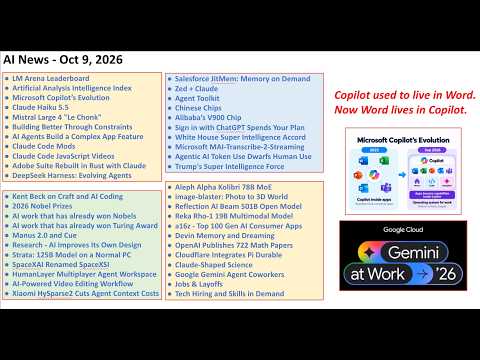
White House Announces Super Intelligence Accord
The White House has introduced a new 'Super Intelligence Accord' alongside the formation of a dedicated Super Intelligence Force.
Lev Selector
© Lev SelectorMarket & Regulationbusiness
Alibaba Unveils V900 AI Chip
Alibaba announces its new V900 semiconductor chip, expanding domestic supply for AI training and inference workloads.
Lev Selector