Coding Tools
GitHub Copilot Code Review adds adaptive effort and secret detection
GitHub Changeloghigh confidence
Why it matters
- →Adaptive effort levels reduce developer friction by automating the decision of how deeply to review a pull request.
- →Cross-repository context helps catch dependency issues that isolated repository reviews often miss.
- →AI-driven secret detection adds a layer of security beyond traditional regex-based scanning for exposed credentials.
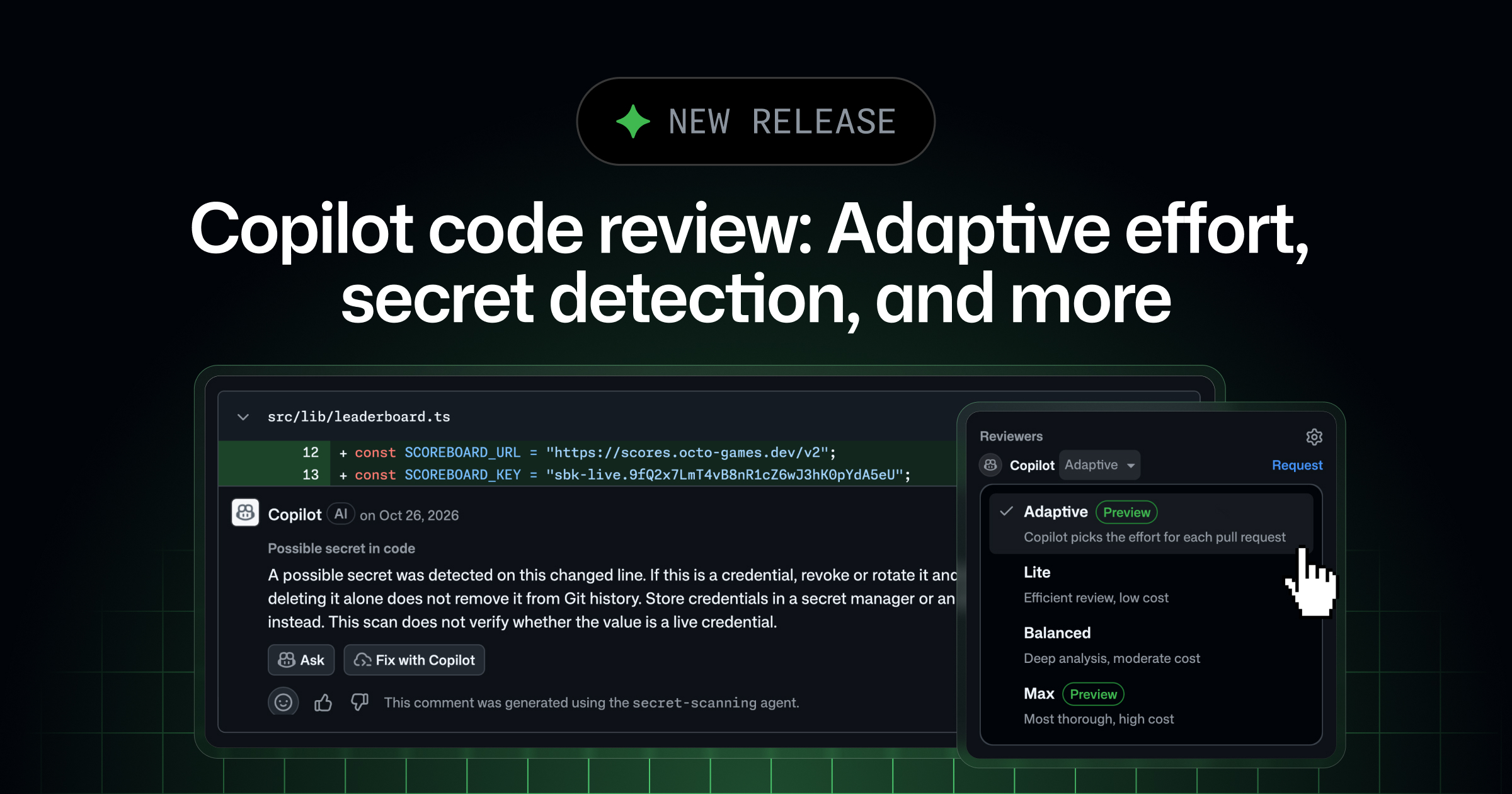
GitHub has updated Copilot Code Review with adaptive effort levels, cross-repository context, and secret detection features now in public preview. The adaptive system automatically selects review depth (Lite, Balanced, or Max) based on pull request complexity, replacing manual configuration. Cross-repository context allows the tool to analyze related public repositories for dependency impacts, while AI-powered secret detection identifies exposed credentials using both deterministic methods and LLMs. Additionally, Copilot Code Review for Azure Repos has reached general availability, enabling integration with Azure DevOps workflows and billing via GitHub AI credits.
Read originalThe story around this
Earlier coverage that leads up to this article, and what followed. Lines connect each piece to the closest one after it, converging here.
How we got here
- 1GitHub Copilot Enhances Code Review Automation
GitHub Changelog · September 11, 2026 · Same story
- 2GitHub Copilot Code Review GA with Auto-Resolution
GitHub Changelog · September 18, 2026 · Same story
Follow this story
Open the full story →GitHub AI Scan API now manages repository-level settings
More from GitHub Changelog
 © GitHub Changelog
Coding Toolscoding
GitHub expands security advisory permissions
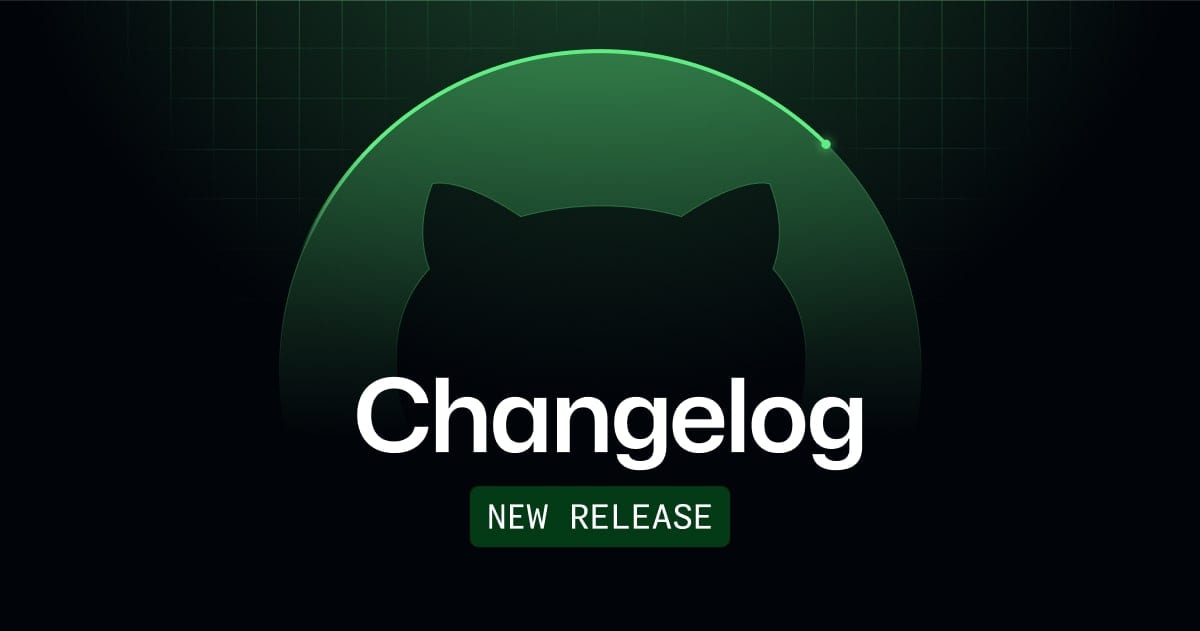
GitHub finally decouples security advisory management from full admin rights. By introducing granular custom repository roles, organizations can now grant specific teams access to private vulnerability reports without handing over the keys to the entire repo. This shift addresses a major friction point in secure software development, allowing for precise least-privilege access control. It moves GitHub closer to enterprise-grade security hygiene by separating code ownership from security oversight.
GitHub Changelog
 © GitHub Changelog
More in Coding Tools
Coding Toolscoding
llama.cpp b12642 fixes MoE weight copying bug
This release patches a critical correctness bug in multi-node Mixture-of-Experts inference where shared expert weights were copied partially, leading to stale data and incorrect outputs. The fix ensures all experts are properly replicated across nodes before graph execution, stabilizing large-scale distributed runs. While the binary lineup remains consistent with previous versions—supporting CUDA 13, ROCm 10.0, and various CPU/GPU backends—the underlying logic correction is vital for anyone running complex MoE models like Inkling2 on multi-node setups. It’s a quiet but necessary fix for reliability in advanced deployment scenarios.
llama.cpp Releases
Coding Toolscoding
llama.cpp b12643 fixes Qwen3 audio tail
This release quietly patches a critical inference bug in llama.cpp’s multimodal handling of Qwen3-Omni and Qwen3-ASR models. Previously, zero-padding artifacts introduced extra tokens that corrupted audio output, a subtle but fatal flaw for speech recognition tasks. The fix replaces magic numbers with explicit token mapping logic, ensuring the model processes only valid audio frames. While not a new feature, it stabilizes one of the most popular open-source multimodal pipelines for developers relying on Qwen’s audio capabilities.