Models & Labs
GitHub Copilot upgrades to MAI Code 2 models
GitHub Changeloghigh confidence
Why it matters
- →Replaces legacy Codex models with the new MAI architecture for agentic coding.
- →Introduces a distinct 'Flash' tier optimized for speed and cost efficiency.
- →Expands support for complex, multi-file reasoning tasks beyond simple autocomplete.
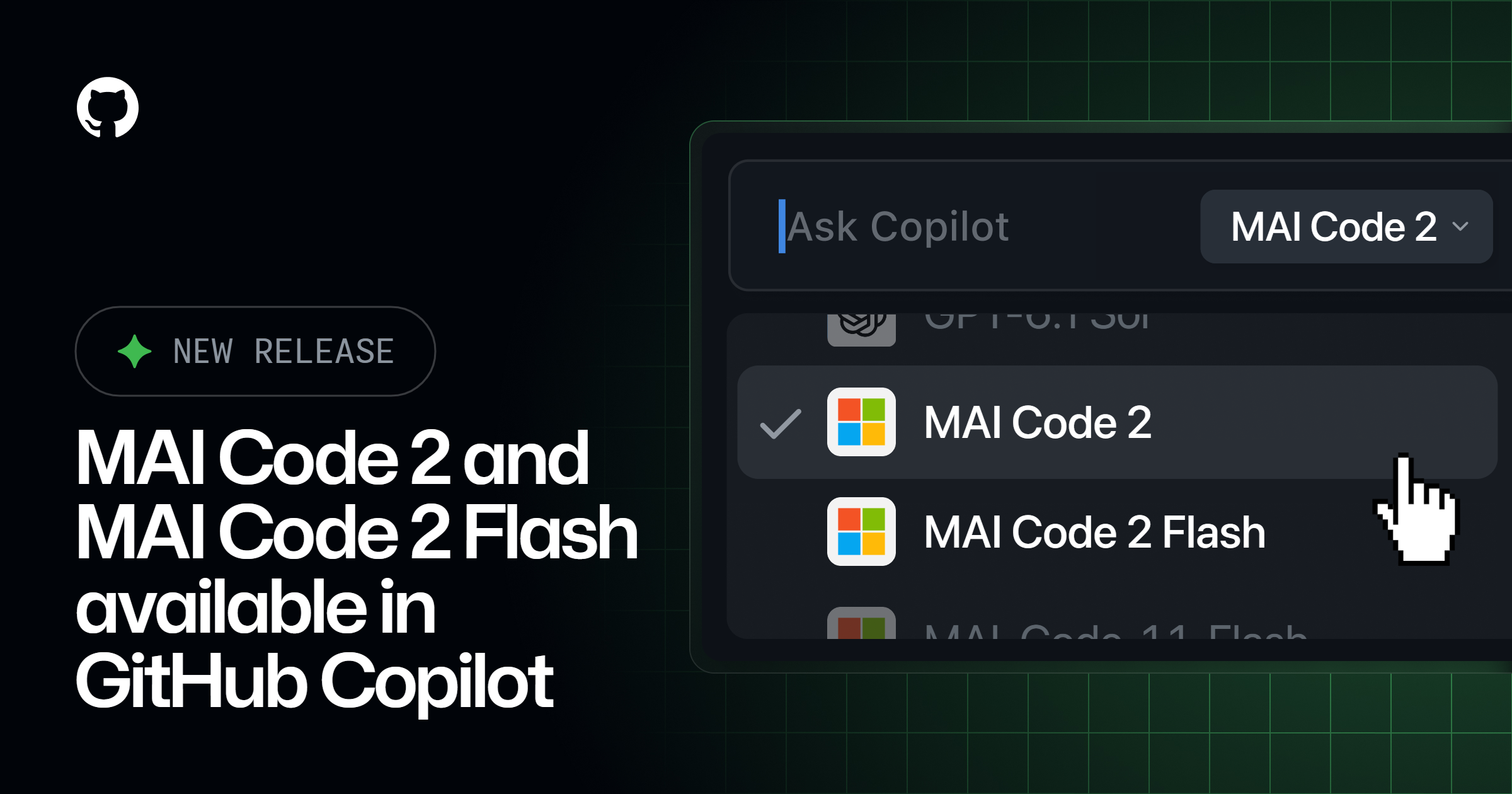
GitHub has integrated the new MAI Code 2 and MAI Code 2 Flash models into GitHub Copilot, replacing previous proprietary architectures. MAI Code 2 is designed for complex agentic tasks such as multi-file implementation and deep debugging, while MAI Code 2 Flash offers a lightweight alternative for rapid iteration and routine fixes. Both models are available to eligible subscribers across major IDEs including VS Code, JetBrains, and Xcode. Administrators can manage access via new model policies in Copilot settings.
Read originalThe story around this
Earlier coverage that leads up to this article, and what followed. Lines connect each piece to the closest one after it, converging here.
How we got here
- 1MAI-Code-1.1-Flash now in GitHub Copilot
GitHub Changelog · August 11, 2026 · Same story
- 2GitHub Copilot Enhances Flexibility with New Features
GitHub Changelog · August 14, 2026 · Same story
Follow this story
Open the full story →GitHub Copilot app supports Enterprise Server
3 developments
- Nov 13 · GitHub Changelog
GitHub Copilot app supports Enterprise Server - Nov 16 · GitHub Changelog
GitHub Copilot adds GHES support and new models - Nov 17 · GitHub Changelog
GitHub Copilot upgrades to MAI Code 2 models (This article)↳ GitHub Copilot replaces Codex with MAI Code 2 models for agentic workflows and repository-wide reasoning.
More from GitHub Changelog
 © GitHub Changelog
Coding Toolscoding
GitHub expands security advisory permissions
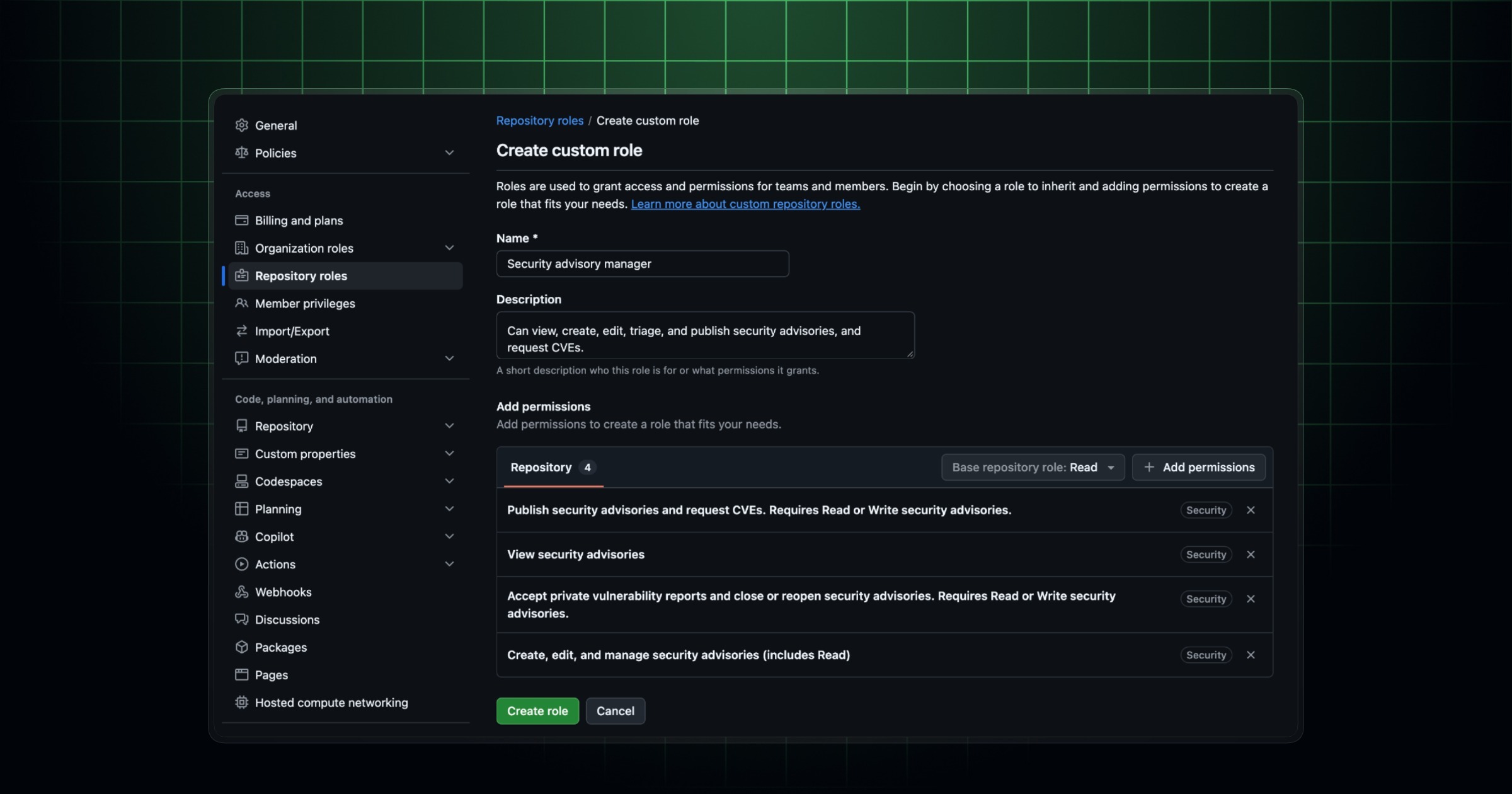
GitHub finally decouples security advisory management from full admin rights. By introducing granular custom repository roles, organizations can now grant specific teams access to private vulnerability reports without handing over the keys to the entire repo. This shift addresses a major friction point in secure software development, allowing for precise least-privilege access control. It moves GitHub closer to enterprise-grade security hygiene by separating code ownership from security oversight.
GitHub Changelog
 © GitHub Changelog
Coding Toolscoding
GHES 3.23 RC: On-device AI secret detection
GitHub Enterprise Server 3.23’s release candidate brings a critical security upgrade for air-gapped enterprises: on-device AI secret detection. Unlike cloud-based scanners, this self-contained model runs entirely on the appliance’s CPU, requiring no GPU or outbound connection to detect unstructured secrets. This capability effectively closes the gap between connected and isolated environments, allowing organizations with strict data sovereignty rules to maintain automated security hygiene. The update also expands Dependabot’s advisory coverage to six additional package ecosystems and introduces stricter OAuth token expiration defaults.
GitHub Changelog
 © GitHub Changelog
Coding Toolscoding
Azure DevOps to GitHub Enterprise Live Migrations GA
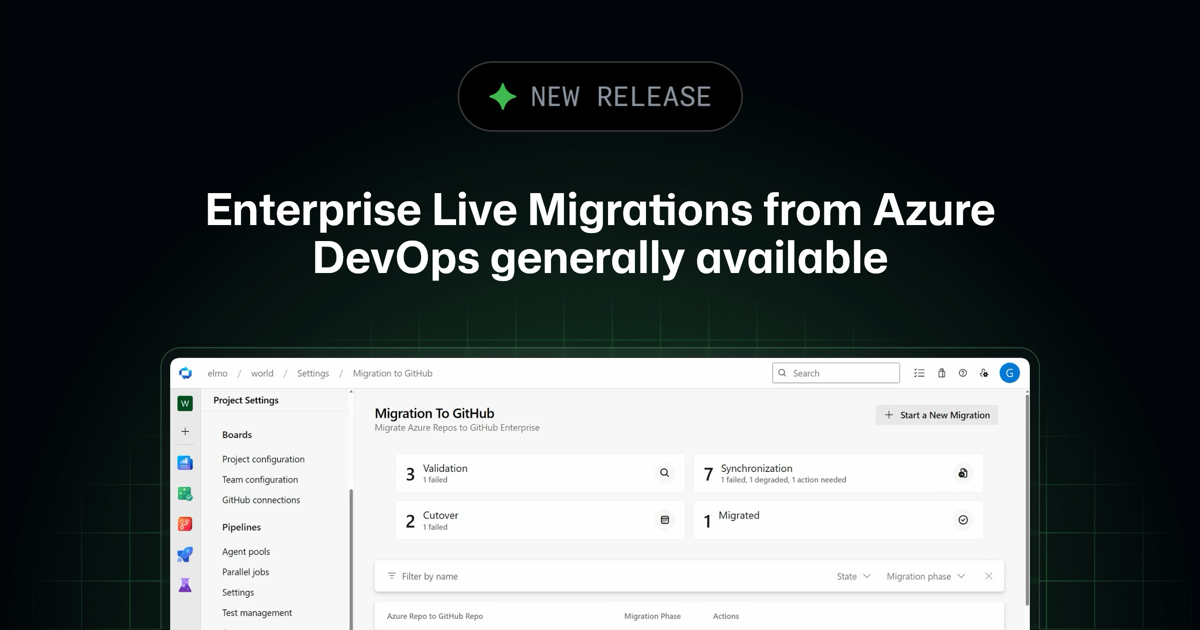
Microsoft finally solves the painful 'big bang' migration problem for enterprises moving from Azure DevOps to GitHub. The new Enterprise Live Migrations tool allows continuous syncing of Git history and pull requests while teams keep working, eliminating the need for a disruptive downtime window. By preserving branch policies and rewiring Azure Pipelines automatically, it drastically reduces the manual overhead that usually stalls these transitions. This shifts migration from a risky project milestone to a manageable operational task.
GitHub Changelog
More in Models & Labs
Models & Labscoding
llama.cpp b12641 adds CUDA 13 and ROCm 10
This release quietly closes the hardware gap for local inference by adding default support for CUDA 13 and ROCm 10.0 alongside existing CUDA 12 builds. NVIDIA users can now leverage newer driver stacks without manual configuration, while AMD GPU owners gain parity with the latest ROCm version. The build also expands to Linux s390x and Windows arm64, ensuring broader platform coverage for diverse hardware setups. There are no new model architectures or quantization methods here, just a robust infrastructure update that keeps llama.cpp compatible with the fastest available consumer and enterprise GPUs.
llama.cpp Releases
Models & Labsother
llama.cpp b12646 adds CUDA 13 and Snapdragon support
This release quietly cements llama.cpp as the universal inference runtime by finally supporting CUDA 13 alongside the established CUDA 12 builds. The addition of ROCm 10.0 for both Linux and Windows further closes the gap with NVIDIA's ecosystem, while new binaries for Ubuntu s390x and openEuler 910b extend reach into specialized hardware. Most notably, initial support for Linux arm64 Snapdragon devices brings CPU, Adreno GPU, and Hexagon NPU acceleration to mobile-class silicon. There are no new model architectures here, just a broader net for deployment across increasingly fragmented hardware landscapes.
llama.cpp Releases
Investment · $100M
Models & Labsother
Black Forest Labs raises $100M for world models
Black Forest Labs, the studio behind Flux, has secured $100 million in Series B funding led by Nvidia and a16z to pivot toward 'world models.' This isn't just another image generator raise; it signals a strategic bet on AI that understands physics and spatial reasoning rather than just pixels. The backing from Nvidia is particularly telling, suggesting they see value in simulation environments for training future autonomous agents. While Flux remains their cash cow, this capital injection accelerates the race to build AI systems that can predict how the physical world works.
Sifted