General AI
AI Systems Utilize External Memory for Enhanced Context
Lev Selectorhigh confidence
Why it matters
- →Enhances AI's ability to provide accurate and contextually relevant responses.
- →Allows AI to handle more information than its internal context window.
- →Facilitates the development of more sophisticated AI applications.

Modern AI systems are increasingly using external memory to improve their functionality. This involves accessing information stored outside the model itself, such as in databases, documents, or cloud storage. For example, when asked about a contract expiration date, an AI can retrieve the relevant document and extract the necessary information to provide an accurate response. This process, known as Retrieval, is a key component of Retrieval-Augmented Generation (RAG), which combines retrieved data with language model outputs.
Read originalThe story around this
Earlier coverage that leads up to this article, and what followed. Lines connect each piece to the closest one after it, converging here.
How we got here
- 1Enhancing Claude AI with Memory and Import Features
Duncan Rogoff · April 23, 2026 · Background
- 2Memory Tools May Degrade AI Model Performance
TechCrunch AI · June 10, 2026 · Related
- 3Persistent Memory Enhances AI Agent Performance
Lev Selector · June 12, 2026 · Related
- 4MIT Develops Spatiotemporal Memory for Robots
MIT News AI · June 17, 2026 · Background
- 5Memora Enhances AI Memory for Long-Horizon Tasks
Microsoft Research · June 29, 2026 · Related
- 6Scaling AI Agents with Redis Iris
Cole Medin · July 9, 2026 · Background
- 7ChatGPT's Computer History Feature Enhances Contextual Access
The AI Daily Brief · August 16, 2026 · Background
- 8Agentic Memory Calibration for AI Models
Hugging Face Blog · August 18, 2026 · Background
What happened next
- 9RAG: Enhancing AI with External Information Retrieval
Lev Selector · August 21, 2026 · Related
- 10AI Models Struggle with Classic Intelligence Tests
MIT Technology Review AI · August 26, 2026 · Background
- 11Perplexity's Local Computer-Use Agent
The AI Daily Brief · August 29, 2026 · Background
- 12AI Infrastructure Demands New Architectural Approach
MIT Technology Review AI · September 4, 2026 · Background
- 13Scaling AI Second Brains to Teams with Row-Level Security
Cole Medin · September 17, 2026 · Background
Follow this story
Open the full story →Understanding AI's Context Window and Memory Limitations
3 developments
- Aug 18 · Lev Selector
Understanding AI's Context Window and Memory Limitations - Aug 18 · Lev Selector
Exploring AI Memory: Context Window vs. Saved Memory↳ AI systems can save specific information between conversations, distinct from context windows and retraining. - Aug 19 · Lev Selector
AI Systems Utilize External Memory for Enhanced Context (This article)↳ AI systems now use external memory sources like databases and documents to enhance responses.
More from Lev Selector
 © Lev Selector
Market & Regulationbusiness
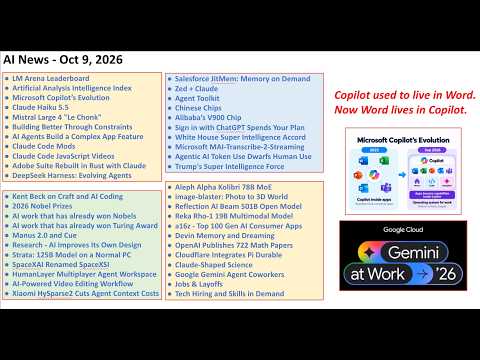
White House Announces Super Intelligence Accord
The White House has introduced a new 'Super Intelligence Accord' alongside the formation of a dedicated Super Intelligence Force.
Lev Selector
© Lev SelectorResearchresearch
OpenAI Publishes 722 Math Papers
OpenAI releases a massive collection of 722 research papers focused on mathematical reasoning and verification.
Lev Selector
© Lev SelectorMarket & Regulationbusiness
Alibaba Unveils V900 AI Chip
Alibaba announces its new V900 semiconductor chip, expanding domestic supply for AI training and inference workloads.
Lev Selector
More in General AI
 © Hugging Face Blog
General AIother
Ai2 replaces priority scheduling with GPU time budgets
Allen Institute for AI solved the 'tragedy of the commons' in its H100 and B200 clusters by abandoning priority queues for a budget-based system. Researchers now spend allocated GPU time rather than hoarding it, turning resource allocation into a transparent administrative process. This shift eliminates squatting and priority inflation while keeping occupancy high through hierarchical fair-share scheduling. It proves that treating compute as a financial asset works better than treating it as a shared utility.
Hugging Face Blog
General AIagents
Revolut launches agentic shopping features
Revolut is moving beyond simple chatbots by introducing agentic capabilities that allow users to delegate complex shopping tasks directly within the app. This shift marks a significant step in AI commerce, transforming passive assistants into active buyers who can search, compare, and potentially execute transactions autonomously. For a fintech giant with millions of daily users, this integration brings autonomous agents from experimental tech to mainstream consumer finance. It signals that the next battleground for AI isn't just generating content, but executing real-world economic actions on behalf of the user.
Sifted
 © The AI Daily Brief
General AIproductivity
OpenAI Enables ChatGPT to Generate Its Own Interfaces
OpenAI has updated ChatGPT to allow the AI to generate its own user interfaces for complex tasks.
The AI Daily Brief