Coding Tools
GitHub REST API now manages code coverage rulesets
GitHub Changeloghigh confidence
Why it matters
- →Enables programmatic management of code quality gates via API.
- →Facilitates consistent enforcement across multiple repositories in IaC workflows.
- →Reduces manual overhead for maintaining coverage standards on GitHub Enterprise.

GitHub has made the Restrict code coverage repository ruleset option available through its REST API. Previously limited to the web interface, this update allows developers to create, update, and read code coverage requirements programmatically. The feature supports enforcing minimum line coverage or maximum tolerable drops for pull requests. It is currently available on GitHub Enterprise Cloud and GitHub Team plans, requiring GitHub Code Quality to be enabled.
Read originalMore from GitHub Changelog
 © GitHub Changelog
Coding Toolscoding
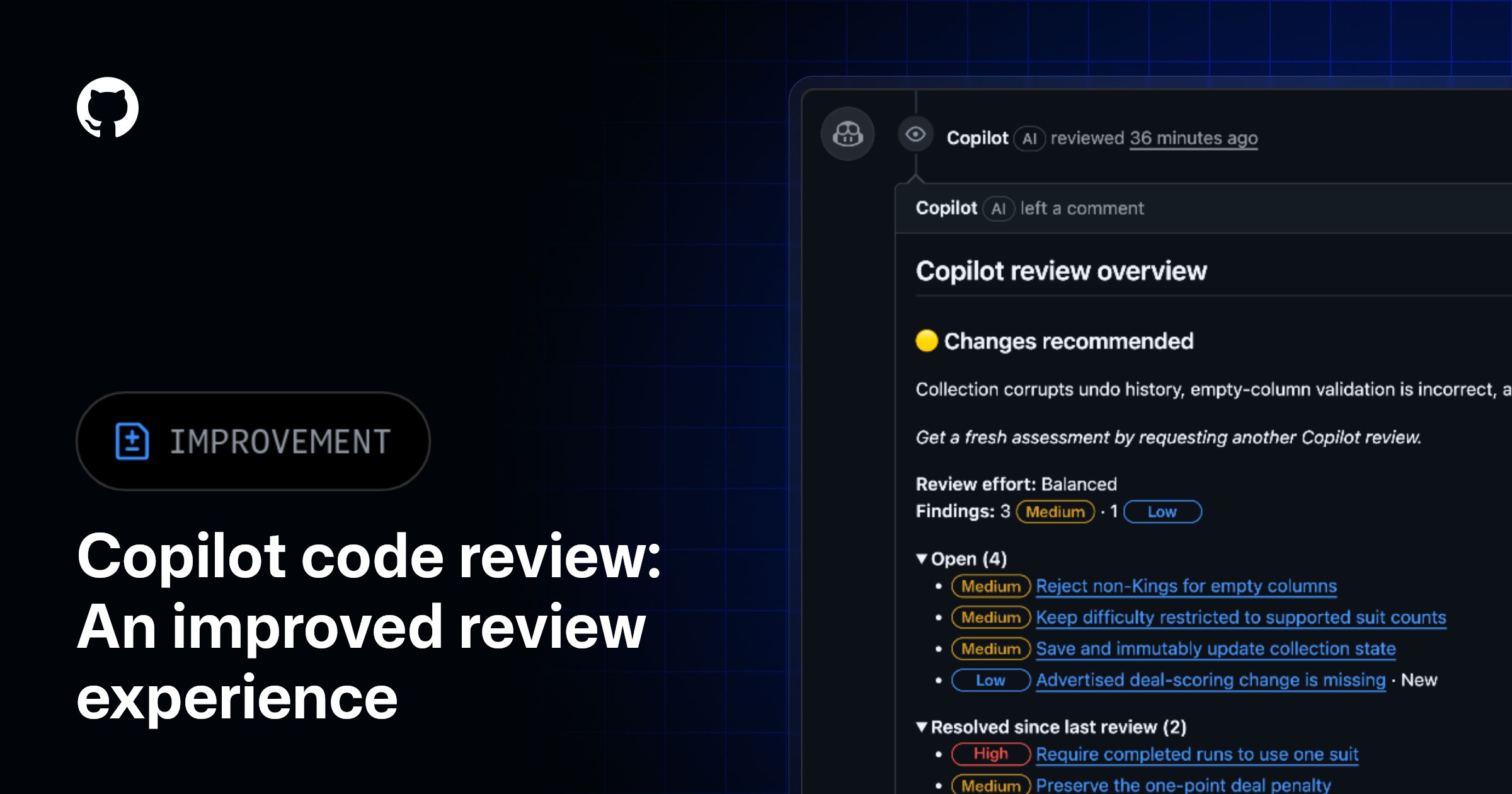
GitHub Copilot Code Review GA with Auto-Resolution
GitHub Copilot’s code review tool has reached general availability, shifting from experimental to a core part of the pull request workflow. The biggest leap is auto-resolution: Copilot now validates whether its own suggestions were actually fixed by subsequent commits and closes them out automatically, saving developers from manual cleanup. It also groups findings into clear states like 'Resolved' or 'Previously missed,' giving a real-time health check of the PR rather than just a static list of errors. This reduces context switching significantly, letting engineers focus on new issues while the AI handles the administrative burden of closing old ones.
GitHub Changelog
 © GitHub Changelog
Coding Toolscoding
GitHub Copilot adds model tiers and Sentry integration
GitHub is finally giving users control over the cost-performance trade-off in Copilot with new efficiency, balance, and intelligence tiers. This moves beyond blind API calls, letting developers explicitly choose speed versus quality across VS Code and the CLI. The real workflow shift comes from the Sentry canvas, which turns crash reports into actionable pull requests directly within the IDE. Combined with agent metrics now being generally available, Copilot is transitioning from a simple autocomplete tool to a measurable, enterprise-grade development platform.
GitHub Changelog
 © GitHub Changelog
Coding Toolscoding
GitHub Copilot Deprecates Legacy Models in October 2026
GitHub is quietly pruning its model lineup by deprecating selected legacy models across all Copilot experiences on October 19th, 2026. This forces a migration to newer alternatives for both Enterprise and Business customers, with automatic enablement unless administrators have explicitly disabled global defaults. The move signals a strategic consolidation of the underlying inference stack, reducing maintenance overhead while pushing users toward more capable or cost-effective options. Developers relying on specific older model behaviors in their workflows need to audit their integrations now rather than waiting for the cutoff.
GitHub Changelog
More in Coding Tools
Coding Toolscoding
llama.cpp b11036 adds CUDA 13 and ROCm 10.0
This release quietly closes the hardware gap for local inference by adding default builds for CUDA 13 and ROCm 10.0. NVIDIA users on newer driver stacks can finally run without workarounds, while AMD GPU owners get parity with the latest ROCm version. Apple Silicon support is explicitly disabled in this build, a notable regression for Mac users who need to wait for the next patch. The inclusion of OpenVINO and SYCL builds further cements llama.cpp as the universal runtime for diverse hardware, ensuring no major accelerator is left behind.
llama.cpp Releases
Coding Toolscoding
llama.cpp b11037 fixes GPU inference bugs
This release prioritizes stability over new features, addressing critical correctness issues in vector handling for GET_ROWS operations. By fixing vec4 alignment checks and updating CUDA libraries to versions 12.8 and 13.3, it ensures reliable performance across NVIDIA hardware on both Linux and Windows. The inclusion of ROCm 10.0 builds further solidifies AMD GPU support without requiring complex configuration. While no new model architectures are added, these fixes prevent silent corruption in local inference tasks that could otherwise go unnoticed.
llama.cpp Releases
Coding Toolscoding
llama.cpp b11039 fixes SWA pattern roundtrip
This release finally closes a gap in how llama.cpp handles sliding window attention patterns during model conversion. Previously, loaders silently ignored array-based SWA configurations from models like OLMo2 and Gemma3n, relying on hardcoded defaults that masked potential precision loss. The new Model-Saver now explicitly writes per-layer SWA flags and MLA geometry, ensuring bit-exact roundtrips for a dozen architectures including Plamo3 and Cohere2. This matters because it guarantees that converted GGUF files preserve the exact inference behavior of their original checkpoints, eliminating silent degradation for complex attention mechanisms.
llama.cpp Releases