Models & Labs
Aleph Alpha and Mistral boost Europe's sovereign AI
Siftedhigh confidence
Why it matters
- →Provides European enterprises with compliant alternatives to US-based foundational models.
- →Advances the strategic goal of data sovereignty and local AI infrastructure.
- →Signals growing market viability for non-US AI providers in regulated sectors.
Aleph Alpha and Mistral have released new AI models aimed at strengthening Europe's sovereign AI capabilities. These releases provide European enterprises with alternatives to US-dominated foundational models, addressing growing concerns over data sovereignty and regulatory compliance. The move supports the broader goal of establishing a self-reliant European AI infrastructure. Industry observers view this as a significant step toward reducing dependency on American tech giants.
Read originalThe story around this
TopicMistral AI FundingRising
Earlier coverage that leads up to this article, and what followed. Lines connect each piece to the closest one after it, converging here.
How we got here
- 1Mistral CEO Advocates Open Source AI Amid Anthropic Ban
Sifted · June 17, 2026 · Related
- 2France Boosts AI Infrastructure with NVIDIA Technologies
NVIDIA Blog · June 18, 2026 · Related
- 3Europe Scrambles for AI Sovereignty Amid Global Shifts
The AI Daily Brief · June 21, 2026 · Related
- 4Mistral AI's Strategic Growth and Funding
TechCrunch AI · July 4, 2026 · Related
- 5Mistral Gains Ground Amid U.S. AI Restrictions
WIRED AI · August 4, 2026 · Related
- 6Mistral AI raises €3B in Series D funding
TechCrunch AI · September 8, 2026 · Related
- 7Mistral's Fundraise and European AI Sovereignty
Sifted · September 11, 2026 · Related
- 8Cohere and Aleph Alpha Announce $20B Merger
Lev Selector · September 25, 2026 · Related
What happened next
- 9Europe's Q3 VC hits $25B, AI drives record growth
Crunchbase News · October 8, 2026 · Background
- 10Mistral Releases Large Model 4
Matt Wolfe · October 9, 2026 · Background
More from Sifted
Market & Regulationother
Mistral faces open model 'abliteration' risk
Abliteration is emerging as a critical vulnerability for open-weight providers like Mistral. This technique lets users extract specific capabilities from model weights without full fine-tuning, effectively bypassing safety guardrails and licensing restrictions. The method poses a significant risk by enabling the repurposing of proprietary data for unintended or malicious uses. As these extraction techniques become more sophisticated, the sustainability of the open-source AI business model may require stricter technical safeguards or legal frameworks. Companies releasing open models face a stark choice between maintaining strict control or risking their core IP being repurposed for malicious ends. The issue strikes at the heart of the open-source ecosystem, where revenue relies on trust that shared weights won't be easily weaponized. This shift forces a reevaluation of how open-weight models are distributed and protected in an increasingly hostile landscape.
Sifted
General AIagents
Revolut launches agentic shopping features
Revolut is moving beyond simple chatbots by introducing agentic capabilities that allow users to delegate complex shopping tasks directly within the app. This shift marks a significant step in AI commerce, transforming passive assistants into active buyers who can search, compare, and potentially execute transactions autonomously. For a fintech giant with millions of daily users, this integration brings autonomous agents from experimental tech to mainstream consumer finance. It signals that the next battleground for AI isn't just generating content, but executing real-world economic actions on behalf of the user.
Sifted
Investment
Market & Regulationother
Ex-OpenAI robotics startup enters insolvency
The collapse of this factory automation venture signals a harsh reality check for the physical AI sector. Despite backing from high-profile talent and capital, the inability to scale manufacturing operations has led to insolvency proceedings. This isn't just a single company failure; it underscores the immense difficulty of bridging the gap between sophisticated robotic algorithms and reliable industrial deployment. The market is learning that software prowess does not automatically translate to hardware success. Investors are now questioning whether the hype around embodied AI can survive the brutal economics of physical production. This event serves as a stark reminder that technical capability alone cannot overcome fundamental operational hurdles in the real world.
Sifted
More in Models & Labs
Models & Labsmodels
llama.cpp b11535 release with ROCm 10 and CUDA 13
This release quietly cements llama.cpp as the universal inference runtime by adding default support for ROCm 10.0 and CUDA 13.4 across Linux and Windows. AMD GPU users finally get parity with NVIDIA's latest driver stack without manual configuration, while Apple Silicon KleidiAI builds are temporarily disabled to resolve stability issues. The inclusion of Snapdragon NPU support on Linux signals a serious push into edge AI hardware beyond just x86 and ARM CPUs. It is less about new features and more about ensuring the toolchain keeps pace with the rapidly evolving GPU landscape.
llama.cpp Releases
Models & Labscoding
llama.cpp b11540 adds ROCm 10 and CUDA 13 support
This release quietly closes the hardware gap for local inference by adding default builds for ROCm 10.0 and CUDA 13.4 across Linux and Windows. AMD users finally get parity with NVIDIA in the binary distribution, while CUDA 13 support future-proofs setups on newer drivers. The inclusion of Snapdragon and OpenVINO binaries further broadens the hardware surface area without requiring custom compilation. It is a pragmatic update that makes llama.cpp the most accessible runtime for diverse local AI hardware.
llama.cpp Releases
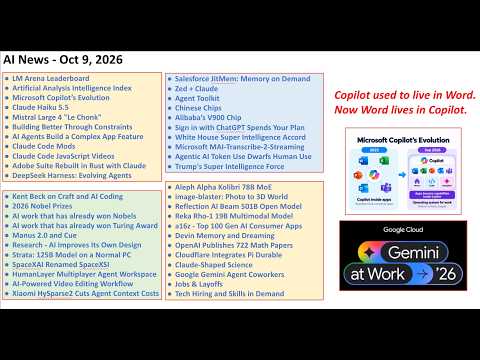 © Lev Selector
Models & Labsmodels
Mistral Large 4 and Claude Haiku 5.5 Released
Mistral releases Large 4 'Le Chonk' while Anthropic launches Claude Haiku 5.5, continuing the trend of cheaper, faster frontier models.
Lev Selector