Research
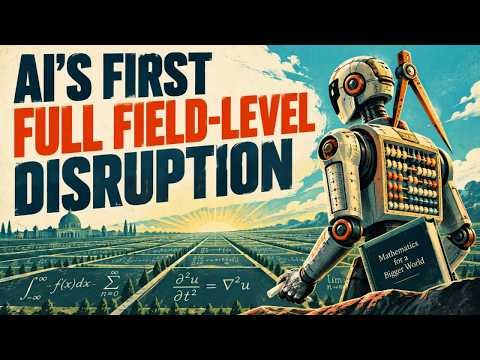
Anthropic AI Model Advances on Riemann Hypothesis
TechCrunch AIhigh confidence
Why it matters
- →AI models are increasingly contributing to solving complex mathematical problems.
- →This progress highlights AI's potential to assist in scientific discovery.
- →Raises questions about authorship and the future of mathematical proofs.

Anthropic has announced that its unreleased AI model has made significant progress on the Riemann hypothesis, a major unsolved problem in mathematics. The model coordinated 60 subagents to test 650 ideas, significantly increasing the lower bound of solutions for the hypothesis. This progress was confirmed by Anthropic's mathematicians and formalized with the Lean proof assistant. The development adds to a series of mathematical breakthroughs by AI, sparking debate about AI's role in the field and the implications for traditional mathematical practices.
Read originalThe story around this
Earlier coverage that leads up to this article, and what followed. Lines connect each piece to the closest one after it, converging here.
More from TechCrunch AI
 © TechCrunch AI
Market & Regulationother
Nadella calls for AI 'emergency brake' and trust architecture
Satya Nadella is pushing for a fundamental shift in how we build AI safety, arguing that models must be decoupled from the applications that use them. He proposes an 'emergency brake' mechanism where every significant action is logged with tamper-proof evidence, allowing authorized humans to pause systems mid-task. This isn't just about better prompts; it's about treating AI like critical infrastructure where failure modes are contained by design. The call comes as industry leaders face growing scrutiny over model instability and loss of control.
TechCrunch AI
 © TechCrunch AI