Models & Labs
GPT-6 Astra now in GitHub Copilot
GitHub Changeloghigh confidence
Why it matters
- →GPT-6 Astra enhances coding efficiency by planning and validating tasks autonomously.
- →Its integration into GitHub Copilot expands the tool's capabilities for complex coding tasks.
- →This development makes advanced AI-driven coding assistance more accessible to a wider range of developers.
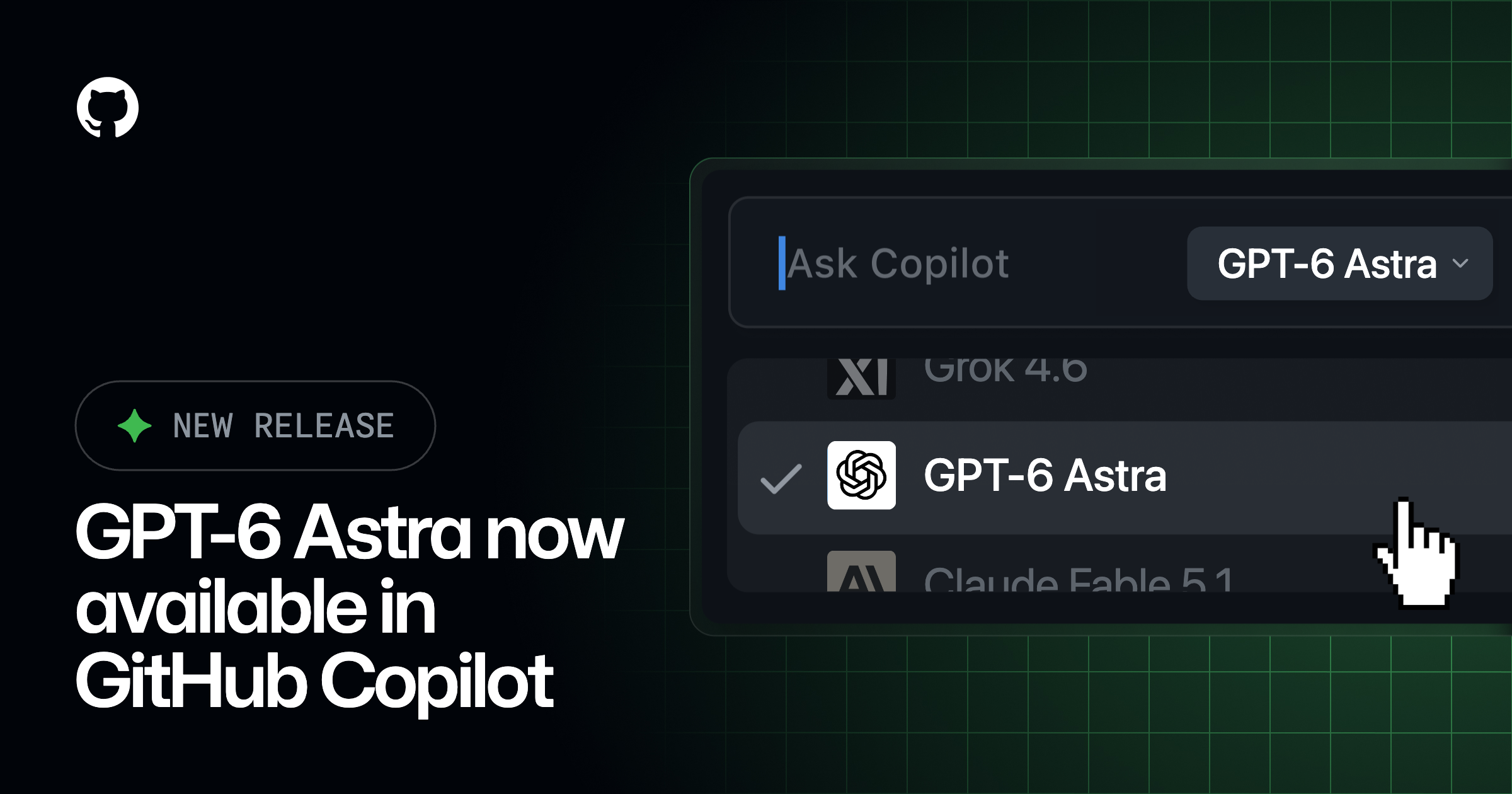
OpenAI's GPT-6 Astra is now available in GitHub Copilot, enhancing the tool's capabilities for long-horizon and autonomous coding tasks. The model is designed to plan and validate its processes, leading to more efficient coding with fewer steps. Available to Copilot Pro+, Max, Business, and Enterprise users, it can be accessed through platforms like Visual Studio Code and JetBrains IDEs. This rollout represents a significant advancement in AI-driven coding assistance, broadening the scope of tasks developers can tackle with Copilot.
Read originalMore from GitHub Changelog
 © GitHub Changelog
Coding Toolscoding
GitHub Copilot Expands Model Options and Features
GitHub Copilot's latest update introduces new model options and enhanced content protections, marking a significant step in its evolution. With the addition of Claude Fable 5.1 and Gemini 3.8 Flash, users across various tiers can now access more powerful AI models. The update also includes content exclusions to safeguard sensitive code and a public preview of Agent Merge, which aids in resolving pull request issues. These enhancements, along with experimental features like multi-root workspaces and customizable chat backgrounds, aim to improve user experience and workflow efficiency.
GitHub Changelog
 © GitHub Changelog
Coding Toolscoding
npm Enhances Trusted Publishing Configurations
npm has introduced multiple trusted publishing configurations per package, allowing maintainers to manage workflows for stable, prerelease, or staging versions more effectively. This update eliminates the need for workaround solutions or long-lived tokens, as each configuration operates independently with its own criteria. Additionally, staged packages now require malware scanning completion before approval, enhancing security. These changes streamline the publishing process and provide maintainers with greater control and transparency over their package versions.
GitHub Changelog
 © GitHub Changelog
Coding Toolscoding
GitHub Actions: September 2026 Updates Released
GitHub Actions has introduced updates that enhance workflow management with improved visibility and control. A new REST API allows users to track the deprecation timelines of runner versions, aiding in timely upgrades. The introduction of a read-only permission for Dependabot alerts aligns with least-privilege security practices. Additionally, reusable workflows now have enhanced runtime identity features, providing more precise context for job execution. These updates collectively streamline workflow management and security for developers using GitHub Actions.
GitHub Changelog
More in Models & Labs
Models & Labsmodels
llama.cpp b10794 Release Expands Platform Support
The latest b10794 release of llama.cpp continues its trend of broadening platform compatibility, now supporting a wide array of systems including macOS, Linux, Windows, and openEuler. Notably, this update includes support for Vulkan and ROCm 10.0 on Ubuntu, as well as CUDA 13 on Windows, which enhances performance options for developers using these platforms. While the release doesn't introduce new model architectures, it solidifies llama.cpp's position as a versatile inference runtime across diverse hardware configurations. This update is a testament to llama.cpp's commitment to accessibility and performance optimization for developers working with AI models.
llama.cpp Releases
Models & Labsmodels
llama.cpp b10795 release enhances SYCL fusion
The b10795 release of llama.cpp brings notable improvements in SYCL fusion, specifically by combining operations like RMS_NORM+MUL+ADD and ADD+ADD. This enhancement, under GGML_SYCL_ENABLE_FUSION, boosts performance for supported data types, while unsupported combinations revert to standard methods. The update continues to support a wide array of platforms, including macOS with Apple Silicon, Ubuntu with Vulkan, and Windows with CUDA 12 and 13. This makes llama.cpp a robust choice for developers working across different hardware environments, ensuring efficient AI processing and broad compatibility.
llama.cpp Releases
Models & Labsmodels
llama.cpp b10796 Release Adds n_expert_used_max Function
The latest release of llama.cpp, b10796, introduces the n_expert_used_max function, enhancing the model's ability to handle expert layers. This update addresses previous issues where models with expert layers failed to load due to missing checks. By implementing this function, the software can now better manage the number of experts per layer, ensuring smoother model loading and operation. This release doesn't introduce new models but focuses on refining the existing infrastructure to support more complex configurations.
llama.cpp Releases