Coding Tools
GitHub Copilot Assisted Permissions GA
GitHub Changeloghigh confidence
Why it matters
- →Reduces friction in AI-assisted coding by automating approval for safe commands.
- →Provides enterprise admins with granular control over AI agent permissions.
- →Enhances security by using LLMs to detect risky file or URL access.
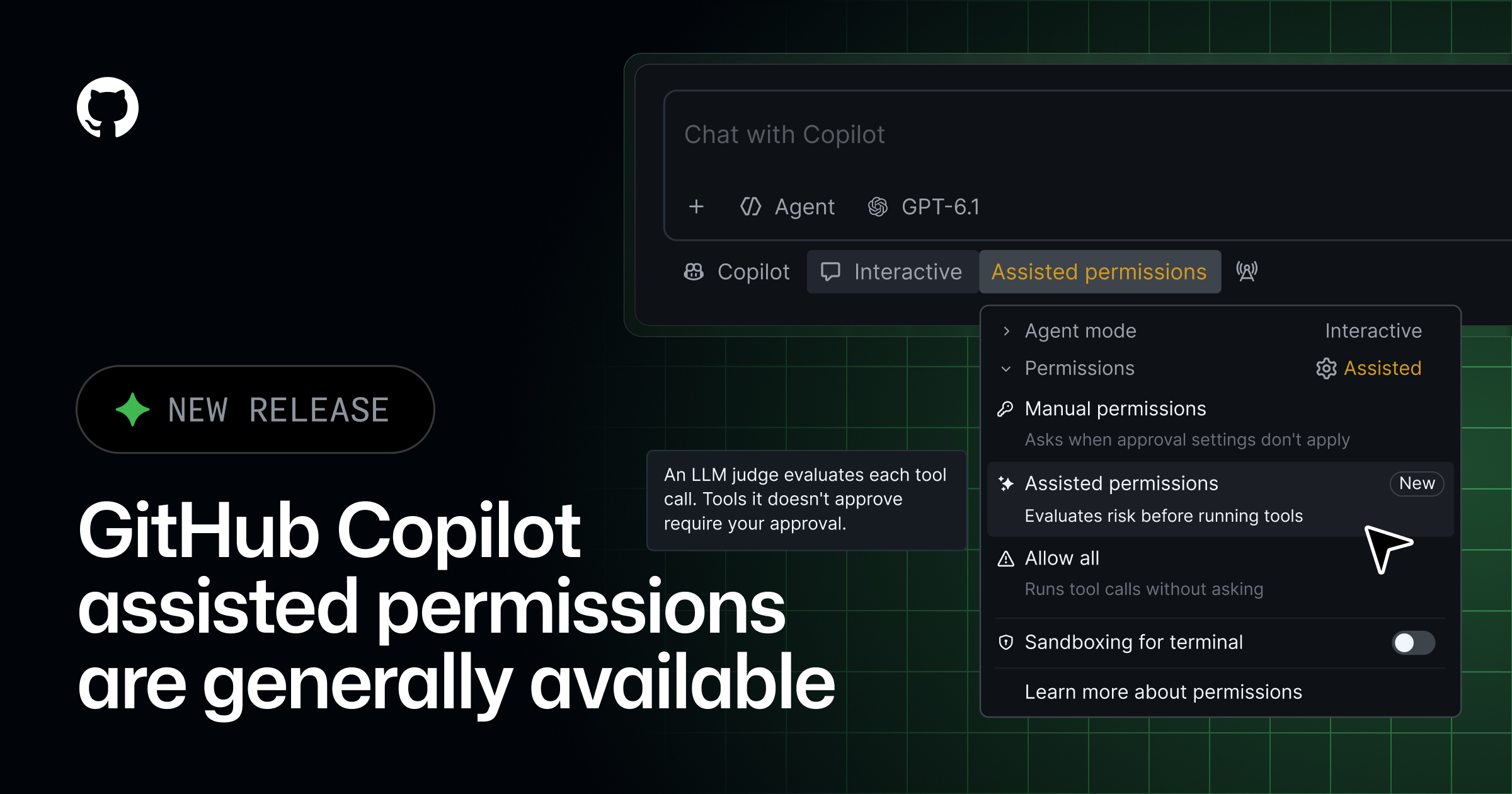
GitHub has made Copilot's assisted permissions generally available across its CLI, desktop app, and Visual Studio Code extension. The feature uses a large language model to evaluate AI-generated commands, automatically approving those classified as safe while flagging others for manual user approval. Enterprise administrators can configure default permission modes and restrict 'Allow All' settings to ensure security policies are enforced. This update aims to streamline developer workflows by reducing repetitive approval prompts for low-risk operations.
Read originalThe story around this
Earlier coverage that leads up to this article, and what followed. Lines connect each piece to the closest one after it, converging here.
How we got here
- 1GitHub Introduces Managed Permissions for Copilot
GitHub Changelog · September 9, 2026 · Same story
- 2GitHub Copilot Model Policy API GA
GitHub Changelog · October 19, 2026 · Same story
Follow this story
Open the full story →GitHub Copilot Assisted Permissions GA
3 developments
- Oct 26 · GitHub Changelog
GitHub Copilot Assisted Permissions GA (This article) - Oct 28 · GitHub Changelog
GitHub Copilot plugins GA with enterprise controls↳ GitHub Copilot plugins reach GA with enterprise controls allowing admins to mandate or block specific tools for security compliance. - Oct 28 · GitHub Changelog
GitHub Copilot adds session continuity and computer use↳ GitHub Copilot adds session continuity for cross-device work and experimental computer use for direct desktop app interaction.
More in Coding Tools
Coding Toolscoding
Claude Code v2.1.316: Subagents and Gateway Budgets
Anthropic is tightening control over Claude Code's autonomous behavior with new environment variables that let you disable 'ultrathink' or cap subagent effort levels. For teams, the introduction of pooled group budgets on the gateway allows shared monthly spending limits across members, a practical fix for enterprise cost management. The release also patches critical bugs where shell commands would hang or crash on exit, stabilizing the developer experience significantly.
Claude Code Releases
Coding Toolscoding
llama.cpp b12022 adds ROCm 10 and Snapdragon support
This release quietly cements llama.cpp as the universal inference runtime by finally bringing ROCm 10.0 to Linux and Windows alongside CUDA 13.4, effectively closing the hardware gap for AMD users who were previously left behind. The inclusion of native Snapdragon support on Linux marks a significant step toward running local LLMs on ARM-based mobile chips without emulation overhead. While KleidiAI on Apple Silicon is disabled in this build, the broader expansion to diverse accelerators ensures that developers aren't locked into NVIDIA ecosystems anymore.
llama.cpp Releases
Coding Toolscoding
llama.cpp b12023 fixes shared prefix bug
This release addresses a specific inference artifact where decision prefixes were incorrectly bleeding into output embeddings. By capping shared prefixes at the first output position, llama.cpp ensures that option tokens remain distinct for parent and child tasks. This is a targeted fix for multi-step reasoning or voting workflows rather than a performance boost. It stabilizes complex generation patterns without changing the underlying model architecture.
llama.cpp Releases