Coding Tools
Copilot JetBrains update adds model controls and MCP settings
GitHub Changeloghigh confidence
Why it matters
- →Enterprise admins can now enforce default agent models via managed settings while keeping user override options.
- →The new 'Fix' action in diagnostics streamlines the path from error detection to code repair using agent mode.
- →MCP automatic startup controls allow developers to manage resource usage and tool activation explicitly.

GitHub has released an update for the Copilot plugin in JetBrains IDEs, introducing granular controls for enterprise administrators and developers. Key features include managed settings to set default agent models, a new 'Fix' action in diagnostic menus that leverages agent mode, and MCP server startup toggles. The update also improves chat navigation, account management UI, and overall reliability across worktrees. Notably, support for JetBrains IDE version 2025.1 has been discontinued, requiring users to upgrade to 2025.2 or later.
Read originalThe story around this
Earlier coverage that leads up to this article, and what followed. Lines connect each piece to the closest one after it, converging here.
How we got here
- 1GitHub Copilot for JetBrains Enhances Model Management
GitHub Changelog · July 28, 2026 · Same story
- 2Copilot JetBrains 1.18 adds agent controls and shared skills
GitHub Changelog · September 23, 2026 · Same story
More from GitHub Changelog
 © GitHub Changelog
Coding Toolscoding
Copilot adds sandboxing and Claude Haiku 5.5
GitHub Copilot is tightening the leash on autonomous agents with local sandboxing, a critical step for enterprise security that restricts file, network, and credential access. The update also brings Claude Haiku 5.5 to all paid tiers, expanding the model lineup available within the IDE. Meanwhile, the CLI now integrates seamlessly with local Ollama instances, allowing developers to swap between cloud and local models without leaving their workflow. These changes shift Copilot from a simple autocomplete tool toward a more controlled, multi-model agent platform.
GitHub Changelog
 © GitHub Changelog
Coding Toolscoding
CodeQL 2.27.2 updates analysis and breaks macOS 27 support
CodeQL 2.27.2 tightens security coverage with new C++ regex parsing and SQL-injection models for Comdb2, while refining Rust async data flow. The release also corrects false positives in C# clickjacking and XSS queries, making enterprise scanning more precise. However, the most disruptive change is the abrupt loss of support for macOS 27 and Xcode 27 due to Apple dropping multi-architecture binaries, forcing developers to downgrade their toolchains for compiled language analysis. This update underscores the fragility of static analysis pipelines when underlying OS dependencies shift without warning.
GitHub Changelog
 © GitHub Changelog
Coding Toolscoding
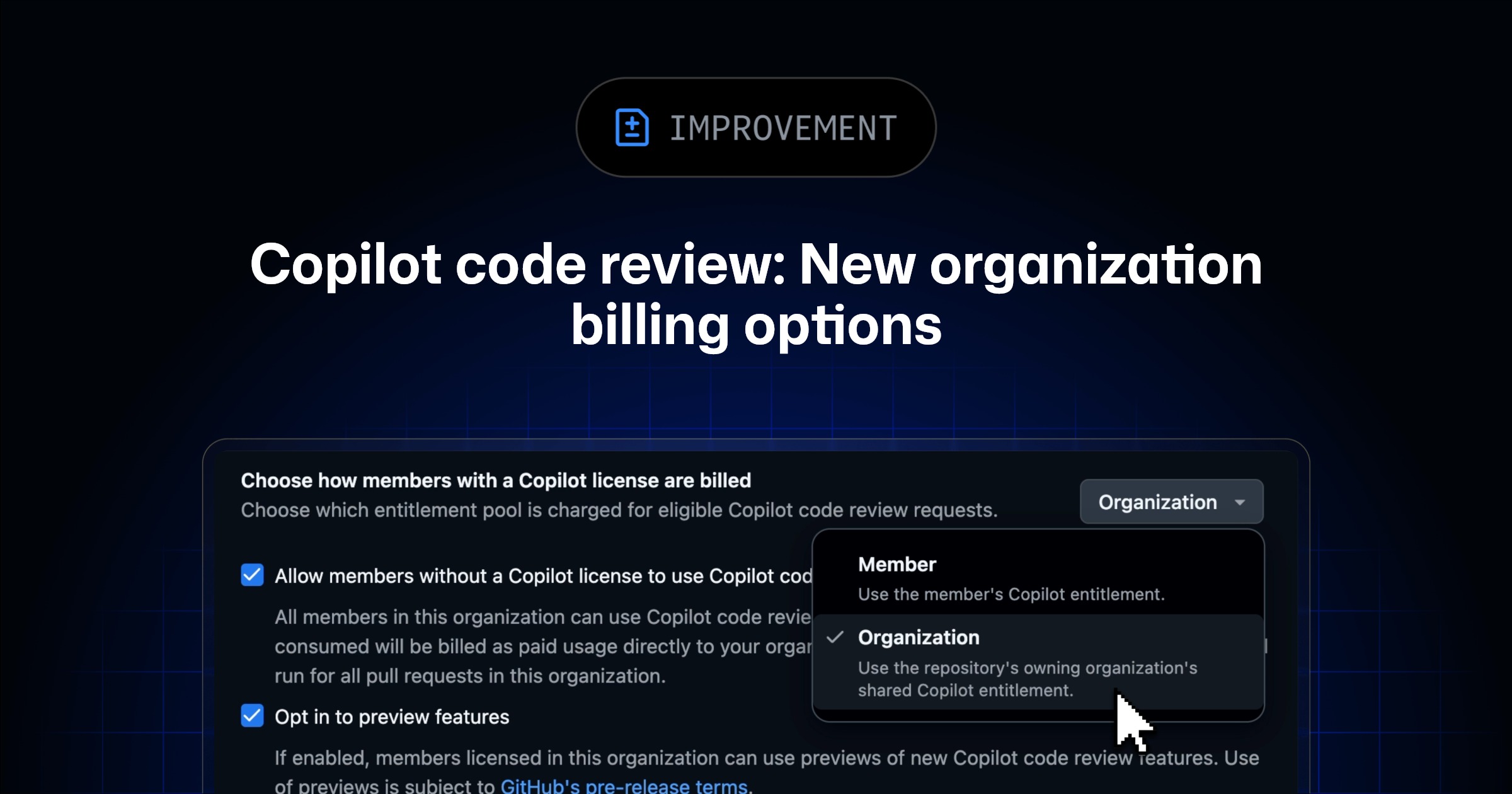
GitHub Copilot Code Review adds org billing controls
GitHub is tightening the leash on enterprise AI spending with new billing and access controls for Copilot Code Review. Organizations can now shift costs from individual member quotas to a central cost center using AI Credits, preventing personal license exhaustion from halting team workflows. Simultaneously, admins can block external licenses from triggering reviews, ensuring only authorized corporate accounts consume resources. This moves Copilot from a perk to a managed utility, giving finance teams actual visibility into AI consumption.
GitHub Changelog
More in Coding Tools
Coding Toolscoding
llama.cpp b11555 adds ROCm 10 and Snapdragon support
This release quietly cements llama.cpp as the universal inference runtime by finally bringing first-class ROCm 10.0 support to both Linux and Windows. AMD GPU users no longer need workarounds, effectively closing a long-standing parity gap with NVIDIA's CUDA ecosystem. The inclusion of Snapdragon AI stack binaries for Linux marks a significant expansion into mobile-edge hardware, while the addition of CUDA 13 builds future-proofs the tool against upcoming driver requirements. By standardizing these complex backend integrations into single downloadable binaries, the project removes friction for anyone deploying local models on non-NVIDIA silicon.
llama.cpp Releases
Coding Toolscoding
llama.cpp RPC logging overhaul
This release refactors llama.cpp’s RPC backend logging, turning a binary debug flag into a granular verbosity system. Developers can now trace tensor transfers and graph cache evictions with precision, which is critical for debugging distributed inference setups. The cleanup also unifies log handling across client and server sides, reducing noise and fixing format specifier bugs. It’s a maintenance win that makes diagnosing remote inference failures significantly easier.
llama.cpp Releases
Coding Toolscoding
llama.cpp b11558 fixes OpenCL and adds ROCm 10
This release quietly patches critical stability issues for OpenCL inference on Qualcomm hardware, ensuring q4_k dense bin kernels no longer crash when image limits are exceeded. It also brings ROCm 10.0 support to both Linux and Windows, keeping the project aligned with AMD's latest driver stack. While KleidiAI is temporarily disabled on macOS builds, the core value here is fixing fragmentation for non-NVIDIA users who rely on Vulkan or OpenCL for local LLMs.
llama.cpp Releases