Coding Tools
Together Link bridges open models to coding agents
Together AI Bloghigh confidence
Why it matters
- →Reduces coding agent costs by routing to cheaper open models like GLM 5.3.
- →Integrates directly into existing tools like Claude Code and Codex without workflow changes.
- →Provides dynamic model selection based on task complexity for optimal performance and price.
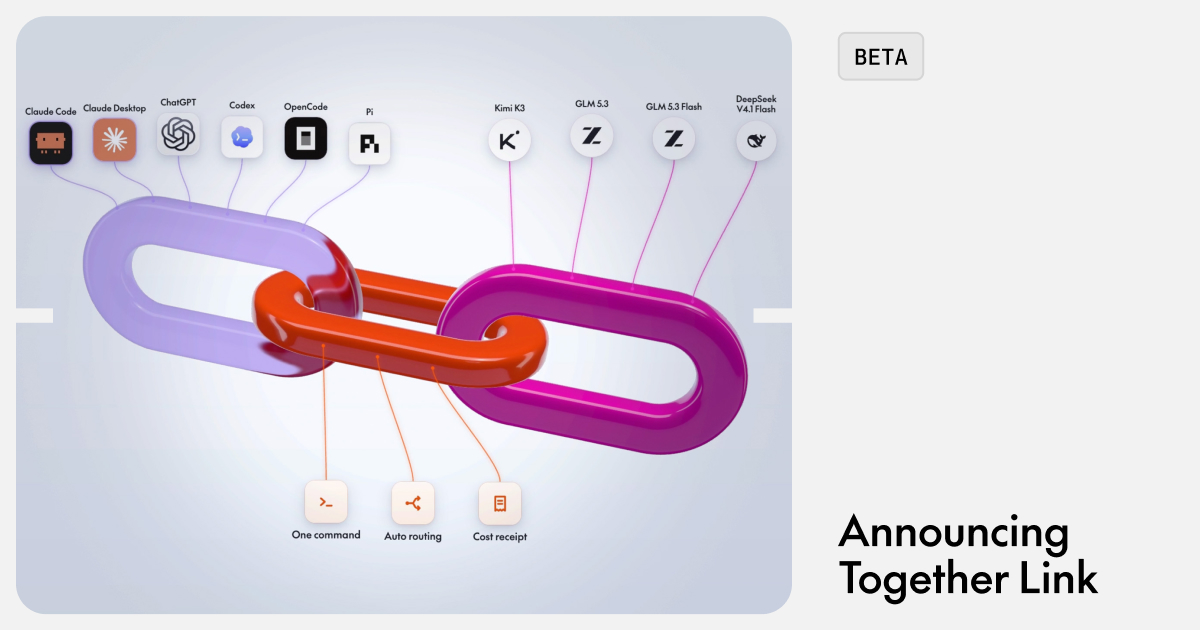
Together AI has launched Together Link, a tool that integrates open-source models into popular coding agents like Claude Code and Codex. The service routes tasks to models such as GLM 5.3 and Kimi K3 via Together's serverless infrastructure, aiming to reduce the high costs associated with premium closed models. Users can switch between native and open models using a single command, with automatic routing based on task complexity. The platform tracks per-session savings compared to using top-tier proprietary models.
Read originalThe story around this
Earlier coverage that leads up to this article, and what followed. Lines connect each piece to the closest one after it, converging here.
How we got here
- 1Benchmarking Open Models for Agentic Use
Hugging Face Blog · June 18, 2026 · Related
- 2Together AI Launches Provisioned Throughput for Open Models
Together AI Blog · July 8, 2026 · Same story
- 3AI Agents Transform Scientific Computing
OpenAI · July 28, 2026 · Related
- 4Together AI Enhances Model Inference Configuration
Together AI Blog · July 29, 2026 · Same story
- 5Strands Agents Integrate with Hugging Face for Seamless AI Training
Hugging Face Blog · August 13, 2026 · Related
- 6OpenAI's Coding Agents Boost Research Speed
OpenAI · September 6, 2026 · Related
- 7Open Source AI Software Factory Automates Coding Agents
Cole Medin · September 12, 2026 · Related
- 8Claude Code relaunches Projects for multi-agent coordination
The Verge AI · September 17, 2026 · Related
More in Coding Tools
Coding Toolscoding
Claude Code v2.1.290: Plugin hooks and agent stability fixes
This release significantly tightens the security model for Claude Code plugins by exposing server tool IDs and approval ceilings to hook functions, allowing developers to build more granular permission checks. It also stabilizes long-running agent sessions by fixing critical bugs in subagent resume logic and scheduled task persistence after compaction. For plugin authors, the new validation flags ensure gating hooks are properly configured before deployment. These changes make the platform safer for enterprise use while reducing friction for complex automated workflows.
Claude Code Releases
Coding Toolscoding
llama.cpp b11424 adds CUDA 13 and ROCm 10.0
This release quietly closes the hardware gap for local inference by adding default support for CUDA 13 and ROCm 10.0 alongside existing CUDA 12 builds. NVIDIA users can now leverage newer driver stacks without manual configuration, while AMD GPU owners finally get first-class parity with the same ease of use previously reserved for CUDA. Apple Silicon KleidiAI is disabled in this specific build, a notable regression for Mac users who rely on that optimization. The inclusion of Snapdragon and OpenVINO binaries further broadens the reach to edge devices and Intel hardware. It’s less about new features and more about llama.cpp solidifying its position as the universal runtime for every major accelerator.
llama.cpp Releases
Coding Toolscoding
llama.cpp b11425 adds ROCm 10 and Snapdragon support
This release quietly cements llama.cpp as the universal inference runtime by finally bringing first-class ROCm 10.0 support to both Linux and Windows. AMD GPU users no longer need workarounds, effectively closing a long-standing parity gap with NVIDIA's CUDA ecosystem. The inclusion of Snapdragon AI stack binaries for Linux marks a strategic push into ARM-based edge devices, while the simultaneous addition of CUDA 13 builds ensures compatibility with the latest driver stacks. By standardizing these hardware backends across major operating systems, the project removes friction for developers deploying models on diverse non-NVIDIA hardware.
llama.cpp Releases