Models & Labs
NVIDIA Unveils Jetson Thor for Robotics and Edge AI
NVIDIA Bloghigh confidence
Why it matters
- →NVIDIA's new modules enable mass-market deployment of intelligent machines.
- →The T3000 and T2000 offer scalable AI compute power for diverse applications.
- →New agent skills simplify development and optimize memory usage.
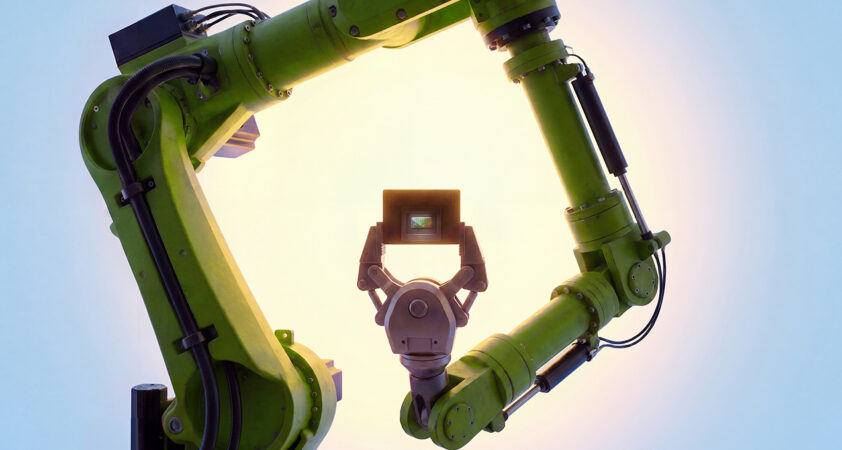
NVIDIA has launched the Jetson T3000 and T2000 modules, designed to enhance robotics and edge AI applications. These modules, part of the Thor architecture, offer significant AI compute power in a compact form, facilitating the deployment of intelligent machines in various industries. The T3000 delivers 865 FP4 teraflops of AI compute, while the T2000 provides a more accessible entry point for edge AI systems. This development expands NVIDIA's edge AI platform, offering scalable solutions and simplifying development with new agent skills for memory optimization.
Read originalThe story around this
Earlier coverage that leads up to this article, and what followed. Lines connect each piece to the closest one after it, converging here.
How we got here
- 1NVIDIA Wins COMPUTEX 2026 Best Choice Awards
NVIDIA Blog · May 21, 2026 · Related
- 2NVIDIA Launches Cosmos 3 for Physical AI
Hugging Face Blog · June 1, 2026 · Related
- 3NVIDIA Jetson Advances Agentic AI in Robotics
NVIDIA Blog · June 2, 2026 · Related
- 4Nvidia Unveils AI Agent-Centric Tech at COMPUTEX
The Rundown AI · June 2, 2026 · Related
- 5Nvidia Unveils Blueprint for Advanced Humanoid Robots
WIRED AI · June 3, 2026 · Same story
- 6NVIDIA Launches Nemotron 3 Ultra Model
Ollama Blog · June 4, 2026 · Related
- 7NVIDIA Unveils Nemotron 3 Ultra Model
Sam Witteveen · June 4, 2026 · Related
- 8NVIDIA Unveils Nemotron 3 Ultra for AI Agents
Matt Wolfe · June 5, 2026 · Related
What happened next
- 9NVIDIA Releases Cosmos 3 Edge for Robotics
Hugging Face Blog · July 20, 2026 · Related
- 10Nvidia Unveils Vera Rubin Chip System for AI Data Centers
WIRED AI · July 21, 2026 · Related
- 11AMD Unveils Helios AI Rack System
TechCrunch AI · July 23, 2026 · Background
- 12NVIDIA Jetson Orin Nano 2 targets edge AI for robots
AI News · August 26, 2026 · Same story
- 13Nvidia Expands AI Advantage Beyond GPUs
TechCrunch AI · August 29, 2026 · Related
Follow this story
Open the full story →NVIDIA Unveils Jetson Thor for Robotics and Edge AI
2 developments
- Jul 15 · NVIDIA Blog
NVIDIA Unveils Jetson Thor for Robotics and Edge AI (This article) - Jul 28 · NVIDIA Blog
NVIDIA Jetson: Compact AI Power for Developers↳ The Jetson Orin Nano Super delivers 67 trillion operations per second for edge AI development.
More in Models & Labs
Models & Labsother
llama.cpp b11193 adds Snapdragon Hexagon and ROCm 10
This release quietly expands llama.cpp's hardware support to include Qualcomm's Hexagon NPU on Linux arm64, a significant step for local inference on Snapdragon devices. It also updates CUDA builds to version 13.4 and introduces ROCm 10.0 binaries, keeping the project aligned with the latest NVIDIA and AMD driver ecosystems. KleidiAI on Apple Silicon is temporarily disabled in this build, likely due to stability checks rather than a feature rollback. For developers targeting edge AI or diverse GPU stacks, this update ensures broader compatibility without requiring custom compilation.
llama.cpp Releases
 © Lev Selector
Models & Labsmodels
NVIDIA NVFP4 and SoL-Pi Token Efficiency
NVIDIA introduced the NVFP4 4-bit format and SoL-Pi technology, which uses 2x fewer tokens for improved efficiency.
Lev Selector
© Lev SelectorModels & Labsmodels
Claude Opus 5.5 and GPT-6 Sol Released
Anthropic released Claude Opus 5.5 on September 22, while OpenAI launched GPT-6 Sol and Luna variants, advancing frontier model capabilities.
Lev Selector