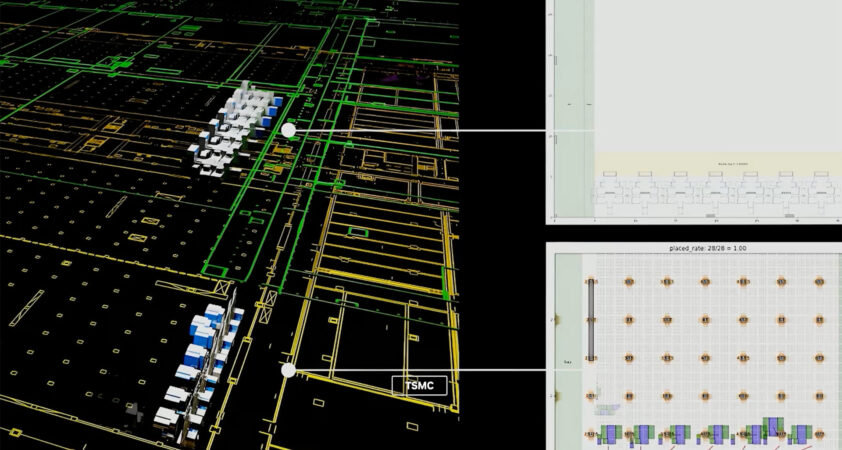
Taiwan's manufacturing leaders are significantly contributing to the global AI infrastructure buildout by partnering with NVIDIA. Companies such as TSMC, Foxconn, and Quanta Cloud Technology are utilizing NVIDIA's AI technologies to enhance their manufacturing processes. This collaboration involves applying AI to improve efficiency and adaptability in operations, from semiconductor production to robotics. The initiative highlights Taiwan's critical role in shaping the future of AI-driven manufacturing, setting new benchmarks for efficiency and innovation.
Read original
© NVIDIA BlogFinancial institutions are increasingly adopting transaction foundation models to unify and enhance their AI capabilities. These models, powered by NVIDIA's technology, allow firms to interpret consumer behavior in context, improving tasks like fraud detection and credit scoring. By leveraging transformer architectures, these models transform raw transaction data into actionable intelligence, reducing the need for handcrafted features and enabling more efficient AI deployment. This shift marks a significant evolution in how financial data is processed, offering a more integrated and scalable approach to AI in the industry.
© NVIDIA BlogNVIDIA's latest JetPack 7.2 release marks a significant step in bringing agentic AI capabilities to the physical world, particularly in robotics and industrial automation. By integrating the NemoClaw framework, Jetson devices can now deploy AI agents that automate complex tasks, from defect detection to autonomous decision-making. This update enhances the Jetson platform with improved performance and memory optimization, making it more accessible for developers to create sophisticated AI systems. The move from server-based AI to edge deployment signifies a shift towards more autonomous and efficient operations across various industries.
© NVIDIA BlogNVIDIA is broadening its AI Cloud ecosystem to cater to the surging global need for AI computational resources. By collaborating with partners worldwide, NVIDIA aims to position AI factories closer to data sources and users, thereby improving the efficiency of AI training, inference, and deployment. This expansion includes new partnerships in regions such as Southeast Asia, Australia, and the Americas, focusing on scalable and energy-efficient infrastructure. The initiative strengthens NVIDIA's role in the AI infrastructure sector, supporting applications from enterprise AI to national AI initiatives, and ensuring that AI capabilities are more accessible and effective.
© SiftedTilt, a London-based live commerce startup, has raised $26 million to expand its AI-driven shopping platform across Europe. This funding round, led by Vinted Ventures, highlights the growing interest in AI-enhanced retail solutions. Tilt plans to use the investment to improve its platform's capabilities and broaden its reach, potentially reshaping consumer interactions with online shopping. With support from Vinted Ventures, known for strategic investments, Tilt is poised to make a significant impact in the European market. This development positions Tilt to take advantage of the rising demand for innovative e-commerce experiences.
© TechCrunch AIAlphabet, the parent company of Google, is set to raise $80 billion through stock sales to bolster its AI infrastructure. This strategic move aims to address the growing demand for AI solutions from both enterprises and consumers. The funds will be directed towards capital expenditures to enhance global compute capabilities, with $10 billion coming from a stock sale to Berkshire Hathaway. This significant financial commitment reflects Alphabet's determination to maintain a competitive edge in the AI sector. By scaling its investments, Alphabet seeks to support the anticipated growth in AI services. This initiative positions the company to better meet future demands in the rapidly evolving AI landscape.
© TechCrunch AINvidia is making a bold move into the CPU market with its new RTX Spark chip, designed to power AI-driven PCs. This 'superchip' aims to transform how users interact with their computers, enabling AI agents to handle tasks traditionally done through manual input. With major PC manufacturers like Dell, HP, and Microsoft on board, these AI PCs promise enhanced performance for creators and gamers alike. The introduction of RTX Spark could redefine the PC landscape, offering a new level of AI integration and performance. However, the success of this venture will depend on pricing and market reception.