Coding Tools
GitHub Copilot adds feature-level engagement metrics
GitHub Changeloghigh confidence
Why it matters
- →Enables precise measurement of which Copilot features drive actual developer productivity.
- →Distinguishes between passive automation and active agent usage for better ROI analysis.
- →Provides rolling population data for more stable adoption trend tracking.
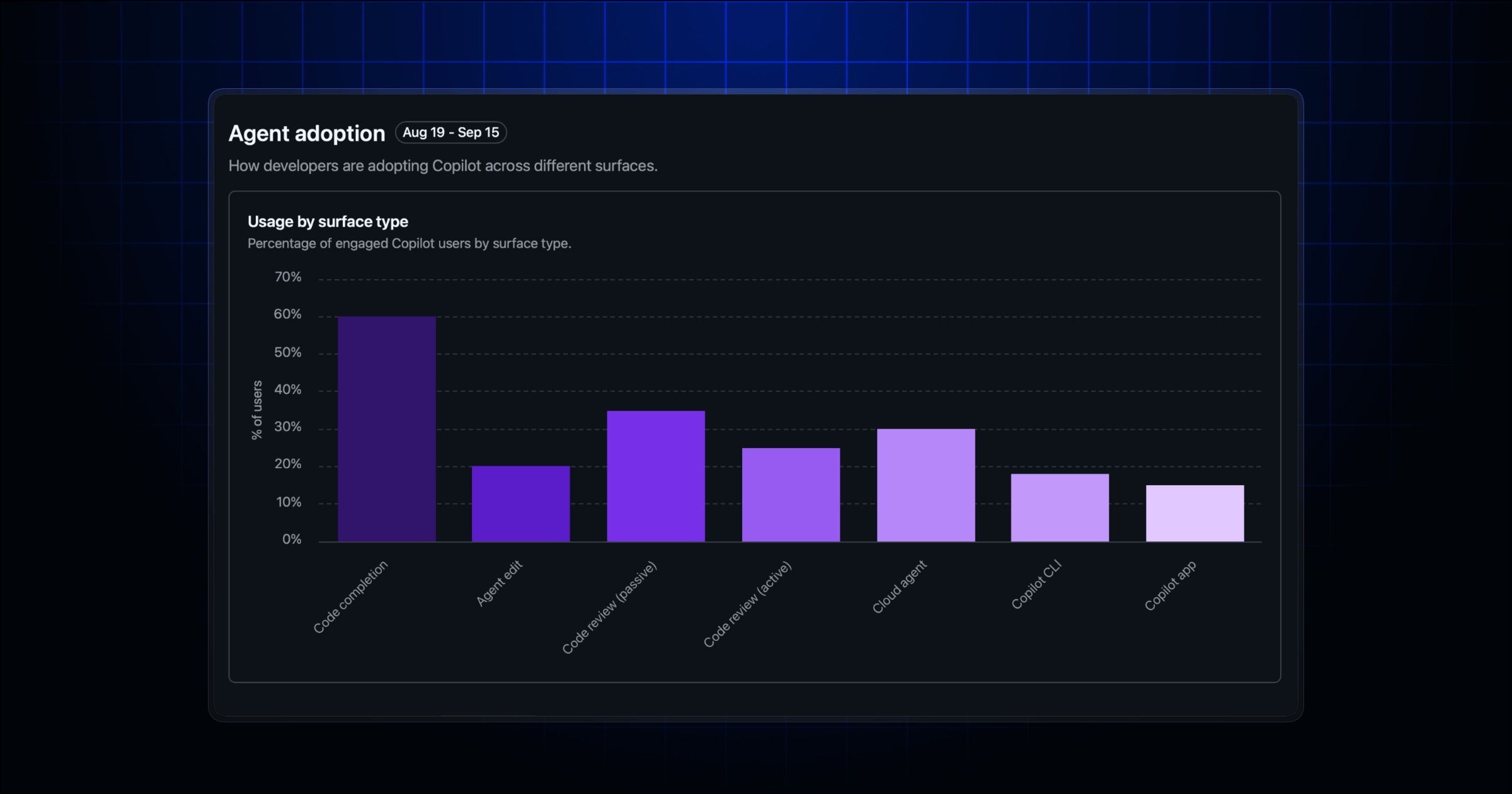
GitHub has updated its Copilot impact dashboard and associated APIs to display detailed feature engagement metrics for enterprise administrators. The update distinguishes between passive features, such as automatic code reviews, and active tools like agent edits and the CLI, providing a clearer picture of developer adoption. Additionally, AI adoption phase reporting now includes the full rolling 28-day population for each phase, offering a more stable metric than previous daily-active-only counts. These changes are available to enterprise owners and billing managers with the appropriate permissions.
Read originalMore from GitHub Changelog
 © GitHub Changelog
Coding Toolscoding
GitHub Copilot CLI adds agentic usage metrics
GitHub is finally giving enterprise admins visibility into how developers actually use Copilot CLI customizations. The new API fields track interaction counts and distinct usage for skills, custom agents, MCP servers, slash commands, and plugins across per-user and aggregate reports. This moves beyond simple seat utilization to measure which automations are gaining traction and where enablement gaps exist. It’s a necessary step for justifying AI infrastructure spend, though the privacy-preserving anonymization of customer-defined names limits granular auditing.
GitHub Changelog
 © GitHub Changelog
Coding Toolscoding
GitHub Actions ubuntu-latest migrates to Ubuntu 26.04
The default runner for GitHub Actions is shifting from Ubuntu 24.04 to 26.04, a move that will silently update workflows using the ubuntu-latest label between October and November 2026. This isn't just a patch; it's a full OS upgrade that removes or updates core tools, meaning builds relying on specific package versions could break without warning. Developers need to proactively pin their runners to ubuntu-24.04 if they aren't ready, or test against the new image now to avoid mid-migration failures. The window is wide, but the risk of silent breakage makes this a mandatory maintenance task for any active CI/CD pipeline.
GitHub Changelog
 © GitHub Changelog
Coding Toolscoding
GitHub Actions execution protections GA
GitHub is hardening CI/CD pipelines by making workflow execution protections generally available, targeting the notorious pull_request_target vulnerability. The update adds granular control via workflow file targeting, allowing teams to lock down specific deployment scripts while leaving CI open. A new REST API enables policy-as-code management at scale, and automated enforcement for public repos begins in November 2026. This shifts security from manual configuration to a structured, auditable governance layer.
GitHub Changelog
More in Coding Tools
Coding Toolscoding
llama.cpp b11017 adds CUDA 13 and ROCm 10 builds
This release quietly extends llama.cpp's hardware support to the latest NVIDIA and AMD stacks. By shipping native binaries for CUDA 13 and ROCm 10, it ensures compatibility with newer GPU architectures without requiring users to compile from source. The inclusion of both CUDA versions side-by-side is a pragmatic move for enterprise environments managing mixed infrastructure. While no new model formats are introduced, this update keeps the runtime relevant as hardware vendors push their latest drivers.
llama.cpp Releases
Coding Toolscoding
llama.cpp b11018 adds CUDA 13 and ROCm 10 builds
This release quietly cements llama.cpp as the universal inference runtime by finally supporting NVIDIA's latest CUDA 13 stack alongside AMD's ROCm 10. For the first time, users on cutting-edge hardware can run local models without being forced into legacy driver versions or waiting for vendor-specific optimizations. The inclusion of both CUDA 12 and 13 binaries side-by-side removes a major friction point for developers managing mixed environments. While no new model architectures are added, this infrastructure update ensures compatibility with the fastest consumer and data center GPUs hitting the market right now.
llama.cpp Releases
Coding Toolscoding
llama.cpp b11019 fixes embedded GGUF loading bugs
This release patches a subtle but critical bug where embedding a GGUF file inside another container caused tensor data corruption due to misaligned memory mapping. The fix ensures the data section is aligned relative to the GGUF header rather than the outer file offset, preventing silent errors that could ruin inference results. It also adds support for loading LoRA adapters via FILE pointers and disables mmap with a warning when alignment issues are detected. This stabilizes llama.cpp for complex packaging scenarios where models are bundled within larger archives or custom formats.
llama.cpp Releases