Models & Labs
Claude Code v2.1.219 Update Released
Claude Code Releaseshigh confidence
Why it matters
- →The introduction of Claude Opus 5 as the default model enhances processing capabilities with a 1M context.
- →Improved error handling and security settings increase reliability for developers.
- →Support for deeper nested subagents expands the tool's flexibility for complex workflows.
Claude Code has released version 2.1.219, featuring the new Claude Opus 5 model as the default, which supports a 1M context and offers fast mode pricing. The update enhances security with a sandbox.network.strictAllowlist setting and improves error handling by categorizing failures. Additionally, the update allows nested subagent forwarding up to a depth of three, increasing the tool's flexibility for complex tasks. These improvements aim to make Claude Code more robust and adaptable for developers.
Read originalThe story around this
Earlier coverage that leads up to this article, and what followed. Lines connect each piece to the closest one after it, converging here.
What happened next
- 1Claude Code v2.1.218 Update Released
Claude Code Releases · July 25, 2026 · Same story
- 2Claude Code v2.1.232 Release
Claude Code Releases · August 14, 2026 · Same story
More from Claude Code Releases
Coding Toolscoding
Claude Code v2.1.292 patches security and agent logic
This release tightens the leash on Claude Code's autonomous capabilities while fixing critical sandbox escapes. The new effort parameter for Agent tools lets developers explicitly control sub-agent depth, a necessary guardrail as these systems grow more complex. Security fixes are prominent, addressing how plugins handle network paths and how file permissions persist during session resumption. It’s a stability patch that ensures the tool remains usable in enterprise environments without compromising on the new agent features.
Claude Code Releases
Coding Toolscoding
Claude Code v2.1.293 updates Haiku and fixes agent bugs
Anthropic quietly shipped a significant model update alongside routine maintenance. Claude Haiku 5.5 is now the default on the API, offering a 1M context window at $0.10 per million tokens, which lowers the cost floor for high-volume coding tasks. The release also patches critical stability issues in the local agent runtime, specifically fixing memory leaks in HTTP MCP connections and resolving session state corruption during context compaction. These fixes matter because they stabilize the autonomous coding workflow that developers rely on daily. With Haiku 5.5 now standard, teams can deploy cheaper, faster iterations without manual configuration.
Claude Code Releases
Coding Toolscoding
Claude Code v2.1.294 fixes hook logic
Anthropic quietly patched a frustrating edge case in Claude Code’s agent hooks. Previously, instructions like 'Block commands that...' were often ignored because the model didn't recognize them as valid blocking criteria. This update ensures those prompts are properly interpreted, while also refining how stop conditions are judged to prevent premature termination. It’s a small but necessary fix for anyone relying on strict guardrails in automated coding workflows.
Claude Code Releases
More in Models & Labs
Models & Labsmodels
llama.cpp b11535 release with ROCm 10 and CUDA 13
This release quietly cements llama.cpp as the universal inference runtime by adding default support for ROCm 10.0 and CUDA 13.4 across Linux and Windows. AMD GPU users finally get parity with NVIDIA's latest driver stack without manual configuration, while Apple Silicon KleidiAI builds are temporarily disabled to resolve stability issues. The inclusion of Snapdragon NPU support on Linux signals a serious push into edge AI hardware beyond just x86 and ARM CPUs. It is less about new features and more about ensuring the toolchain keeps pace with the rapidly evolving GPU landscape.
llama.cpp Releases
Models & Labscoding
llama.cpp b11540 adds ROCm 10 and CUDA 13 support
This release quietly closes the hardware gap for local inference by adding default builds for ROCm 10.0 and CUDA 13.4 across Linux and Windows. AMD users finally get parity with NVIDIA in the binary distribution, while CUDA 13 support future-proofs setups on newer drivers. The inclusion of Snapdragon and OpenVINO binaries further broadens the hardware surface area without requiring custom compilation. It is a pragmatic update that makes llama.cpp the most accessible runtime for diverse local AI hardware.
llama.cpp Releases
 © Lev Selector
Models & Labsmodels
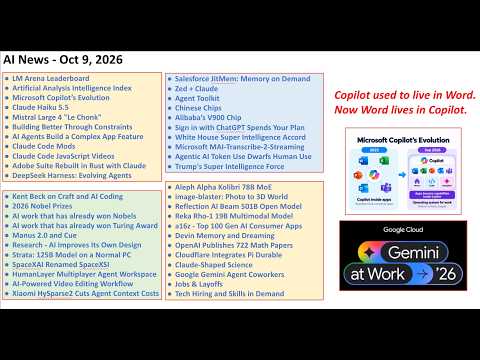
Mistral Large 4 and Claude Haiku 5.5 Released
Mistral releases Large 4 'Le Chonk' while Anthropic launches Claude Haiku 5.5, continuing the trend of cheaper, faster frontier models.
Lev Selector