Research
AgentHands: Enhancing XR with Interactive Hand Gestures
Google Research Bloghigh confidence
Why it matters
- →AgentHands enhances user engagement by synchronizing gestures with speech in XR environments.
- →It bridges the gap between verbal instructions and physical demonstrations, reducing cognitive load.
- →This innovation represents a shift towards more human-centric AI interactions in spatial computing.
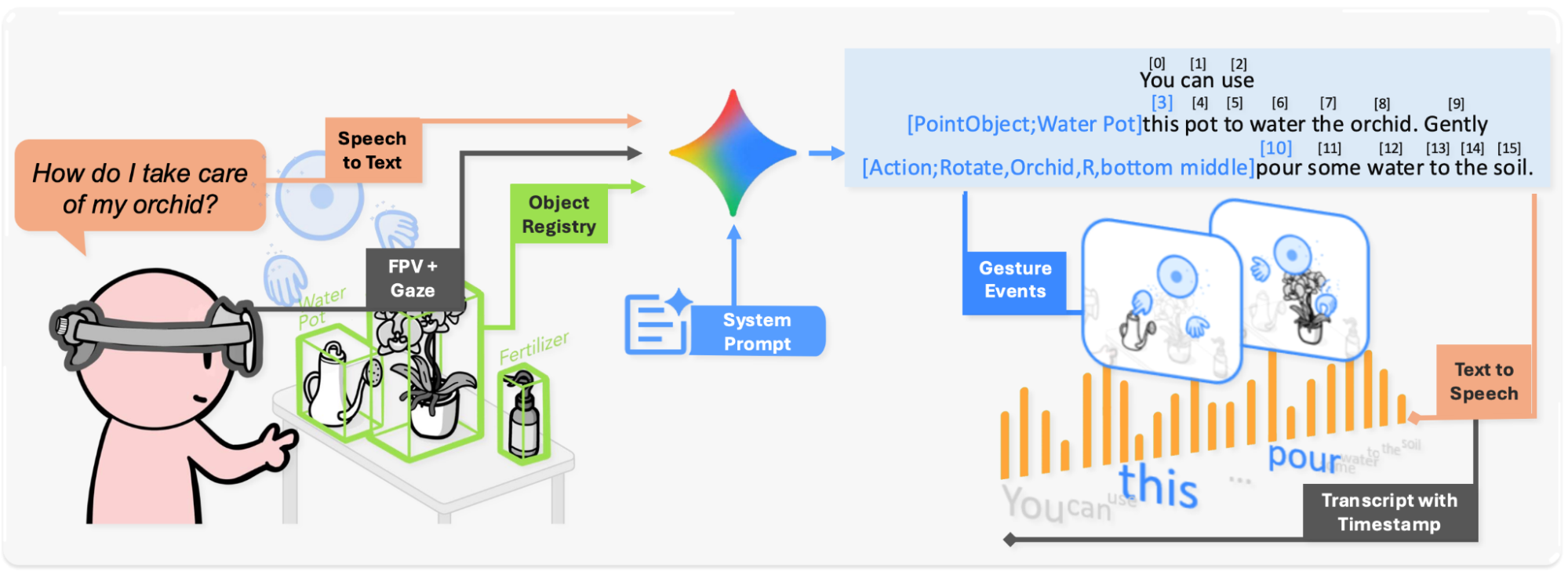
Google Research has unveiled AgentHands, a prototype that enhances XR interactions by integrating synchronized hand gestures with AI conversations. This system uses LLMs to map high-level reasoning into precise physical motions, allowing AI agents to provide spatially grounded guidance. By transforming verbal instructions into intuitive gestures, AgentHands aims to make interactions more natural and engaging. This development represents a significant step towards more human-centric AI systems that operate dynamically within our physical environments.
Read originalMore from Google Research Blog
 © Google Research Blog
Researchresearch
AI Tool Prioritizes Biomarkers from Wearable Data
Google Research has unveiled the Biomarker Discovery Framework, a multi-agent AI system designed to prioritize candidate biomarkers from wearable sensor data. This framework addresses the challenge of turning vast physiological data streams into clinically meaningful insights by combining hypothesis generation, statistical analysis, and literature-grounded reasoning. It successfully identified 41 mental health and 25 metabolic biomarkers across large cohorts, demonstrating its potential to enhance predictive performance when integrated with demographic data. By maintaining human oversight and rigorous statistical validation, this tool represents a significant step forward in digital medicine research.
Google Research Blog
 © Google Research Blog
Researchresearch
Google's ME-POIs Enhances AI's Understanding of Places
Google Research has introduced a novel framework called Mobility-Embedded POIs (ME-POIs) that enhances AI models' understanding of real-world places by integrating mobility data with traditional text-based representations. This approach allows AI to capture the dynamic rhythms of places, improving predictions about attributes like busyness and price levels. By combining text descriptions with anonymized mobility patterns, ME-POIs creates a more holistic representation of places, leading to significant accuracy gains in various predictive tasks. This development marks a shift in how AI models can perceive and interpret the physical world, moving beyond static metadata to a richer, context-aware understanding.
Google Research Blog
More in Research
 © EleutherAI Blog
Researchresearch
EleutherAI Explores AI Lie Detection in Aletheia's Quest
EleutherAI's participation in Aletheia's Quest, a competition focused on AI lie detection, has shed light on the intricacies of identifying AI-generated falsehoods. Organized by Cadenza Labs and NDIF, the event tasked teams with developing lie detectors using both black-box and white-box methods on models with up to 120 billion parameters. EleutherAI discovered that black-box monitoring can be surprisingly effective, while white-box probes often struggle outside their training scenarios. This research highlights the challenges in evaluating AI deception as models become more advanced, particularly in detecting subtle forms of deception that go beyond simple factual errors.
EleutherAI Blog
Researchresearch
MIT AI predicts extreme weather without past data
MIT engineers have developed an AI tool that forecasts extreme weather events without relying on historical disaster data. This innovation, called Extreme Event Aware or η-learning, allows for the prediction of statistically-possible events that have not yet occurred, offering new insights for city planners and insurers. By using point statistics and spatial maps, the tool can generate scenarios like a storm with unprecedented rainfall levels. This approach could significantly enhance preparedness for rare but potentially devastating weather events, providing a new layer of resilience planning.
AI News
 © Hugging Face Blog
Researchresearch
4-bit Model Outperforms Full-Precision Original
Hugging Face's latest research introduces Quantization-Aware Healing (QAH), a method that allows a compressed, 4-bit model to outperform its full-precision counterpart. By distilling directly from the original, pre-compression model, QAH avoids the limitations of traditional quantization-aware training. This approach not only enhances accuracy but also improves training stability, as demonstrated by a GPT-OSS 120B model that excels on 7 out of 9 benchmarks. The innovation lies in using a full-size, full-precision teacher to guide the smaller, quantized student, resulting in a model that is both efficient and highly capable.
Hugging Face Blog