Models & Labs
Claude Fable 5.1 Now in GitHub Copilot
GitHub Changeloghigh confidence
Why it matters
- →Claude Fable 5.1 enhances GitHub Copilot with advanced capabilities for complex coding tasks.
- →The model's data retention requirement introduces new considerations for enterprise users.
- →This release signifies a deeper integration of AI into mainstream development tools.
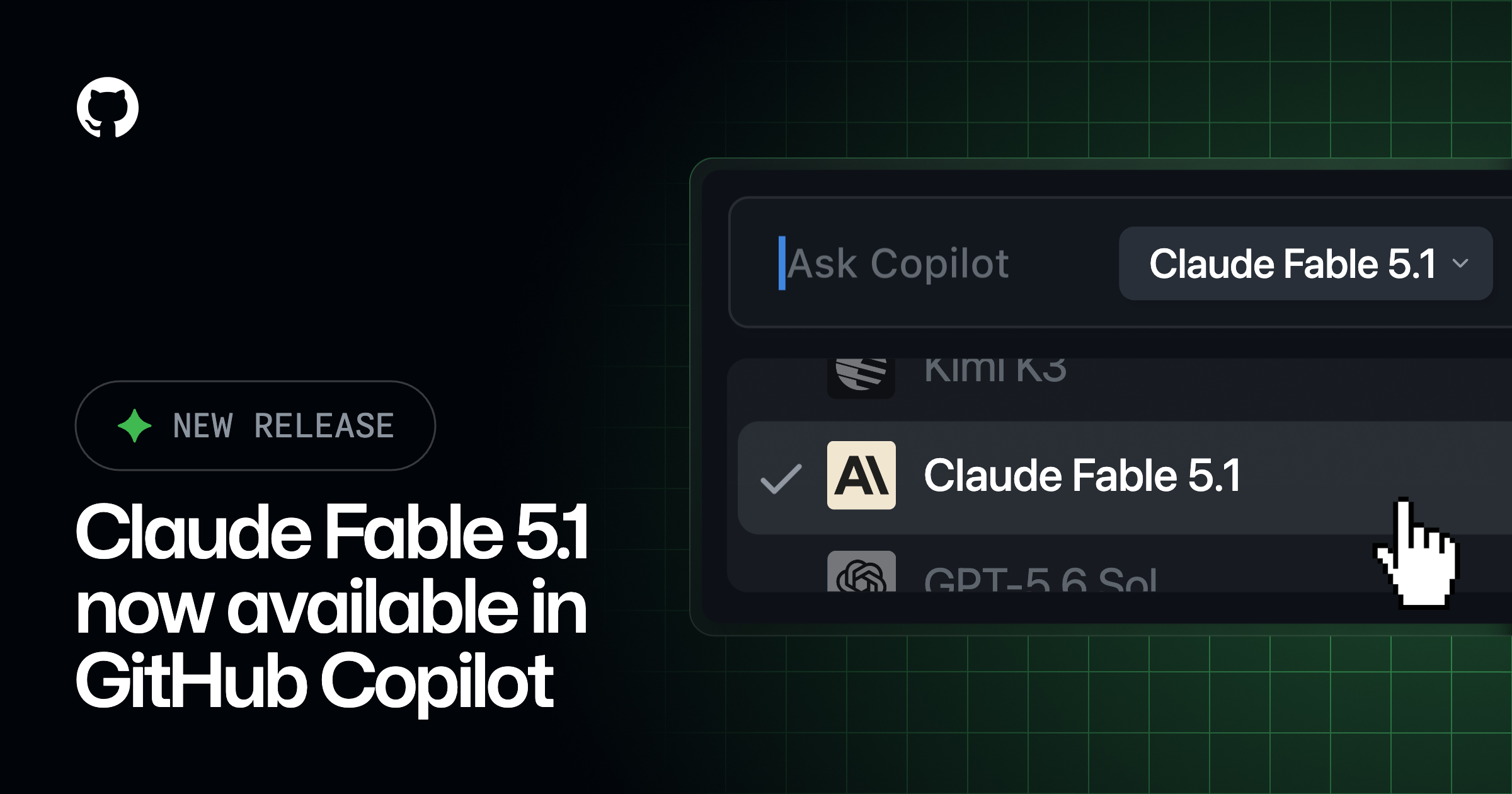
Anthropic's Claude Fable 5.1 model is now generally available in GitHub Copilot, aimed at improving long-horizon coding and knowledge tasks. The model is part of Anthropic's Mythos class and is designed for deep codebase research and complex workflows. Unlike previous models, Claude Fable 5.1 requires data retention by default to operate safety classifiers, although zero data retention is available for eligible enterprise customers. This integration into GitHub Copilot represents a significant enhancement for developers seeking advanced AI support in their coding environments.
Read originalThe story around this
Earlier coverage that leads up to this article, and what followed. Lines connect each piece to the closest one after it, converging here.
How we got here
- 1Anthropic Launches Claude Fable 5 and Mythos 5
Anthropic · June 9, 2026 · Same story
- 2Anthropic Releases Claude Fable 5 with Safety Measures
WIRED AI · June 9, 2026 · Same story
- 3Claude Fable 5 now available in GitHub Copilot
GitHub Changelog · June 9, 2026 · Same story
- 4Anthropic Releases Claude Fable 5 and Mythos 5
Skill Leap AI · June 9, 2026 · Same story
- 5Anthropic Releases Claude Fable 5 to Public
The Rundown AI · June 10, 2026 · Same story
- 6Anthropic Releases Claude Fable Model
Fireship · June 11, 2026 · Same story
- 7Claude Fable 5 Capabilities Explored
The AI Advantage · June 12, 2026 · Same story
- 8Claude Opus 5 Now in GitHub Copilot
GitHub Changelog · July 24, 2026 · Same story
What happened next
- 9Anthropic releases Claude Opus 5.5 with tighter security
The Verge AI · September 22, 2026 · Same story
- 10Anthropic releases official Claude Code playbook for Opus 5.5
Duncan Rogoff · September 23, 2026 · Same story
- 11Claude Code v2.1.284 adds Sonnet 5.5
Claude Code Releases · September 30, 2026 · Same story
- 12Anthropic ships Claude 3.5 updates and new apps
Duncan Rogoff · October 21, 2026 · Related
- 13Claude Code v2.1.311 fixes critical session stability bugs
Claude Code Releases · October 28, 2026 · Related
Follow this story
Open the full story →Claude Fable 5.1 Now in GitHub Copilot
7 developments
- Sep 1 · GitHub Changelog
Claude Fable 5.1 Now in GitHub Copilot (This article) - Sep 1 · TechCrunch AI
Anthropic's Fable 5.1: Cheaper, Less Restrictive AI↳ Fable 5.1 reduces token costs, eases restrictions, and offers zero data retention for on-premise use. - Sep 1 · The Verge AI
Anthropic launches Claude Fable 5.1 with cost savings - Sep 1 · Wes Roth
Anthropic releases Claude Fable 5.1 with cheaper caching - Sep 2 · The Rundown AI
Anthropic launches Claude Fable 5.1 model - Sep 3 · Matt Wolfe
Anthropic Introduces Claude Fable and Mythos 5.1 - Sep 4 · AI Explained
Anthropic Releases Fable 5.1 and Mythos Models
More in Models & Labs
Models & Labsmodels
llama.cpp b12029 adds CUDA 13 and Snapdragon support
This release quietly cements llama.cpp as the universal inference runtime by finally supporting NVIDIA's latest CUDA 13 stack alongside AMD's ROCm 10.0. The inclusion of native builds for Linux arm64 with Snapdragon chips, covering CPU, Adreno GPU, and Hexagon NPU, signals a serious push into mobile edge deployment. While Apple Silicon KleidiAI is disabled in this specific build, the broader hardware coverage means developers no longer need to compile from source for most modern accelerators. It’s less about new features and more about removing friction for anyone running local models on bleeding-edge or diverse hardware.
llama.cpp Releases
 © The Verge AI
Models & Labsother
Apple Intelligence arrives in China via iOS 27.3
Apple is finally unlocking its AI suite for Chinese users with the iOS 27.3 beta, marking a significant regulatory milestone after months of approval delays. The rollout relies on Alibaba’s Qwen model rather than OpenAI, integrating features like notification summaries and visual intelligence directly into the OS. By sidestepping the new Siri in favor of established text and image tools, Apple is prioritizing immediate utility over the full generative experience. This move effectively brings Apple’s AI capabilities to a massive new market, albeit with localized constraints that distinguish it from the global release.
The Verge AI
 © Matt Wolfe
Models & Labsmodels
Google Releases Gemini 4 Carbon for Cost-Efficient Inference
Google launched Gemini 4 Carbon, a new model variant aimed at providing high performance at a lower cost for inference tasks.
Matt Wolfe