Models & Labs
GLM 5.3 Flash: Z.AI's Cost-Efficient Model Variant
Sam Witteveenhigh confidence
Why it matters
- →GLM 5.3 Flash offers a cheaper inference option without significant performance drops.
- →It enables developers to scale AI applications more cost-effectively.
- →Demonstrates Z.AI's strategy of providing tiered model options for different needs.
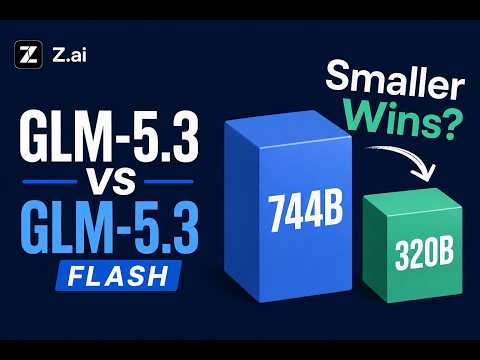
Z.AI has launched GLM 5.3 Flash, a streamlined version of its flagship GLM 5.3 model designed for cost-effective deployment. The new variant maintains strong benchmark performance while offering reduced latency and lower inference costs compared to the full model. This release provides developers with a viable option for scaling AI applications where budget and speed are critical factors. The move underscores the industry trend toward optimizing large language models for practical, high-volume use cases.
Read originalMore from Sam Witteveen

More in Models & Labs
Models & Labscoding
llama.cpp b10996 adds CUDA 13 and ROCm 10.0 builds
This release quietly closes the hardware gap for local inference by adding native support for CUDA 13 and ROCm 10.0 across Linux and Windows. NVIDIA users can now leverage newer driver stacks without waiting for upstream updates, while AMD GPU owners finally get first-class ROCm 10 binaries that match the maturity of their CUDA counterparts. Apple Silicon builds remain available but KleidiAI is explicitly disabled here, suggesting a focus on stability over new kernel optimizations for this specific iteration. The inclusion of openEuler support for Huawei's Ascend chips further broadens the ecosystem beyond standard x86 and ARM consumer hardware.
llama.cpp Releases
Models & Labsmodels
Llama.cpp b10981 release enhances OpenVINO support
The latest b10981 release of llama.cpp brings significant improvements to OpenVINO integration, particularly in optimizing stateful decode and GPU MoE inference. By addressing issues like stateful decode errors and enhancing the handling of sliding-window layers, this update ensures more reliable and efficient model performance. The release also introduces new features such as the GGML_OPENVINO_REQUANT_KQUANT for 4-bit requantization and improved handling of multi-head models. These changes make llama.cpp more robust and versatile, especially for developers working with complex AI models on diverse hardware setups.