Coding Tools
GitHub adds repo protection status to security assessments
GitHub Changeloghigh confidence
Why it matters
- →Helps security teams prioritize remediation based on actual exposure rather than just vulnerability severity.
- →Clarifies risk landscape by distinguishing between protected and unprotected repository states.
- →Reduces noise in security assessments by highlighting where branch protection rules are lacking.
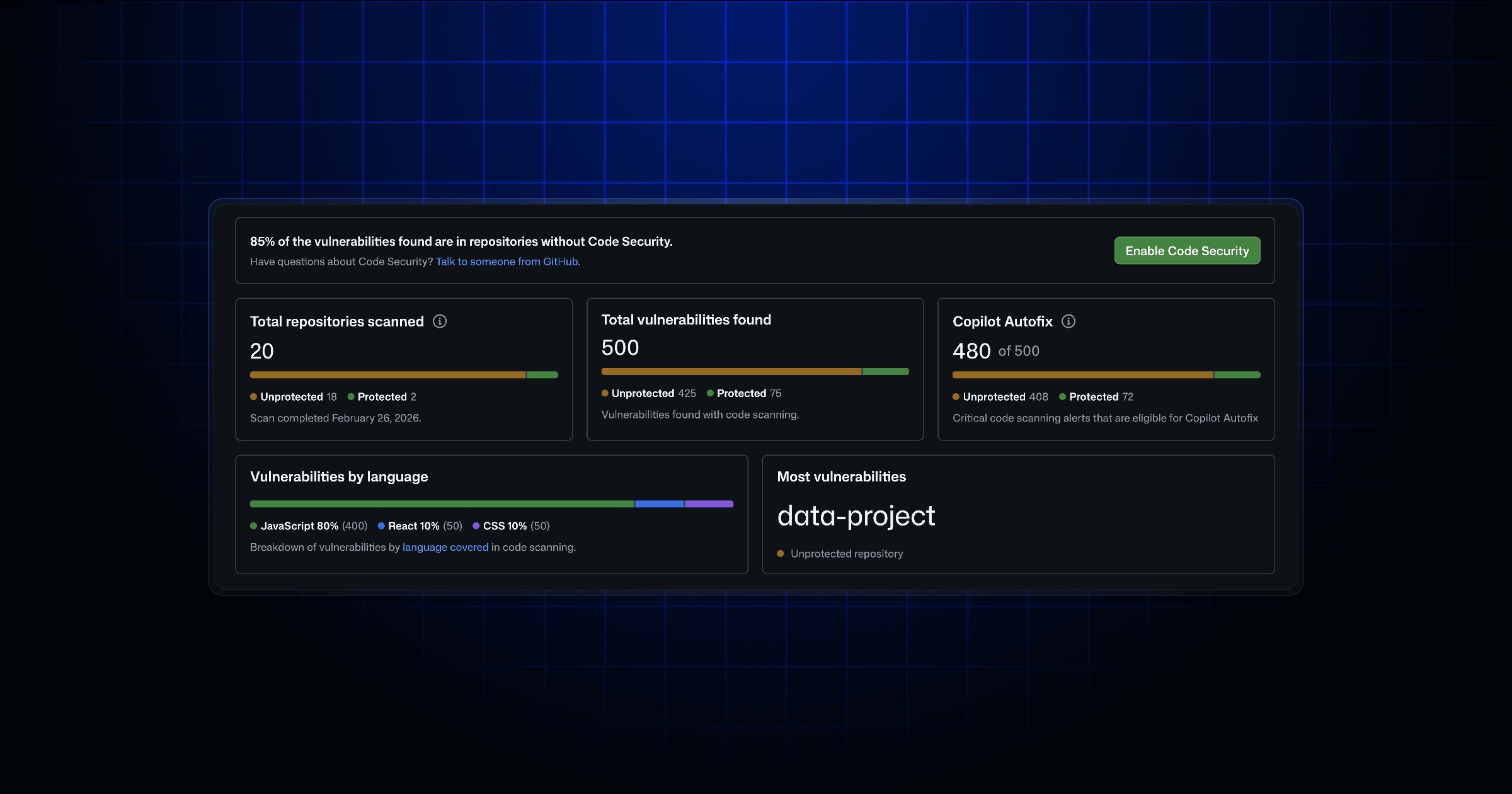
GitHub has updated its code and secret risk assessment tools to indicate whether identified vulnerabilities are located in protected or unprotected repositories. This feature is available for organization admins and security managers via the Security tab in GitHub Enterprise Cloud and GitHub Team, with support for GitHub Enterprise Server 3.24 coming later. The update aims to help teams better prioritize remediation efforts by distinguishing between high-risk exposures in open branches and lower-risk issues in protected ones.
Read originalThe story around this
Earlier coverage that leads up to this article, and what followed. Lines connect each piece to the closest one after it, converging here.
How we got here
- 1GitHub rate limits private vulnerability reports
GitHub Changelog · October 1, 2026 · Related
- 2GitHub API adds security advisory comments
GitHub Changelog · October 2, 2026 · Related
More from GitHub Changelog
More in Coding Tools
Coding Toolscoding
Claude Code v2.1.317 patches security and stability
This release prioritizes trust and reliability over new features, addressing critical friction points for enterprise users. The most significant addition is a safety check that prompts before sending account emails to external networks, directly tackling data leakage concerns in automated workflows. For developers managing scale, the new gateway admin API cost report provides granular visibility into spend per developer and IdP group, solving a major blind spot in self-hosted deployments. Stability fixes for session persistence, proxy timeouts, and credential handling ensure that long-running agent tasks don't silently fail or leak data.
Claude Code Releases
Coding Toolscoding
llama.cpp b12053 updates Apple memory and adds ROCm 10
This release quietly fixes a memory allocation quirk on Apple Silicon by switching to vm_allocate, which should stabilize buffer handling across macOS and iOS. More notably, it brings ROCm 10.0 support to both Linux and Windows, finally giving AMD GPU users parity with CUDA builds in the standard distribution. The update also extends CUDA 13 compatibility to ARM64 architectures, broadening the hardware base for high-performance inference. It’s a maintenance-heavy release that solidifies llama.cpp as a cross-platform runtime rather than just a local Mac tool.
llama.cpp Releases
Coding Toolscoding
llama.cpp b12057 adds ROCm 10 and Snapdragon support
This release quietly cements llama.cpp as the universal inference runtime by finally bringing first-class ROCm 10.0 support to both Linux and Windows. AMD GPU users no longer need workarounds, effectively closing a long-standing parity gap with NVIDIA's CUDA ecosystem. Equally notable is the new Snapdragon build for Linux, which unlocks local AI on ARM-based laptops using Adreno GPUs and Hexagon NPUs. While KleidiAI on Apple Silicon is temporarily disabled, the expansion into AMD and Qualcomm hardware signals a strategic shift toward broadening accessible local inference beyond just NVIDIA.
llama.cpp Releases