Models & Labs
Meta AI launches Mac app for productivity
The Verge AIhigh confidence
Why it matters
- →Meta's AI app enhances productivity by integrating with Google Workspace and supporting dictation.
- →The app's ability to analyze social media metrics offers valuable insights for businesses and creators.
- →This launch signifies Meta's commitment to expanding its AI capabilities across platforms.

Meta has launched a new Mac app for its AI chatbot, designed to enhance productivity by allowing users to share their screen with the AI for suggestions and content creation. The app integrates with Google Workspace and supports dictation across all apps, positioning it as a versatile tool for business and creative tasks. Meta's AI can analyze social media metrics and automate tasks like performance updates, aiming to compete with other AI productivity tools. This launch marks Meta's effort to expand its AI capabilities across different platforms.
Read originalThe story around this
TopicMeta Muse AI Agent
Earlier coverage that leads up to this article, and what followed. Lines connect each piece to the closest one after it, converging here.
How we got here
- 1Meta Launches Muse Spark AI
Matt Wolfe · May 15, 2026 · Related
- 2Google Workspace Enhances AI Features for Productivity
Google AI Blog · May 19, 2026 · Related
- 3Meta Launches AI Business Agent for Social Commerce
AI News · June 4, 2026 · Related
- 4Meta's Muse Image Model Debuts Strongly
The Rundown AI · July 8, 2026 · Related
- 5Meta Unveils Muse Image AI Model
The AI Daily Brief · July 9, 2026 · Related
- 6Meta Launches Muse Spark 1.1
AI Explained · July 10, 2026 · Background
- 7Meta Enhances AI Chatbot with Assistant Features
The Verge AI · July 24, 2026 · Related
- 8Meta Leverages AI to Accelerate App Development
TechCrunch AI · July 30, 2026 · Related
What happened next
- 9Meta Launches Muse, a Personal AI Agent
WIRED AI · September 8, 2026 · Related
- 10Meta Launches Muse AI Assistant
The Verge AI · September 10, 2026 · Related
- 11Meta Launches Muse Personal AI Agent
Matt Wolfe · September 11, 2026 · Related
- 12Meta's Muse AI assistant launches on Mac
TechCrunch AI · September 18, 2026 · Same story
- 13Instagram adds AI assistant for creator optimization
The Verge Creator Economy · September 30, 2026 · Related
Follow this story
Open the full story →Meta AI launches Mac app for productivity
3 developments
- Aug 19 · The Verge AI
Meta AI launches Mac app for productivity (This article) - Aug 20 · TechCrunch AI
Meta AI Launches New Mac App with Dictation - Aug 21 · Matt Wolfe
Meta Launches New AI Mac App
More from The Verge AI
 © The Verge AI
General AIproductivity
ChatGPT adds interactive UI elements with GPT-6
OpenAI is shifting ChatGPT from a static text stream to an interactive interface by integrating visuals and tools directly into responses. This Intelligent UI feature, powered by the new GPT-6 models, allows users to engage with diagrams, calculators, and games without leaving the chat window. The update prioritizes utility over pure conversation, enabling tasks like retirement planning or learning Mahjong through in-line interactive elements. While Plus and Pro users get the more capable Sol model, free users receive the efficient Luna variant, making this a broad consumer-facing upgrade rather than a niche developer tool.
The Verge AI
 © The Verge AI
Models & Labsother
Microsoft Surface Laptop Ultra launches with Nvidia RTX Spark
The Surface Laptop Ultra marks the commercial debut of Nvidia’s RTX Spark, an Arm-based chip designed to bring serious local AI inference to Windows laptops. Starting at $2,599, this device signals a shift toward premium hardware capable of running large models locally, moving beyond cloud dependency for enterprise and creative workflows. Microsoft pairs this with 'Hybrid Intelligence' features in Copilot, allowing the agent to access local files and take OS-level actions like filing taxes or managing emails. This isn't just a new laptop; it's the first concrete proof that Arm-based PC silicon can handle the thermal and memory demands of 120B+ parameter models on-device.
The Verge AI
 © The Verge AI
Models & Labsagents
Microsoft Copilot gains local file access and OS actions
Microsoft is shifting Copilot from a chat interface to an active agent capable of manipulating local files and system settings. The new 'Hybrid Intelligence' approach combines cloud reasoning with local execution, allowing the AI to search folders, rename documents, and draft emails without leaving the desktop environment. This moves beyond simple text generation into tangible OS-level automation, effectively turning Copilot into a personal assistant that can handle multi-step workflows like tax filing preparation. The capability arrives over the next few months, marking a significant step toward autonomous desktop agents.
The Verge AI
More in Models & Labs
 © TechCrunch AI
Models & Labsagents
Microsoft launches Nvidia Spark AI PCs with agent-ready Windows 11
Microsoft is finally shipping the hardware promised alongside Nvidia’s RTX Spark chip, targeting developers who want to run local AI agents without cloud dependency. The Surface Laptop Ultra and Dev Box feature unified memory and specialized cooling designed specifically for on-device model orchestration. More importantly, Windows 11 now includes Execution Containers, a sandboxing layer that lets multiple AI agents operate safely alongside user data. This moves the platform from just hosting models to actively managing agent context and actions locally. It signals a shift where the OS itself becomes the runtime environment for autonomous software.
TechCrunch AI
 © GitHub Changelog
Models & Labscoding
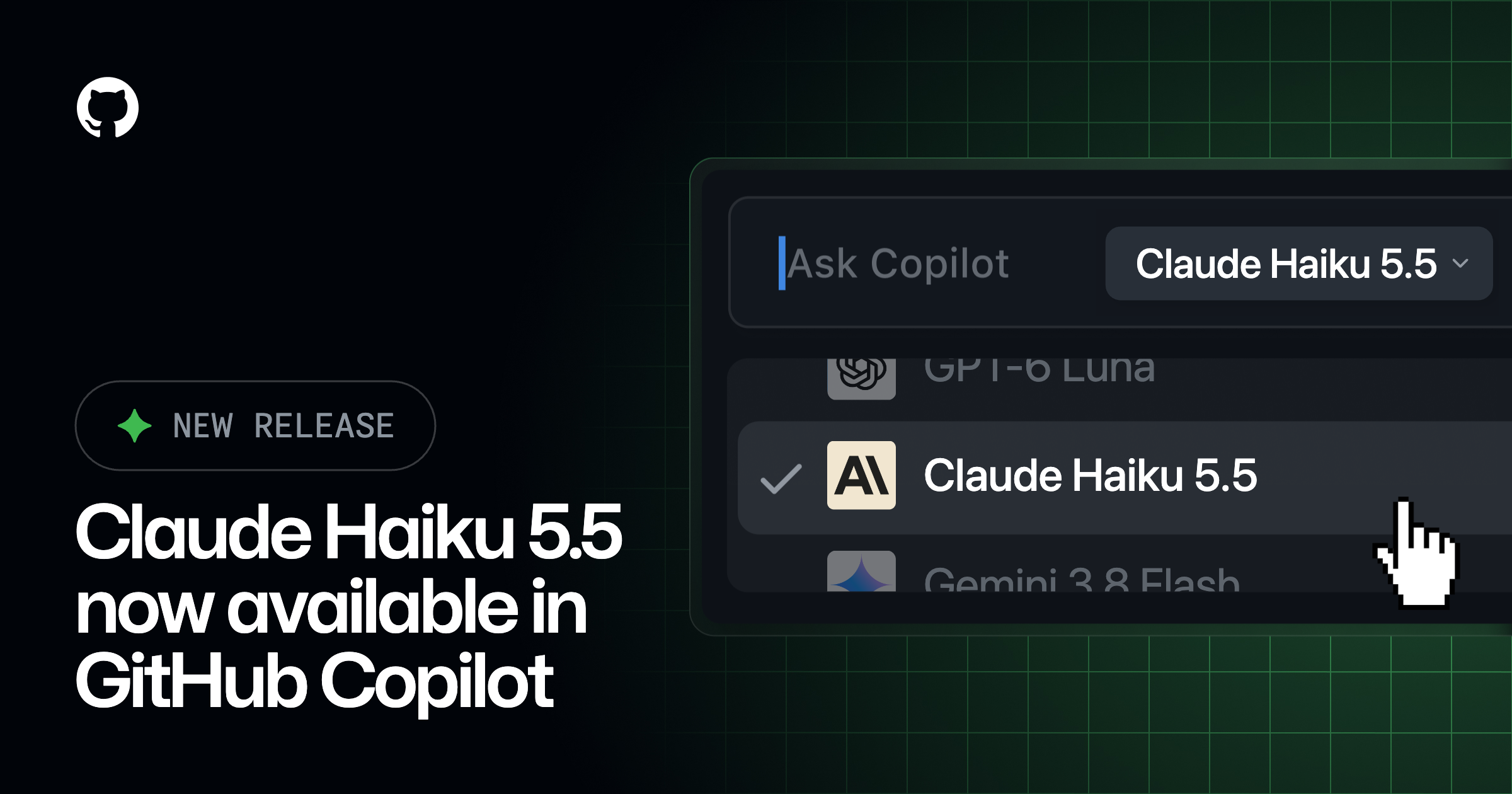
Claude Haiku 5.5 arrives in GitHub Copilot
Anthropic’s latest lightweight model is now live inside GitHub Copilot, targeting high-volume coding tasks like subagents and terminal work. Early benchmarks suggest it matches Sonnet 5 on many coding challenges while consuming significantly fewer tokens and steps. This availability across VS Code, JetBrains, and mobile apps gives developers a faster, cheaper option for routine edits without sacrificing quality. The gradual rollout means most users will see it soon, with admin controls allowing enterprises to manage access via model policies.
GitHub Changelog
 © TechCrunch AI
Models & Labsother
OpenAI launches GPT-6 with interactive Intelligent UI
OpenAI is shifting ChatGPT from a text-only chatbot to an interactive workspace with the GPT-6 launch. The new 'Intelligent UI' embeds tappable buttons, custom calculators, and editable graphs directly into conversations, moving beyond static images to functional tools. This marks a significant pivot toward making complex topics like engineering or finance more accessible through direct manipulation rather than passive reading. While Pro users get immediate access, the broader rollout follows shortly for free tiers.
TechCrunch AI